
Best Network Switches 2026
A category-specific approach to ranking Network Switches
Most general product roundups are built around broad buyer priorities. Flickthru evaluates network switches for IT managers, prioritising switching performance capacity, port and uplink flexibility, poe capability, management and observability, and security and segmentation.
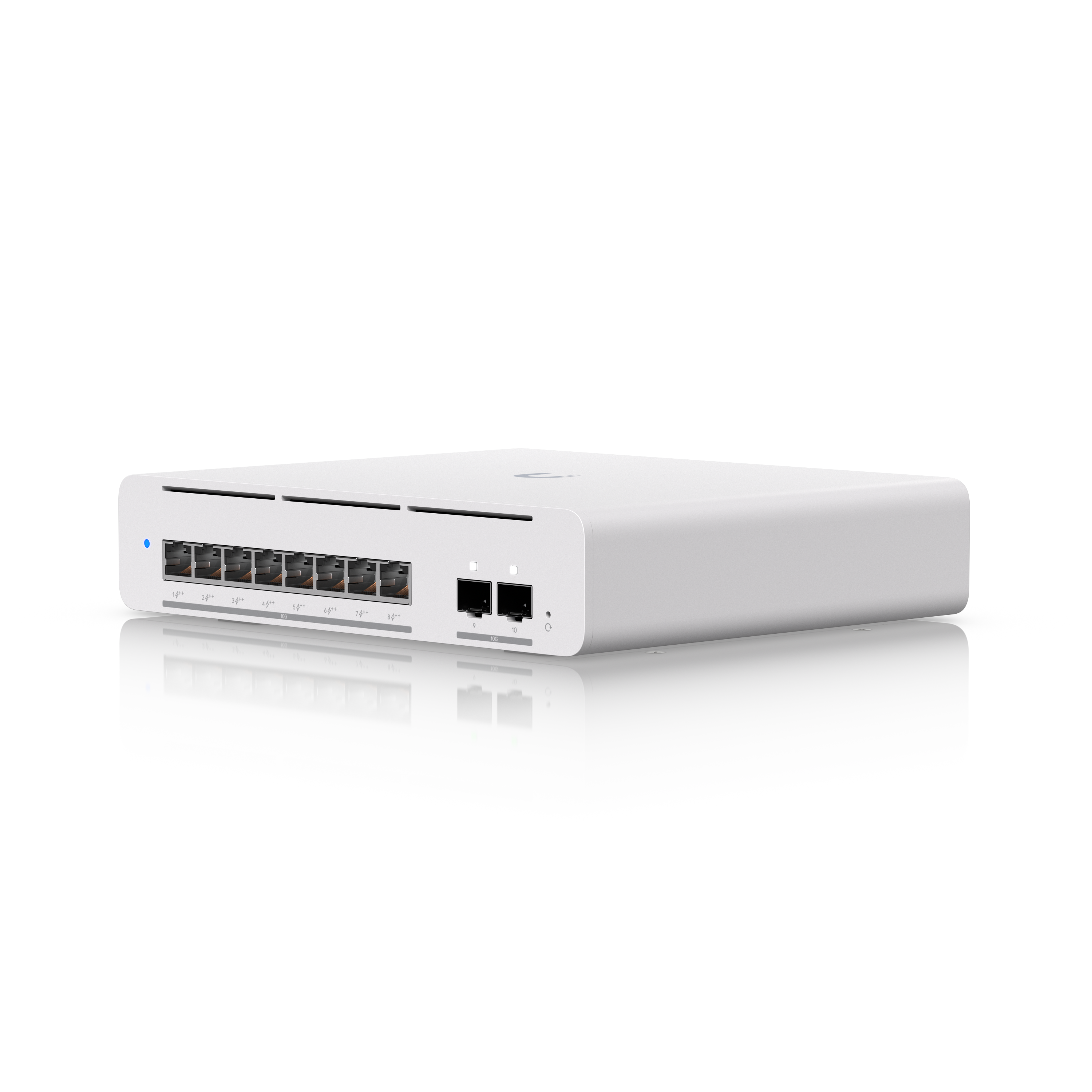
Ubiquiti UniFi Pro XG 8 PoE
The strongest compact high-speed switch here when 10GBASE-T and PoE++ matter more than port count.
- Eight multi-rate 10GBASE-T PoE++ ports
- Two additional 10GbE SFP+ uplinks
- Compact UniFi-managed design
- Port And Uplink Flexibility scores 91/100 in this comparison, among the strongest dimensions evaluated
- 155W total PoE budget limits simultaneous high-draw loads
- Best fit requires the UniFi management ecosystem
- Reliability Support Lifecycle scores 76/100, lower than this product’s other evaluated dimensions
Ranked #1 with a CORE score of 86, driven by top marks for switching performance and port/uplink flexibility (91 each) — the eight multi-rate 10GBASE-T PoE++ ports and dual SFP+ uplinks give it the strongest raw connectivity of any switch in this guide.
Eight multi-rate 10GBASE-T ports plus two independent SFP+ uplinks give it unusually dense high-speed connectivity for its size. Independent testing indicates reasonable performance in its network testing, but the 155W PoE pool must be planned carefully across high-draw devices.
Current official support and firmware routes are available, but no comparable multi-year failure-rate dataset was found. Buyers should evaluate replacement coverage and controller-change procedures for the intended site.
- Large port-count access layers
- Deployments needing a high aggregate PoE budget or vendor-neutral management
| Format | Compact managed Layer 3 PoE switch |
|---|---|
| Copper Ports | 8×10GBASE-T, backward-compatible with 1/2.5/5GbE |
| Fiber Uplinks | 2×10GbE SFP+ |
| Poe | PoE++ on eight copper ports; 155W total budget |
| Management | UniFi Network application |
| Deployment | Desktop or compact rack deployment |

TP-Link Omada SG3218XP-M2
A particularly strong value for balanced 2.5GbE access, PoE+ and 10GbE uplinks in an Omada network.
- Sixteen 2.5GbE access ports
- 240W PoE budget for eight PoE+ devices
- Dual 10GbE uplinks and flexible Omada management
- Scalability And Value scores 88/100 in this comparison, among the strongest dimensions evaluated
- Only eight copper ports provide PoE
- No 10GBASE-T access ports or PoE++
- Active cooling is unsuitable for silence-critical rooms
Ties for the top CORE score at 86 on the back of an 88 in scalability and value plus matching 88s for switching performance and port flexibility — sixteen 2.5GbE ports and dual 10GbE uplinks make it the best-value pick without sacrificing headroom.
Sixteen 2.5GbE access ports. 240W PoE budget for eight PoE+ devices. Only eight copper ports provide PoE.
TP-Link provides an active US support route and controller options that avoid a single management mode. Comparable field-failure data and long-term firmware-quality testing remain unavailable.
- Sites needing 60W or 90W PoE++
- Dense 10GBASE-T edge connectivity
| Format | Rack-mountable L3 managed access switch |
|---|---|
| Copper Ports | 16×2.5GbE RJ45; eight provide PoE+ |
| Fiber Uplinks | 2×10GbE SFP+ |
| Poe | 240W total PoE budget |
| Switching | 120Gbps switching capacity; 89.28Mpps forwarding specification |
| Management | Omada cloud, hardware or software controller; standalone management |
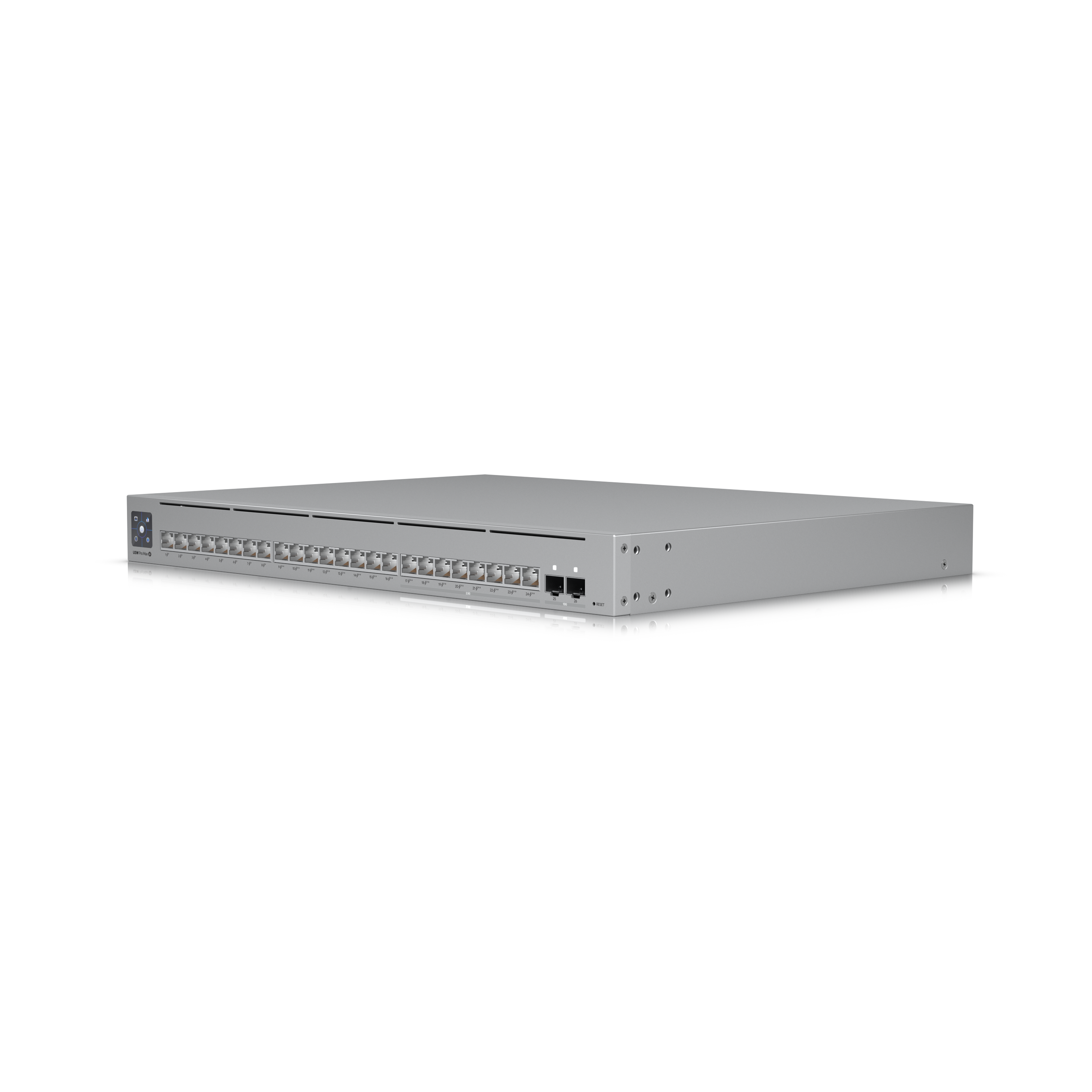
Ubiquiti UniFi Pro Max 24 PoE
A versatile, scalable UniFi access switch whose mixed-speed design suits real offices better than headline port counts suggest.
- Useful mix of 1GbE and 2.5GbE PoE ports
- Large PoE reserve and two 10GbE uplinks
- Excellent UniFi visibility and configuration workflow
- Management And Observability scores 88/100 in this comparison, among the strongest dimensions evaluated
- Premium acquisition cost
- Only eight access ports are multi-gig
- Management is strongly tied to UniFi
A CORE score of 85 puts it just behind the leaders, helped most by an 88 in management and observability — the UniFi controller experience and mixed 1GbE/2.5GbE PoE layout make it the strongest choice for actively growing sites.
The mixed 1GbE and 2.5GbE access design is backed by two 10GbE uplinks and a 112Gbps switching specification. The retained deployment review found the 10GbE backbone, VLAN controls and port-level history useful in practice.
UniFi supplies active firmware and support channels, and the model can integrate with redundant power accessories. Independent long-duration failure data is not available, so operational rollback and spare strategy remain important.
- Vendor-neutral networks
- Sites requiring 10GbE to many edge devices
| Format | 24-port managed Layer 3 PoE access switch |
|---|---|
| Access Ports | 16×1GbE plus 8×2.5GbE RJ45 |
| Uplinks | 2×10GbE SFP+ |
| Poe | PoE+/PoE++ across the access layer; 400W power configuration |
| Switching | 112Gbps switching capacity; 56Gbps non-blocking throughput |
| Management | UniFi Network with Etherlighting and port history |
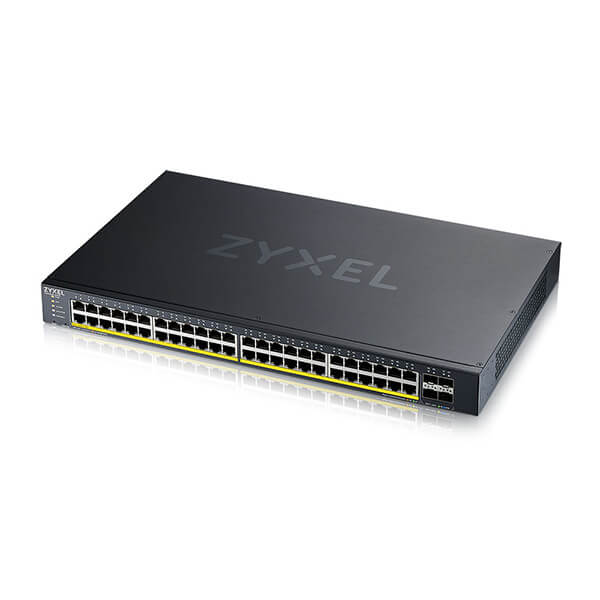
Zyxel XGS1935-52HP
A high-value, port-dense PoE+ workhorse, provided Gigabit access remains sufficient.
- Forty-eight PoE+ access ports
- Four 10GbE uplinks and strong management depth
- Competitive port density and limited lifetime warranty
- Poe Capability scores 88/100 in this comparison, among the strongest dimensions evaluated
- No multi-gig access ports
- Standalone and cloud modes are alternatives rather than simultaneous Smart Sync
- Large deployment requires careful PoE budgeting
Also scoring 85 overall, it earns its place through an 88 in PoE capability and the highest port count in the group — forty-eight PoE+ ports and four 10GbE uplinks make it the density leader for larger SMB rollouts.
ITPro confirmed the 176Gbps backplane, 130.9Mpps forwarding figure and 375W PoE budget, and found the fans very quiet. The key constraint is architectural rather than throughput-related: all 48 access ports remain Gigabit.
Zyxel lists a limited lifetime warranty, while the refreshed design adds lower idle consumption and stronger surge protection. No independent multi-year failure-rate comparison was available.
- Wi-Fi 7 access layers requiring 2.5GbE
- Compact or fanless installations
| Format | 48-port smart-managed PoE+ access switch |
|---|---|
| Access Ports | 48×1GbE RJ45 PoE+ |
| Uplinks | 4×10GbE SFP+ |
| Poe | 375W total PoE budget |
| Switching | 176Gbps switching capacity; 130.9Mpps forwarding |
| Management | Standalone web interface or Zyxel Nebula cloud |

HPE Networking Instant On 1960 JL807A
A polished and supportable SMB switch whose stacking and four 10GbE uplinks compensate for Gigabit access ports.
- Four 10GbE uplink ports split across copper and fiber
- 370W PoE with Class 6 support
- True stacking and approachable cloud management
- Reliability Support Lifecycle scores 84/100 in this comparison, among the strongest dimensions evaluated
- Access ports are primarily Gigabit
- Higher purchase cost than budget Omada alternatives
- Family review was not a controlled throughput test of JL807A
With a CORE score of 84, its standout is an 84 in reliability and support, the best lifecycle score of any switch reviewed — true stacking and HPE’s support ecosystem make it the safer long-term bet despite trailing the leaders on raw switching performance.
The 24-port JL807A provides a 128Gbps fabric, four 10GbE uplinks and a 370W PoE pool. StorageReview’s family-level deployment found onboarding and remote management straightforward and documented useful diagnostics and stacking behavior.
HPE lists a limited lifetime warranty and layered support options. StorageReview successfully exercised the support workflow, but no comparable failure-rate data was found for this exact configuration.
- Dense 2.5GbE access layers
- Buyers prioritizing the lowest acquisition cost
| Format | 24-port stackable smart-managed PoE access switch |
|---|---|
| Access Ports | 24×1GbE PoE; four ports support higher Class 6 power |
| Uplinks | 2×10GBASE-T plus 2×10GbE SFP+ |
| Poe | 370W total budget |
| Switching | 128Gbps switching capacity; 95Mpps throughput |
| Scalability | Stack up to four switches; local or cloud management |

NETGEAR MS510TXUP
Still one of the most flexible compact multi-gig PoE++ switches, although its age and fan noise deserve consideration.
- Four 10GBASE-T and four 2.5GbE PoE++ access ports
- 295W PoE budget with uninterrupted PoE behavior
- Local and Insight cloud management
- Poe Capability scores 88/100 in this comparison, among the strongest dimensions evaluated
- Only ten total ports
- Three internal fans and 33dBA stated acoustics
- Older platform than several Wi-Fi 7-oriented rivals
Matches that 84 CORE score on the strength of a 90 in both port/uplink flexibility and PoE capability — mixed 10GBASE-T and 2.5GbE ports with a 295W budget give it some of the best multi-gig PoE headroom in its class, offset by lower management and security marks.
StorageReview documented a 140Gbps non-blocking design with four 10G-capable copper ports, four 2.5GbE ports and two 10GbE SFP+ slots. The 295W Ultra60 budget is a major advantage for mixed high-power devices.
The platform offers dual firmware images, cloud update controls and uninterrupted PoE during reboot or firmware work. The published MTBF is a manufacturer statistic, not an independently observed lifetime.
- High port-count office floors
- Silence-critical deployments
| Format | 10-port smart-managed multi-gig PoE++ switch |
|---|---|
| Copper Ports | 4×1/2.5GbE plus 4×1/2.5/5/10GbE |
| Fiber Uplinks | 2×10GbE SFP+ |
| Poe | Eight Ultra60 PoE++ ports; 295W total budget |
| Switching | 140Gbps non-blocking full-duplex bandwidth |
| Management | Local web, SNMP and NETGEAR Insight cloud |

Cisco Catalyst C1300-24P-4X
A security- and management-led choice for conventional Gigabit access, not the fastest edge platform.
- Mature VLAN, ACL and authentication controls
- Four 10GbE SFP+ uplinks
- Broad local management and Cisco support ecosystem
- Security And Segmentation scores 88/100 in this comparison, among the strongest dimensions evaluated
- Gigabit-only access ports
- PoE budget is lower than high-power 24-port rivals
- Advanced Cisco familiarity can increase administration overhead
Rounding out the 84-point tier, it leads the group on security and segmentation at 88 — mature VLAN, ACL and authentication controls plus four 10GbE uplinks make it the pick for security-conscious, Cisco-oriented deployments at conventional Gigabit access speeds.
Twenty-four Gigabit access ports and four 10GbE SFP+ uplinks make this a conventional but well-provisioned office access switch. Its case rests more on management and policy depth than on multi-gig edge performance.
Cisco maintains current software, documentation and support routes for the Catalyst 1300 family. Exact service entitlements and replacement terms depend on the purchased SKU and support plan.
- Multi-gig Wi-Fi 7 access layers
- High-density PoE++ deployments
| Format | 24-port managed business PoE+ switch |
|---|---|
| Access Ports | 24×1GbE RJ45 PoE+ |
| Uplinks | 4×10GbE SFP+ |
| Poe | 195W class budget for the 24P model; verify exact regional SKU |
| Management | Web UI, CLI, SNMP and Cisco Business Dashboard |
| Routing Security | Static routing, VLAN, ACL, 802.1X and DHCP protections |

TP-Link Omada SG2210XMP-M2
A focused, good-value eight-port multi-gig PoE+ switch with useful 10GbE headroom.
- Eight 2.5GbE PoE+ access ports
- Dual 10GbE SFP+ uplinks
- Strong Omada feature set for the price
- Scalability And Value scores 88/100 in this comparison, among the strongest dimensions evaluated
- No PoE++
- 160W budget requires planning
- Heat and active cooling need suitable placement
Its 84 CORE score is driven by an 87 in scalability and value, the best in its size class — eight 2.5GbE PoE+ ports and dual 10GbE uplinks deliver the Omada feature set at a lower price point than the larger switches above it.
Its eight 2.5GbE PoE+ ports and two 10GbE SFP+ uplinks provide an appropriate non-blocking shape for a compact access layer. The retained review identified heat as a practical consideration under load.
TP-Link maintains an active US support route and the Omada controller offers centralized firmware administration. Long-term thermal and failure-rate comparisons were not available.
- High-power Wi-Fi 7 APs requiring PoE++
- Large port-count access layers
| Format | 10-port Omada-managed multi-gig PoE switch |
|---|---|
| Access Ports | 8×2.5GbE RJ45 PoE+ |
| Uplinks | 2×10GbE SFP+ |
| Poe | 160W total PoE budget |
| Management | Omada controller or standalone web management |
| Features | VLAN, ACL, QoS, link aggregation and static routing |
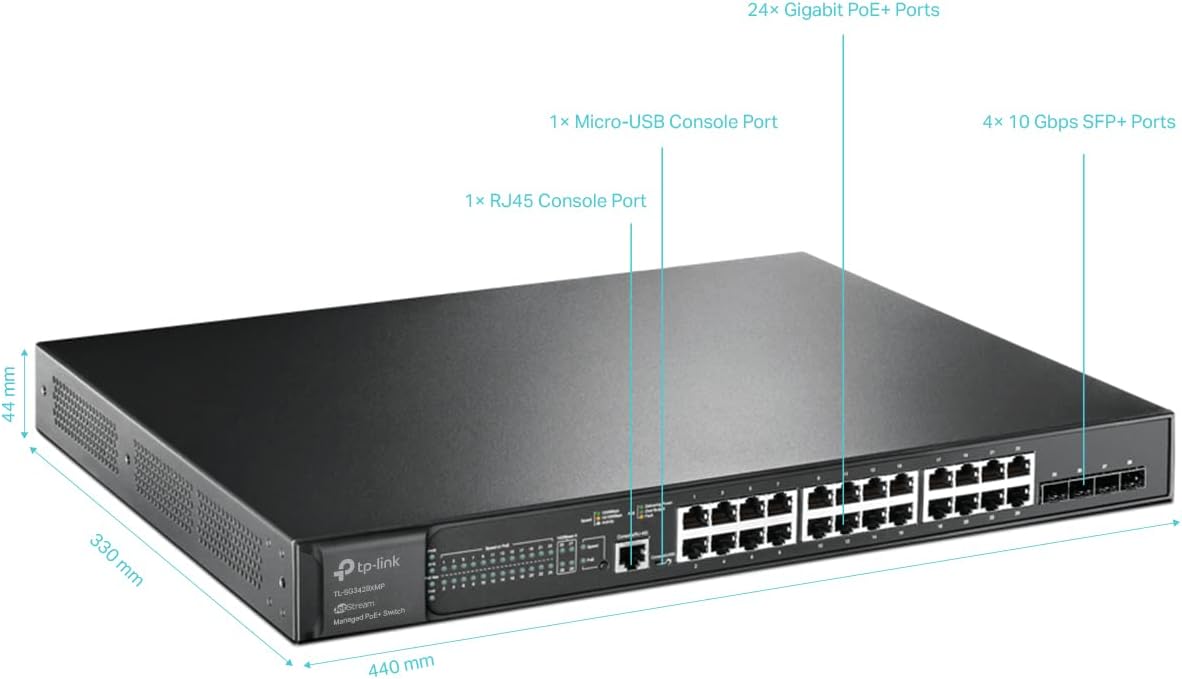
TP-Link Omada TL-SG3428XMP
A 24-port Omada-managed Gigabit PoE+ switch with four 10GbE SFP+ uplinks, built for sites with many Gigabit phones, cameras, and conventional access points that need centralized Omada management.
- Twenty-four powered Gigabit access ports
- Four 10GbE SFP+ uplinks
- Flexible standalone or Omada administration
- Scalability And Value scores 88/100 in this comparison, among the strongest dimensions evaluated
- No multi-gig access ports
- Model naming is easy to confuse with the higher-power XMPP
- Fan noise and heat should be checked for office placement
A CORE score of 83 reflects strong 88s in both scalability/value and PoE capability, powered by twenty-four Gigabit PoE ports and four 10GbE uplinks — the trade-off is Gigabit-only access speed, which caps its ranking against the multi-gig switches above.
The model combines 24 Gigabit powered access ports with four 10GbE SFP+ uplinks, avoiding an obvious aggregation bottleneck. It does not provide 2.5GbE at the edge, so it is less future-facing than the SG3218XP-M2.
Centralized Omada updates and an active US support route help fleet administration. Exact XMP versus XMPP identity must be retained because power budgets and review findings are not interchangeable.
- New 2.5GbE Wi-Fi access layers
- Buyers who have not locked the exact XMP configuration
| Format | 24-port Omada-managed Gigabit PoE+ switch |
|---|---|
| Access Ports | 24×1GbE RJ45 PoE+ |
| Uplinks | 4×10GbE SFP+ |
| Poe | High-capacity PoE+ budget; verify XMP versus XMPP SKU before purchase |
| Management | Omada SDN or standalone management |
| Features | L2+, static routing, VLAN, ACL and QoS |

HPE Networking Instant On 1930 JL684A
A dependable, approachable Gigabit PoE+ access switch with excellent power and uplink provision.
- Large 370W PoE+ budget
- Four 10GbE-capable fiber uplinks
- Simple cloud or local management with strong warranty
- Poe Capability scores 88/100 in this comparison, among the strongest dimensions evaluated
- Gigabit-only access ports
- No physical stacking like the 1960 series
- Port And Uplink Flexibility scores 78/100, lower than this product’s other evaluated dimensions
Closing out the list at 82, its highlight is an 88 in PoE capability — a 370W PoE+ budget and four 10GbE-capable uplinks stand out, but lower port/uplink flexibility (78) is what keeps it in last place here.
JL684A offers 24 powered Gigabit ports and four 10GbE-capable SFP+ uplinks with a 370W power pool. The retained evidence supports management and configuration fit rather than controlled throughput claims.
Large 370W PoE+ budget. Four 10GbE-capable fiber uplinks. Gigabit-only access ports.
- Wi-Fi 7 backhaul at 2.5GbE
- Networks needing true stacking
| Format | 24-port smart-managed PoE+ access switch |
|---|---|
| Access Ports | 24×1GbE RJ45 PoE+ |
| Uplinks | 4×SFP/SFP+ with 10GbE support |
| Poe | 370W total budget |
| Management | Instant On cloud/app or local web interface |
| Support | Limited lifetime warranty |
How We Evaluate Network Switches
Our rankings are built through the Flickthru CORE™ Market Research Engine, which first analyses the category, its intended buyers, and the current US market. Products are then assessed using category-specific evidence, performance indicators, availability, ownership signals, and long-term reliability considerations.
Recommendations reflect overall suitability for the intended buyer – not simply the highest specification, lowest price, or strongest result in a single test. When product-level customer feedback is limited, we prioritize official validation, credible technical evidence, and demonstrated category suitability rather than estimating or inflating review counts. Read the full Flickthru product ranking methodology.
- Category Specific Analysis: Defining buyers’ needs, primary uses, business priorities, acceptable compromises, and category-specific requirements before products are compared.
- Long-Term Reliability: Tracking recurring failure patterns, component durability, warranty trends, and long-term ownership outcomes from verified market data.
- Performance: Evaluating category-specific real-world performance, efficiency, consistency, and practical usability rather than relying on marketing claims alone.
- Features: Assessing functionality, usability, build quality, safety, ergonomics, and category-specific capabilities important to long-term ownership.
- Value: Measuring total cost of ownership, lifecycle longevity, support quality, lifecycle suitability, and overall return on investment.
- Evidence Review: Combining verified purchaser feedback where available with professional testing, official product validation, technical evidence, and market suitability signals.
- Market Coverage: Mapping the current US market, credible product families, availability, price positioning, and relevant competitors within the category.
Products demonstrating recurring reliability concerns, inconsistent performance behavior, poor ownership outcomes, or widespread negative sentiment are algorithmically suppressed from our rankings regardless of marketing claims, sponsorship relationships, or short-term popularity trends.
This methodology is designed to identify products that deliver genuine long-term value, reliability, and real-world usefulness rather than simply matching short-term hype, advertising claims, or isolated test results.