
Best NAS Storage 2026
A category-specific approach to ranking NAS Storage
Most general product roundups are built around broad buyer priorities. Flickthru evaluates nas storage for home users, prioritising software backup management, data protection security, storage expandability, network performance, and media apps compute.
Synology DiskStation DS1525+
The strongest software-led five-bay option here, with excellent protection and expansion but modest media acceleration for its price.
- Five bays plus expansion support suit growing workgroups
- DSM offers unusually broad backup, sync and collaboration tools
- ECC memory and dual 2.5GbE support dependable multi-user storage
- Scores 92/100 on data protection security, among the strongest dimensions evaluated for this product
- Ryzen CPU lacks integrated graphics for hardware media transcoding
- Cost rises further when disks and any expansion are added
- M.2 storage-pool flexibility remains narrower than some rivals
The DS1525+ takes first place because it offers the most complete balance for a growing office: five bays, ECC memory and expansion headroom, backed by DSM’s unusually cohesive backup, recovery and collaboration tools. The DS925+ delivers a similar software experience, but the extra bay makes this the more adaptable long-term purchase; only media-transcoding needs and total system cost keep it from being an automatic choice for everyone.
DiskStation DS1525+ pairs AMD Ryzen V1500B with dual 2.5GbE, which defines its expected workload tier. Available independent testing was not consistent enough to quote a configuration-matched throughput figure, so buyer guidance rests on platform capability rather than advertised speed.
Synology DiskStation DS1525+ is a strong small-business office deployments choice for small businesses and creators prioritising DSM, five-bay capacity and backup workflows, combining scores 92/100 on data protection security, among the strongest dimensions evaluated for this product with scores 91/100 on storage expandability, among the strongest dimensions evaluated for this product.
- Plex users who need efficient hardware transcoding or buyers chasing maximum hardware per dollar.
| Drive Bays | 5 |
|---|---|
| Processor | AMD Ryzen V1500B |
| Memory | 8 GB DDR4 ECC |
| Network | dual 2.5GbE |
| Price Basis | Approximately $799.99 diskless on 2026-08-25 |
Synology DiskStation DS925+
A polished four-bay business NAS with excellent software and protection, but competitors deliver faster compute and networking for similar money.
- DSM backup and collaboration ecosystem is a major strength
- Dual 2.5GbE, ECC memory and M.2 caching improve business suitability
- Supports expansion beyond the four internal bays
- Scores 92/100 on data protection security, among the strongest dimensions evaluated for this product
- No integrated graphics for hardware video transcoding
- Premium price relative to raw CPU and network hardware
- Certified-drive rules still matter for M.2 storage pools
The DS925+ earns second by packaging Synology’s strongest advantages—DSM, ECC memory, straightforward protection and expansion support—into a compact four-bay system. It trails the DS1525+ because the smaller chassis provides less capacity headroom without a compensating hardware-price advantage, yet it remains the better fit for buyers who want polished administration more than media acceleration.
DiskStation DS925+ pairs AMD Ryzen V1500B with dual 2.5GbE, which defines its expected workload tier. Available independent testing was not consistent enough to quote a configuration-matched throughput figure, so buyer guidance rests on platform capability rather than advertised speed.
Synology DiskStation DS925+ is a strong small-business office deployments choice for small offices and serious home users who value DSM and data protection over media acceleration, combining scores 92/100 on data protection security, among the strongest dimensions evaluated for this product with scores 90/100 on software backup management, among the strongest dimensions evaluated for this product.
- Value-first hardware buyers or heavy Plex transcoders.
| Drive Bays | 4 |
|---|---|
| Processor | AMD Ryzen V1500B |
| Memory | 4 GB DDR4 ECC |
| Network | dual 2.5GbE |
| Price Basis | Approximately $639.99 diskless on 2026-08-25 |
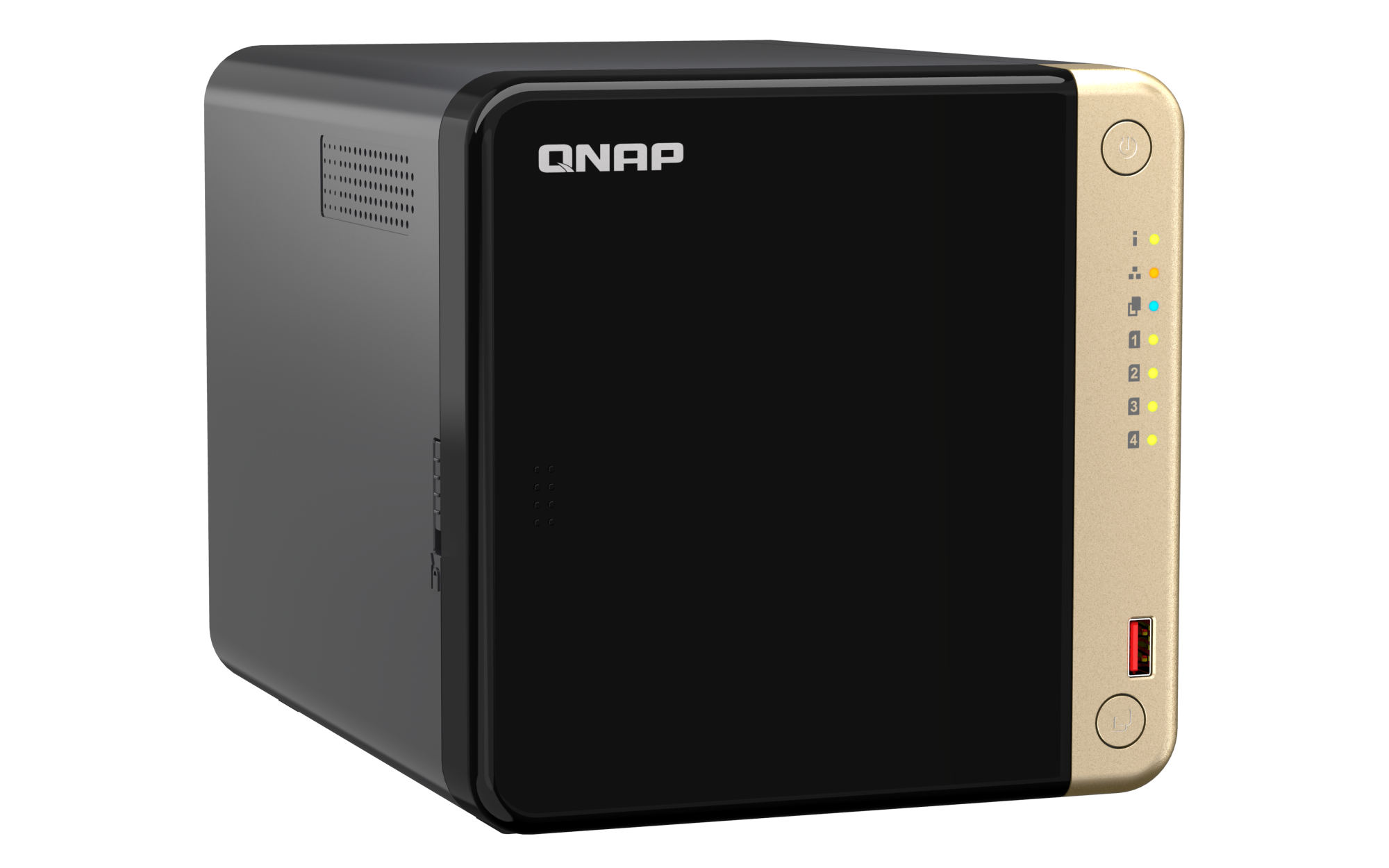
QNAP TS-464
A versatile four-bay all-rounder whose expansion and media hardware remain competitive, provided the owner is comfortable managing QTS.
- Four bays, dual 2.5GbE, M.2 and PCIe provide strong expansion
- Intel graphics support media-transcoding workloads
- QTS offers containers, virtualization and advanced storage tools
- Scores 91/100 on media apps compute, among the strongest dimensions evaluated for this product
- QTS is denser and demands more administration than DSM
- Security depends on disciplined updates and exposure controls
- Diskless price is high for an older Celeron platform
The TS-464 ranks third because it is the most versatile four-bay option for hands-on users: Intel graphics help with Plex, while dual 2.5GbE, M.2 slots and PCIe leave multiple upgrade paths open. It sits behind the Synology pair because QTS asks more of the administrator and disciplined security maintenance matters, but for containers, media and hardware flexibility it can be the smarter buy.
TS-464 pairs Intel Celeron N5095/N5105 with dual 2.5GbE, which defines its expected workload tier. Available independent testing was not consistent enough to quote a configuration-matched throughput figure, so buyer guidance rests on platform capability rather than advertised speed.
QNAP TS-464 is a strong everyday office multitasking choice for power users and Plex households wanting a flexible four-bay NAS, combining scores 91/100 on media apps compute, among the strongest dimensions evaluated for this product with scores 90/100 on storage expandability, among the strongest dimensions evaluated for this product.
- Buyers who want the simplest possible setup and minimal ongoing administration.
| Drive Bays | 4 |
|---|---|
| Processor | Intel Celeron N5095/N5105 |
| Memory | 8 GB DDR4 |
| Network | dual 2.5GbE |
| Price Basis | Approximately $589 diskless on 2026-08-25 |

UGREEN NASync DXP4800 Pro
The hardware-performance standout among four-bay systems, with software maturity—not speed—the central trade-off.
- Core i3, 10GbE and expandable DDR5 deliver exceptional class performance
- Integrated graphics handle demanding media workloads
- Two NVMe slots, HDMI and broad I/O support flexible deployments
- Scores 94/100 on media apps compute, among the strongest dimensions evaluated for this product
- UGOS Pro app depth still trails DSM and QTS
- Higher power demand than lower-end ARM or Celeron systems
- Long-term software-support record is shorter than established rivals
The DXP4800 Pro is the four-bay hardware standout, combining a much stronger Core i3 processor with 10GbE, 2.5GbE, DDR5 and NVMe expansion. That capability puts it ahead of slower value models, but fourth place reflects the real trade-off: UGOS Pro and its support history are not yet as proven as DSM or QTS, so this is a performance-first recommendation rather than the safest all-round choice.
UGREEN NASync DXP4800 Pro is a strong everyday office multitasking choice for creators, Plex users and homelab buyers who want 10GbE and strong compute in four bays, combining scores 94/100 on media apps compute, among the strongest dimensions evaluated for this product with scores 94/100 on network performance, among the strongest dimensions evaluated for this product.
UGREEN NASync DXP4800 Pro is a strong everyday office multitasking choice for creators, Plex users and homelab buyers who want 10GbE and strong compute in four bays, combining scores 94/100 on media apps compute, among the strongest dimensions evaluated for this product with scores 94/100 on network performance, among the strongest dimensions evaluated for this product.
- Buyers who prize the deepest mature first-party backup ecosystem above hardware value.
| Drive Bays | 4 |
|---|---|
| Processor | Intel Core i3-1315U |
| Memory | 8 GB DDR5 |
| Network | 10GbE + 2.5GbE |
| Price Basis | Approximately $719 diskless on 2026-08-25 |

UGREEN NASync DXP6800 Pro
A high-capacity performance platform with rare connectivity at its price, best when its compute and dual-10GbE hardware will actually be used.
- Six bays, dual 10GbE and Core i5 offer major expansion and throughput
- Thunderbolt 4 and PCIe broaden creator and business workflows
- Lab testing confirms strong large-block sequential performance
- Scores 96/100 on network performance, among the strongest dimensions evaluated for this product
- High platform and populated-storage cost
- UGOS application breadth remains behind established ecosystems
- Powerful hardware is unnecessary for basic household backup
The DXP6800 Pro ranks fifth as the shortlist’s strongest studio-oriented middle ground: six bays, a Core i5 and dual 10GbE can serve large working sets without moving to an eight-bay chassis. It is exceptionally capable when several fast clients will use that bandwidth, but its higher entry cost and younger software ecosystem make it less broadly recommendable than the smaller systems above it.
UGREEN NASync DXP6800 Pro is a strong everyday office multitasking choice for studios, power users and small teams moving large files over 10GbE, combining scores 96/100 on network performance, among the strongest dimensions evaluated for this product with scores 95/100 on media apps compute, among the strongest dimensions evaluated for this product.
UGREEN NASync DXP6800 Pro is a strong everyday office multitasking choice for studios, power users and small teams moving large files over 10GbE, combining scores 96/100 on network performance, among the strongest dimensions evaluated for this product with scores 95/100 on media apps compute, among the strongest dimensions evaluated for this product.
- Basic backup buyers or anyone without multi-gig networking.
| Drive Bays | 6 |
|---|---|
| Processor | Intel Core i5-1235U |
| Memory | 8 GB DDR5 |
| Network | dual 10GbE |
| Price Basis | Approximately $999.99 diskless on 2026-08-25 |
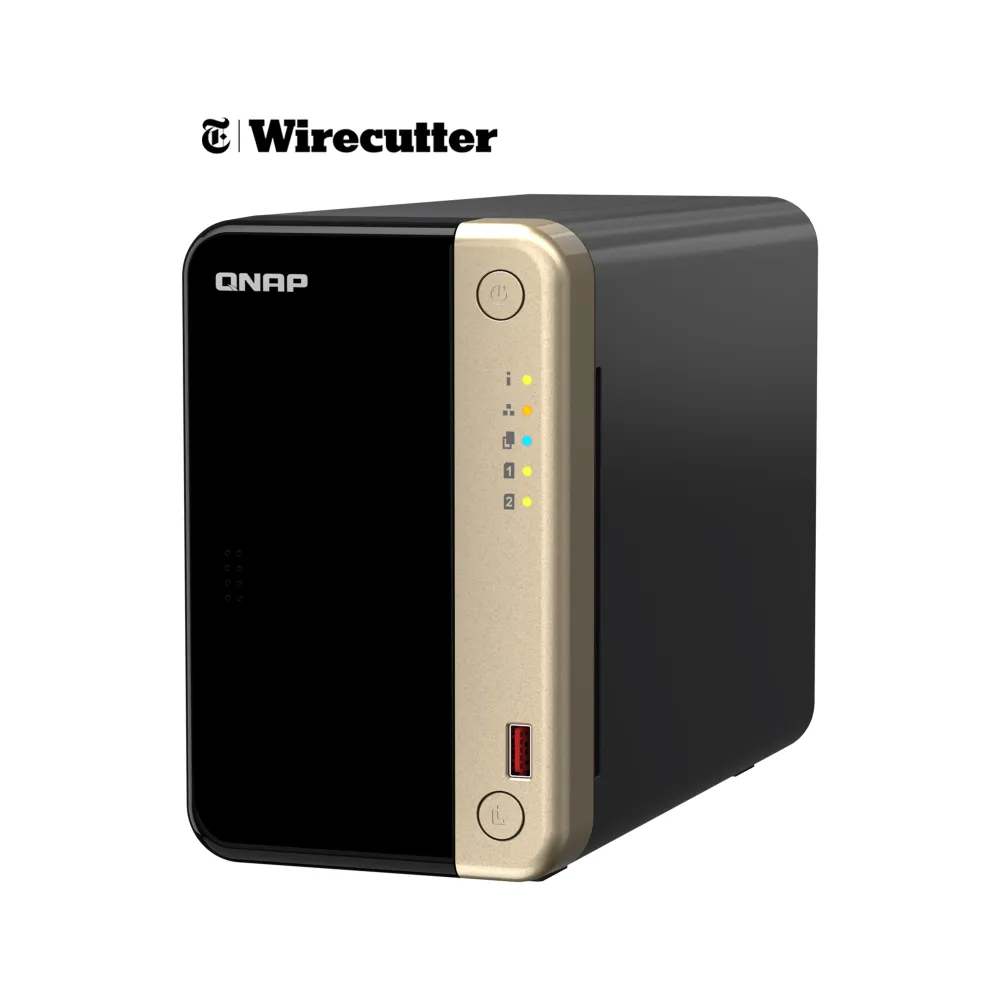
QNAP TS-264-8G
The most capable two-bay power-user option, combining proven transfer speed with strong expansion at a premium price.
- Excellent measured 2.5GbE transfer performance
- M.2 and PCIe expansion are unusual in a two-bay NAS
- Intel graphics and HDMI suit media use
- Scores 91/100 on media apps compute, among the strongest dimensions evaluated for this product
- Two bays limit redundancy and future capacity
- Power draw is relatively high for its class
- QTS requires more security and maintenance attention than simpler systems
The TS-264-8G is the highest-ranked two-bay NAS because it preserves much of the TS-464’s power-user appeal—Intel media acceleration, dual 2.5GbE, M.2 slots and useful application support—in a smaller footprint. Sixth place reflects its hard two-drive capacity ceiling and premium pricing; choose it for fast mirrored storage and apps, not as the foundation for a rapidly growing archive.
QNAP TS-264-8G is a strong small-business office deployments choice for media-focused power users needing a fast, expandable two-bay NAS, combining scores 91/100 on media apps compute, among the strongest dimensions evaluated for this product with scores 88/100 on network performance, among the strongest dimensions evaluated for this product.
QNAP TS-264-8G is a strong small-business office deployments choice for media-focused power users needing a fast, expandable two-bay NAS, combining scores 91/100 on media apps compute, among the strongest dimensions evaluated for this product with scores 88/100 on network performance, among the strongest dimensions evaluated for this product.
- Capacity-heavy teams or buyers wanting a low-power appliance.
| Drive Bays | 2 |
|---|---|
| Processor | Intel Celeron N5095 |
| Memory | 8 GB DDR4 |
| Network | dual 2.5GbE |
| Price Basis | Approximately $439 diskless on 2026-08-25 |

UGREEN NASync DXP4800 Plus
A strong hardware-value four-bay NAS with real 10GbE potential, but software depth and workload-dependent transfer results need consideration.
- 10GbE, 2.5GbE, DDR5 and NVMe deliver strong hardware value
- Docker and VM support extend it beyond file storage
- Measured tests show high throughput in suitable workloads
- Scores 92/100 on network performance, among the strongest dimensions evaluated for this product
- Windows SMB copies in one test were much slower than synthetic results
- UGOS app catalog remains thinner than mature rivals
- Noisy or power-sensitive setups may prefer simpler hardware
The DXP4800 Plus earns seventh by making four bays and 10GbE unusually accessible, with enough compute for containers, backups and direct high-speed workflows. It ranks below the DXP4800 Pro and TS-464 because the Pentium platform offers less headroom and UGOS Pro still carries more software and evidence uncertainty; its appeal is concentrated in hardware value, not turnkey polish.
UGREEN NASync DXP4800 Plus is a strong everyday office multitasking choice for small businesses and enthusiasts wanting affordable 10GbE and containers, combining scores 92/100 on network performance, among the strongest dimensions evaluated for this product with scores 91/100 on media apps compute, among the strongest dimensions evaluated for this product.
UGREEN NASync DXP4800 Plus is a strong everyday office multitasking choice for small businesses and enthusiasts wanting affordable 10GbE and containers, combining scores 92/100 on network performance, among the strongest dimensions evaluated for this product with scores 91/100 on media apps compute, among the strongest dimensions evaluated for this product.
- Users who need a mature turnkey application catalog or uniformly fast client copies.
| Drive Bays | 4 |
|---|---|
| Processor | Intel Pentium Gold 8505 |
| Memory | 8 GB DDR5 |
| Network | 10GbE + 2.5GbE |
| Price Basis | Approximately $699.99 diskless on 2026-08-25 |

UGREEN NASync DXP8800 Plus
The shortlist’s capacity-first performance choice, with excellent hardware offset by cost and a younger software/evidence record.
- Eight bays and dual 10GbE provide major capacity and bandwidth
- Core i5, DDR5 and NVMe slots support heavy apps and caching
- PCIe and extensive I/O leave substantial upgrade headroom
- Scores 97/100 on storage expandability, among the strongest dimensions evaluated for this product
- Expensive before eight drives are added
- Large power and physical footprint for home use
- Scores 70/100 on value support, lower than this product’s other evaluated dimensions
The DXP8800 Plus is unmatched here for raw growth potential: eight bays, dual 10GbE and a Core i5 suit large media libraries, labs and multi-user production storage. It lands eighth because that capacity comes with a steep diskless price, a large deployment footprint and the same younger UGOS Pro support record; it is the right specialist choice, but poor value if those eight bays will remain partly empty.
NASync DXP8800 Plus pairs Intel Core i5-1235U with dual 10GbE, which defines its expected workload tier. Available independent testing was not consistent enough to quote a configuration-matched throughput figure, so buyer guidance rests on platform capability rather than advertised speed.
UGREEN NASync DXP8800 Plus is a strong everyday office multitasking choice for large media collections, labs and small teams needing eight-bay growth, combining scores 97/100 on storage expandability, among the strongest dimensions evaluated for this product with scores 96/100 on network performance, among the strongest dimensions evaluated for this product.
- Small households, first-time NAS buyers or cost-sensitive deployments.
| Drive Bays | 8 |
|---|---|
| Processor | Intel Core i5-1235U |
| Memory | 8 GB DDR5 |
| Network | dual 10GbE |
| Price Basis | Approximately $1499.99 diskless on 2026-08-25 |
Synology DiskStation DS425+
A safe software-first four-bay choice, ranked below faster rivals because its conservative hardware limits long-term performance headroom.
- DSM makes backup, sharing and administration approachable
- Four bays support practical RAID capacity for homes and small offices
- Strong security and update tooling
- Scores 90/100 on data protection security, among the strongest dimensions evaluated for this product
- Older Celeron platform offers limited compute headroom
- Connectivity is modest for the price
- Memory and expansion are less generous than hardware-focused rivals
The DS425+ ranks ninth as the conservative four-bay choice: DSM makes backup, sharing, updates and recovery easier to manage than on most hardware-led rivals. Its position is not a verdict against usability; it reflects the older Celeron processor, 2GB starting memory and modest connectivity, which leave less performance and expansion headroom for the price than every four-bay model above it.
DiskStation DS425+ pairs Intel Celeron J4125 with 2.5GbE + 1GbE, which defines its expected workload tier. Available independent testing was not consistent enough to quote a configuration-matched throughput figure, so buyer guidance rests on platform capability rather than advertised speed.
Synology DiskStation DS425+ is a strong small-business office deployments choice for families and small offices wanting a straightforward four-bay DSM appliance, combining scores 90/100 on data protection security, among the strongest dimensions evaluated for this product with scores 89/100 on usability efficiency, among the strongest dimensions evaluated for this product.
- 10GbE creators, VM-heavy homelabs or buyers maximising hardware value.
| Drive Bays | 4 |
|---|---|
| Processor | Intel Celeron J4125 |
| Memory | 2 GB DDR4 |
| Network | 2.5GbE + 1GbE |
| Price Basis | Approximately $499.99 diskless on 2026-08-25 |
Synology DiskStation DS225+
The most approachable two-bay software-first choice, but its limited hardware and expansion explain its reserve position.
- DSM provides excellent backup, photo and file-sharing tools
- 2.5GbE finally improves two-bay network headroom
- Compact, quiet platform is easy to administer
- Scores 91/100 on usability efficiency, among the strongest dimensions evaluated for this product
- Only two bays and no M.2 slots constrain growth
- Older Celeron and 2GB base memory limit demanding apps
- Hardware transcoding support is not a strength
The DS225+ closes the top ten because it is the easiest recommendation for simple two-drive backup, photo management and file sharing, with DSM doing more of the operational work for the owner. Its compactness is also its ceiling: two bays, 2GB of memory and no M.2 expansion sharply limit future workloads, so it ranks behind the faster TS-264 and every model intended for meaningful growth.
DiskStation DS225+ pairs Intel Celeron J4125 with 2.5GbE + 1GbE, which defines its expected workload tier. Available independent testing was not consistent enough to quote a configuration-matched throughput figure, so buyer guidance rests on platform capability rather than advertised speed.
Synology DiskStation DS225+ is a strong small-business office deployments choice for homes and small offices wanting the easiest dependable two-bay backup NAS, combining scores 91/100 on usability efficiency, among the strongest dimensions evaluated for this product with scores 90/100 on data protection security, among the strongest dimensions evaluated for this product.
- Large media libraries, heavy containers or users needing substantial expansion.
| Drive Bays | 2 |
|---|---|
| Processor | Intel Celeron J4125 |
| Memory | 2 GB DDR4 |
| Network | 2.5GbE + 1GbE |
| Price Basis | Approximately $339.99 diskless on 2026-08-25 |
How We Evaluate NAS Storage
Our rankings are built through the Flickthru CORE™ Market Research Engine, which first analyses the category, its intended buyers, and the current US market. Products are then assessed using category-specific evidence, performance indicators, availability, ownership signals, and long-term reliability considerations.
Recommendations reflect overall suitability for the intended buyer – not simply the highest specification, lowest price, or strongest result in a single test. When product-level customer feedback is limited, we prioritize official validation, credible technical evidence, and demonstrated category suitability rather than estimating or inflating review counts. Read the full Flickthru product ranking methodology.
- Category Specific Analysis: Defining buyers’ needs, primary uses, business priorities, acceptable compromises, and category-specific requirements before products are compared.
- Long-Term Reliability: Tracking recurring failure patterns, component durability, warranty trends, and long-term ownership outcomes from verified market data.
- Performance: Evaluating category-specific real-world performance, efficiency, consistency, and practical usability rather than relying on marketing claims alone.
- Features: Assessing functionality, usability, build quality, safety, ergonomics, and category-specific capabilities important to long-term ownership.
- Value: Measuring total cost of ownership, lifecycle longevity, support quality, lifecycle suitability, and overall return on investment.
- Evidence Review: Combining verified purchaser feedback where available with professional testing, official product validation, technical evidence, and market suitability signals.
- Market Coverage: Mapping the current US market, credible product families, availability, price positioning, and relevant competitors within the category.
Products demonstrating recurring reliability concerns, inconsistent performance behavior, poor ownership outcomes, or widespread negative sentiment are algorithmically suppressed from our rankings regardless of marketing claims, sponsorship relationships, or short-term popularity trends.
This methodology is designed to identify products that deliver genuine long-term value, reliability, and real-world usefulness rather than simply matching short-term hype, advertising claims, or isolated test results.