
Best Soundbars Under $300 2026
A category-specific approach to ranking Soundbars Under $300
Most general product roundups are built around broad buyer priorities. Flickthru ranks currently available new soundbars sold in the US for $300 or less, for buyers who want the strongest overall combination of sound quality, dialogue clarity, bass performance, surround/Atmos capability, connectivity, ease of setup, reliability, and value. The goal is to help shoppers identify which models are best for TV, movies, music and everyday use, while excluding products that are over budget, discontinued, refurbished, used-only, or not genuinely available new in the US. The ranking prioritizes sound & dialogue quality, surround & Atmos immersion, bass performance, connectivity & compatibility, and setup & everyday use.

TCL S65K S Series 5.1
The S65K supplies more physical surround hardware than most competitors near its price, trading some simplicity and bass finesse for a much more complete multi-speaker layout.
- Physical rear speakers provide true 5.1 channel placement
- Wireless subwoofer adds dedicated low-frequency output
- Dolby Atmos, DTS:X and room calibration expand home-theater use
- Full multi-speaker surround package at a sub-$300 price
- Four separate powered pieces require more outlets and placement space
- The subwoofer can sound boomy unless its level is adjusted
- Virtual height effects are less convincing than systems with dedicated up-firing speakers
The S65K includes a soundbar, wireless subwoofer and separate rear speakers for a true 5.1 layout, then adds Dolby Atmos, DTS:X and room calibration. That hardware gives television and films real back-channel movement and dedicated bass without requiring the higher spend normally associated with a complete multi-speaker surround package.
Rear effects come from actual surround speakers, so movement around the room is more distinct than with front-only virtualization. The subwoofer adds substantial impact and the package plays with confidence, although careful level adjustment helps prevent the low end from becoming overbearing and the Atmos height layer remains virtual.
TCL S65K S Series 5.1 scores 76/100 for reliability and support, and its four separately powered pieces give owners more components and connections to manage over time. Owner validation is a strong 92/100.
- Minimalist rooms or buyers prioritizing compactness over immersion
| Channels | 5.1 |
|---|---|
| Dolby Atmos | Yes |
| Wireless Subwoofer Included | Yes |
| Rear Speakers Included | Yes |
| Audio formats | Dolby Atmos, DTS:X |
| Room calibration | Yes |

VIZIO SV510X-0806 5.1 Soundbar SE
The VIZIO’s separate surrounds, center channel and subwoofer give it stronger spatial hardware than most low-cost bars, although its inputs and tuning options are relatively basic.
- Physical rear speakers create genuine back-channel placement
- Dedicated center channel keeps voices focused
- Dolby Atmos support and strong dynamics suit movie use
- Low current price for genuine multichannel hardware
- Feature and music controls are comparatively limited
- Setup flexibility is reduced by the fixed multi-speaker package
- Connectivity is sparse with no HDMI input or optical input
A dedicated center channel, separate rear speakers, wireless subwoofer and Dolby Atmos support give the SV510X-0806 genuine multichannel hardware at a low current price. Together they create clearer dialogue and more convincing front-to-back effects than front-only bars, making it especially suitable for movie-focused rooms that can accommodate the extra speakers.
Speech is anchored by the center channel and effects can move behind the listener through the physical rear speakers rather than front-bar simulation. Dynamic movie material comes through with useful punch, but deep bass extension and connection options are more limited than the system’s surround hardware suggests.
The SV510X-0806 scores 78/100 for reliability and support and 77/100 for owner validation across a large owner sample. Its main ownership trade-offs are the number of separate components to place and the limited connection set.
- Systems that need multiple wired inputs or very deep sub-bass
| Channels | 5.1 |
|---|---|
| Dolby Atmos | Yes |
| Wireless Subwoofer Included | Yes |
| Rear Speakers Included | Yes |
| Center channel | Dedicated |

LG S40TR 4.1
The S40TR’s separate rear speakers and subwoofer deliver authentic surround movement at an unusually low price, while its missing center channel and limited immersive-format support keep it simpler than newer 5.1 systems.
- Physical rear speakers create genuine back-channel effects
- Wireless subwoofer adds dedicated movie bass
- Low current price makes a multi-speaker layout accessible
- Genuine 4.1 layout undercuts more expensive surround systems
- No Dolby Atmos height layer
- No dedicated center channel for dialogue anchoring
- Feature and music flexibility are narrower outside the LG TV ecosystem
The S40TR combines a front soundbar, wireless subwoofer and physical rear speakers to create a genuine 4.1 channel layout at a low current price. Real speakers behind the listener produce more distinct back-channel movement than front-bar simulation, giving films and television a broader sense of space without requiring a much more expensive surround system.
Rear effects arrive from physical speakers behind the listener, creating more obvious front-to-back movement than virtual-surround bars. Bass has dedicated support from the subwoofer, but dialogue relies on the front bar without a discrete center channel and there is no Atmos height layer for overhead effects.
LG S40TR 4.1 scores 78/100 for reliability and support and 80/100 for owner validation. Its separate rear speakers and subwoofer add placement work, and feature support is narrowest outside the LG TV ecosystem.
- Buyers who specifically want Atmos height effects or a single-bar installation

Samsung HW-S60D
The S60D packs extensive wireless features and a surprisingly spacious presentation into one compact enclosure, but it cannot match subwoofer-equipped rivals for low-end weight or true rear-channel effects.
- Five-channel all-in-one design keeps speaker clutter low
- SmartThings, AirPlay 2 and Chromecast broaden wireless playback
- HDMI eARC and Q-Symphony integrate neatly with compatible TVs
- Built-in Wi-Fi streaming widens source compatibility
- Low-bass output is limited without a separate subwoofer
- Surround scale is less enveloping than packages with physical rear speakers
- Its current price is close to the category ceiling despite the single-box design
The HW-S60D fits five channels, HDMI eARC, Wi-Fi streaming, AirPlay 2, Chromecast and Samsung Q-Symphony into a single compact enclosure. Those capabilities keep the room free of extra speaker boxes while still adding wider television sound, flexible music playback and particularly smooth integration for compatible Samsung TVs.
The bar spreads effects wider than a basic stereo speaker and remains easy to set up through HDMI eARC and SmartThings. Dialogue can soften in dense mixes, while the absence of a subwoofer is most obvious in action scenes and bass-heavy music, where impact is lighter than on 2.1 and 5.1 packages.
Samsung HW-S60D earns 80/100 for reliability and support and 86/100 for owner validation, and its single-box design leaves fewer components to place and power. Day-to-day setup and control run through HDMI eARC and SmartThings.
- Buyers who want deep bass or full feature parity with non-Samsung TVs
| Channels | 5.0 |
|---|---|
| Dolby Atmos | Yes |
| Wireless Subwoofer Included | No |
| Rear Speakers Included | No |
| Connections | HDMI eARC, Wi-Fi, AirPlay 2, Chromecast |
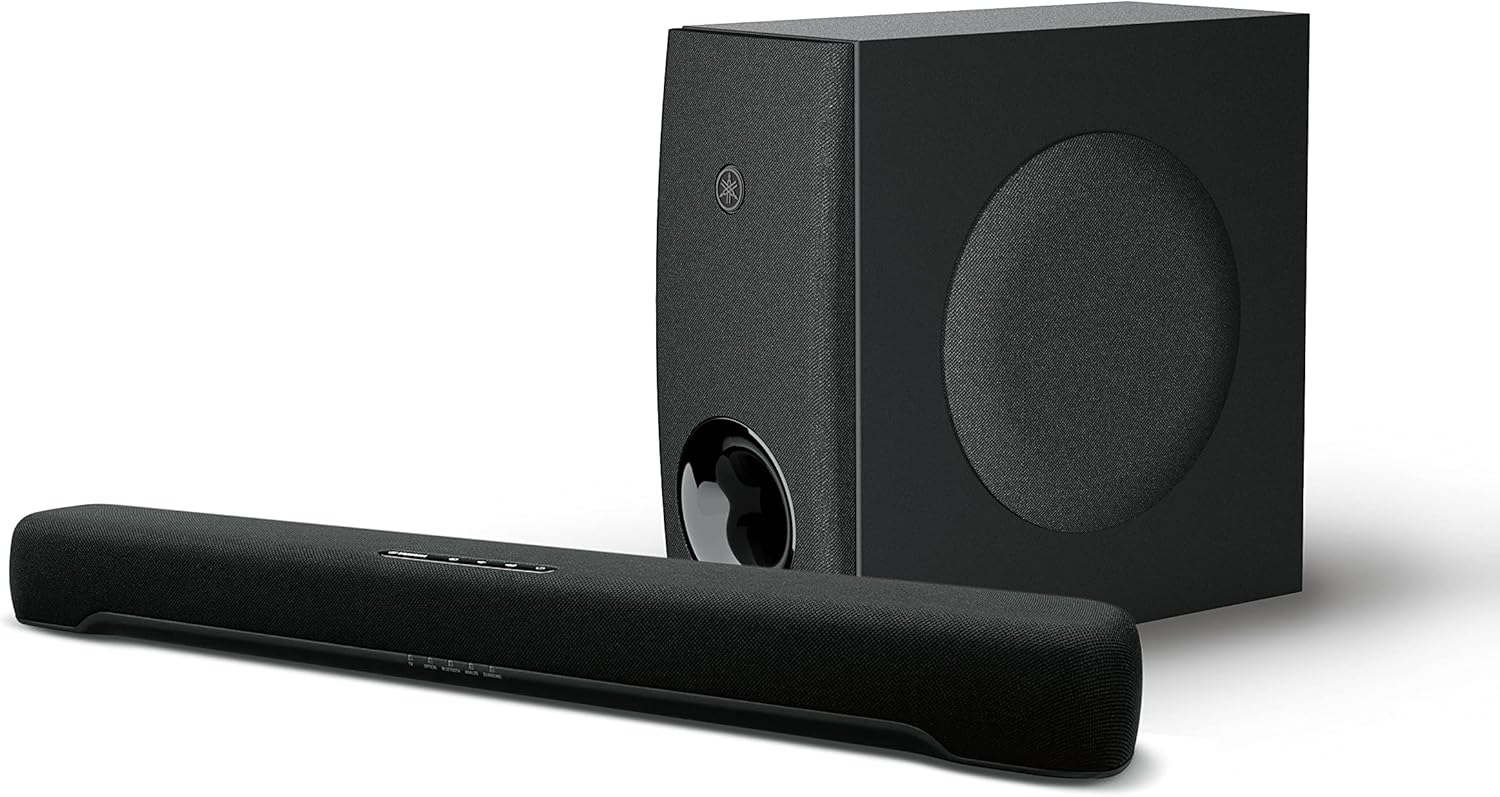
Yamaha SR-C30A
The SR-C30A delivers confident speech and useful bass from a small two-piece system, while its front-only layout and conventional connection set limit spatial and streaming ambition.
- Compact bar keeps the television area uncluttered
- Wireless subwoofer provides dedicated bass support
- Clear Voice processing helps speech intelligibility
- Simple two-piece setup suits bedrooms and modest rooms
- Surround immersion is limited by the front-only speaker layout
- Music flexibility is modest compared with network-connected smart bars
- Connectivity is functional but lacks the breadth of HDMI-input-equipped rivals
The SR-C30A pairs a very small soundbar with a separate wireless subwoofer, Clear Voice processing, four sound modes and HDMI ARC, optical and Bluetooth connections. That layout keeps the television area tidy while still adding dedicated low-frequency output and intelligible speech, which suits bedrooms and modest living rooms where a larger surround package would be awkward.
Clear Voice processing helps bring dialogue forward and the wireless subwoofer adds weight that the narrow bar could not produce alone. The sound remains concentrated around the television rather than wrapping around the room, and music playback is competent rather than a major reason to choose it over connected multiroom products.
Yamaha SR-C30A scores 85/100 for reliability and support, among the higher results in this group. Its compact two-piece layout and conventional HDMI ARC, optical and Bluetooth connections keep everyday operation straightforward.
- Buyers seeking wide Atmos effects or room-filling music scale
| Channels | 2.1 |
|---|---|
| Dolby Atmos | No |
| Wireless Subwoofer Included | Yes |
| Rear Speakers Included | No |
| Connections | HDMI ARC, optical, Bluetooth |

TCL Q65H Q Series 5.1
The Q65H produces a broad, energetic presentation with clear speech and useful HDMI flexibility, while its bass tuning and virtual surround remain less controlled than the better multi-speaker systems.
- Wide front presentation gives films useful scale
- Dialogue stays intelligible across typical TV viewing
- HDMI eARC plus HDMI input simplifies source connection
- Extra HDMI input adds flexibility missing from many rivals
- Surround effects are less precise than systems with physical rear speakers
- Subwoofer output can become boomy instead of tightly controlled
- Music playback is less refined through the midrange
The Q65H combines a 5.1 channel layout, wireless subwoofer, clear speech reproduction and both HDMI eARC and HDMI input in a package that fits beneath the price ceiling. That mix gives films and television a larger, more forceful presentation while keeping source connection straightforward for a living-room system.
Movie soundtracks have convincing scale and dialogue stays easy to follow, helped by the dedicated center-channel focus. The subwoofer adds real impact, although bass can dominate some material, and the surround field does not place effects as precisely as systems with separate rear speakers.
TCL Q65H Q Series 5.1 records 76/100 for reliability and support and 85/100 for owner validation. The ownership point most likely to need attention is subwoofer level, since bass can turn boomy with some material.
- Music-first buyers who prioritize tonal neutrality and tight bass
| Channels | 5.1 |
|---|---|
| Dolby Atmos | Yes |
| Wireless Subwoofer Included | Yes |
| Rear Speakers Included | No |
| Connections | HDMI eARC, HDMI input |

JBL Bar 2.1 Deep Bass MK2
The Bar 2.1 Deep Bass MK2 puts much of its budget into a proper subwoofer and easy TV operation, resulting in a punchy movie experience with fewer smart and surround features.
- Large wireless subwoofer delivers strong low-frequency impact
- HDMI ARC and optical inputs keep TV setup simple
- Two-piece layout provides more bass authority than compact all-in-one bars
- Action scenes gain real physical low-end weight
- Surround presentation is virtual rather than produced by rear speakers
- Music and feature flexibility are basic compared with app-led smart bars
- There is no Dolby Atmos height layer
The Bar 2.1 Deep Bass MK2 pairs a dedicated wireless subwoofer with a straightforward soundbar, HDMI ARC and optical connectivity. That combination adds the low-frequency weight and physical impact missing from most television speakers while keeping installation simple for rooms that do not need separate rear channels or a large smart-audio ecosystem.
The separate subwoofer supplies the physical low-end weight that small bars often lack, making action scenes and bass-heavy programs feel fuller. Speech remains serviceable and setup is direct through HDMI ARC or optical, but spatial effects stay front-heavy and the system offers fewer music-platform and tuning options than more connected rivals.
JBL Bar 2.1 Deep Bass MK2 scores 82/100 for reliability and support, while owner validation is lower at 74/100. Its basic HDMI ARC and optical setup keeps everyday operation simpler than on app-led smart bars.
- Buyers prioritizing Atmos, rear-channel surround or advanced app features
| Channels | 2.1 |
|---|---|
| Dolby Atmos | No |
| Wireless Subwoofer Included | Yes |
| Rear Speakers Included | No |
| Connections | HDMI ARC, optical |

TCL S55H S Class 2.1
The S55H delivers more bass and calibration functionality than its price suggests, although its surround presentation and HDMI timing are the clearest compromises.
- Wireless subwoofer adds meaningful bass for the price
- Room correction helps adapt output to the room
- High clean output suits larger everyday listening levels
- Subwoofer and room correction at a price far below the ceiling
- Surround immersion is weak because rear channels are not reproduced discretely
- HDMI latency can create lip-sync concerns
- Reliability support is less established than on longer-running mature models
The S55H combines a wireless subwoofer, room correction, dialogue enhancement and strong output at a price far below the category ceiling. Those features give everyday television and music more bass and room-adjusted presence than many basic 2.0 bars, making it a practical choice when cost matters more than convincing rear-channel or height effects.
The dedicated subwoofer gives television and music more weight than a single compact bar, and room correction is a useful inclusion at this price. Output remains strong at higher levels, but surround material is collapsed into the front stage and HDMI latency can matter for viewers who are sensitive to lip-sync errors.
TCL S55H S Class 2.1 scores 76/100 for reliability and support and 85/100 for owner validation, though its support record is less established than on longer-running models. HDMI latency is the ownership quirk most likely to matter for lip-sync-sensitive viewers.
- Viewers sensitive to HDMI lip-sync or expecting convincing Atmos
| Channels | 2.1 |
|---|---|
| Dolby Atmos | Yes |
| Wireless Subwoofer Included | Yes |
| Rear Speakers Included | No |
| Room correction | Yes |

Sonos Ray
The Ray sounds clean and articulate for its size and offers excellent app-based music integration, but its 2.0 architecture and optical-only TV connection keep home-theater ambitions modest.
- Speech remains crisp and easy to understand
- Compact enclosure fits small rooms and narrow furniture
- Sonos app and multiroom playback make music use flexible
- Balanced midrange makes casual music listening enjoyable
- No Dolby Atmos or discrete surround capability
- Bass depth is limited without adding another Sonos speaker
- Optical-only TV connection reduces connectivity flexibility
The Sonos Ray combines crisp dialogue, balanced midrange sound, a compact cabinet and access to the Sonos app and multiroom platform. That combination works well in bedrooms and smaller living rooms where tidy placement, easy music playback and clear television speech are more useful than deep bass, rear speakers or Dolby Atmos effects.
Voices sit forward and remain clear at ordinary listening levels, while the midrange is balanced enough for casual music. The compact cabinet cannot generate deep low bass or convincing rear effects on its own, and the lack of HDMI ARC means television control is less flexible than on many similarly priced bars.
Sonos Ray scores 85/100 for reliability and support and 82/100 for owner validation, with ongoing control handled through the Sonos app and multiroom platform. Its optical-only TV connection is the main practical limitation owners live with.
- Buyers seeking Atmos, deep bass or HDMI-based TV connectivity
| Channels | 2.0 |
|---|---|
| Dolby Atmos | No |
| Wireless Subwoofer Included | No |
| Rear Speakers Included | No |
| Connections | Optical (no HDMI ARC) |

Yamaha SR-C20A
The SR-C20A is a tidy step up from built-in TV speakers with articulate speech and simple connections, but its compact cabinet limits low bass and spatial scale.
- Focused midrange keeps television speech clear
- Small chassis fits compact rooms and narrow furniture
- HDMI ARC, optical and Bluetooth cover common simple setups
- Compact one-piece design makes setup quick and simple
- Surround immersion is minimal from the single-bar layout
- Bass extension is limited without a separate subwoofer
- Music flexibility is basic beside Wi-Fi and multiroom smart bars
The SR-C20A puts clear speech reproduction, HDMI ARC, optical input and Bluetooth into a compact one-piece cabinet that fits easily beneath smaller televisions. Its simple layout and focused midrange provide a noticeable everyday improvement over thin TV speakers without adding a separate subwoofer, rear speakers or the placement demands that come with a larger home-theater package.
Dialogue and midrange content remain focused, which helps ordinary television programs sound more intelligible without requiring high volume. The built-in low-frequency driver adds some body but cannot match a separate subwoofer, and the single enclosure keeps effects concentrated around the screen rather than extending behind the listener.
Yamaha SR-C20A records 84/100 for reliability and support and 83/100 for owner validation. Its one-piece cabinet and simple HDMI ARC, optical and Bluetooth connections leave few components to set up or look after.
- Action-movie buyers wanting sub-bass or immersive surround
| Channels | 2.0 with built-in low-frequency driver |
|---|---|
| Dolby Atmos | No |
| Wireless Subwoofer Included | No |
| Rear Speakers Included | No |
| Connections | HDMI ARC, optical, Bluetooth |
How We Evaluate Soundbars Under $300
Our rankings are built through the Flickthru CORE™ Market Research Engine, which first analyzes the category, its intended buyers, and the current US market. Products are then compared using category-specific evidence rather than a generic checklist applied the same way to every product type.
For Soundbars Under $300 specifically, the evaluation focuses on the dimensions that most directly affect real-world performance, everyday usability, ownership experience, and long-term value:
- Sound & Dialogue Quality: We assess tonal balance, speech intelligibility, dynamics and how cleanly the bar reproduces TV, films and music at realistic listening levels.
- Surround & Atmos Immersion: We judge soundstage width, surround placement and, where supported, how convincingly Dolby Atmos or virtual height effects create a sense of space around and above the listener.
- Bass Performance: We assess bass depth, punch, control and how well any subwoofer integrates with the main bar for movies, TV and music.
- Connectivity & Compatibility: We check HDMI ARC/eARC, optical and wireless options, supported audio formats, lip-sync behavior and whether the bar works cleanly with common TVs, streamers and consoles.
- Setup & Everyday Use: We assess installation, controls, app or remote behavior, calibration and how easy it is to make useful adjustments without unnecessary friction.
- Value & Total Cost: We compare performance against the real current price and include required accessories, ongoing fees or replacement burden where they meaningfully affect total ownership cost.
- Features & Music Flexibility: We assess useful sound modes, dialogue enhancement, EQ, wireless music playback and smart or multiroom features that genuinely improve day-to-day use.
- Reliability & Support: We look for recurring fault patterns, firmware stability, warranty and support quality, while avoiding any automatic penalty simply because a newer model has less long-term history.
- Owner Review Validation: We use owner ratings for the exact model and recurring themes in owner reviews to corroborate real-world experience; review volume affects confidence only, not the merit score.
Products are scored dimension-by-dimension across the same contender field so that the same performance standard is applied consistently to every model. Missing noncritical evidence is left unscored rather than assigned a placeholder score, with the remaining supported dimensions renormalized. Evidence confidence is tracked separately and does not alter product merit.
Documented strengths and weaknesses are cross-checked against the final buyer-facing pros and cons before publication, helping ensure that material scoring findings are reflected in the visible recommendation rather than replaced by generic copy. Read the full Flickthru product ranking methodology.