
Best Budget TVs 2026
A category-specific approach to ranking Budget TVs
Most general product roundups are built around broad buyer priorities. Flickthru evaluates budget TVs for shoppers looking for the best-value TVs at lower price points, prioritizing strong picture quality for the money, reliable 4K performance, HDR capability, smart TV usability, gaming features, connectivity, build quality, owner satisfaction and long-term value without paying for premium flagship features. Key priorities are picture & HDR quality, value for money, gaming & motion, smart TV experience, and connectivity & formats.
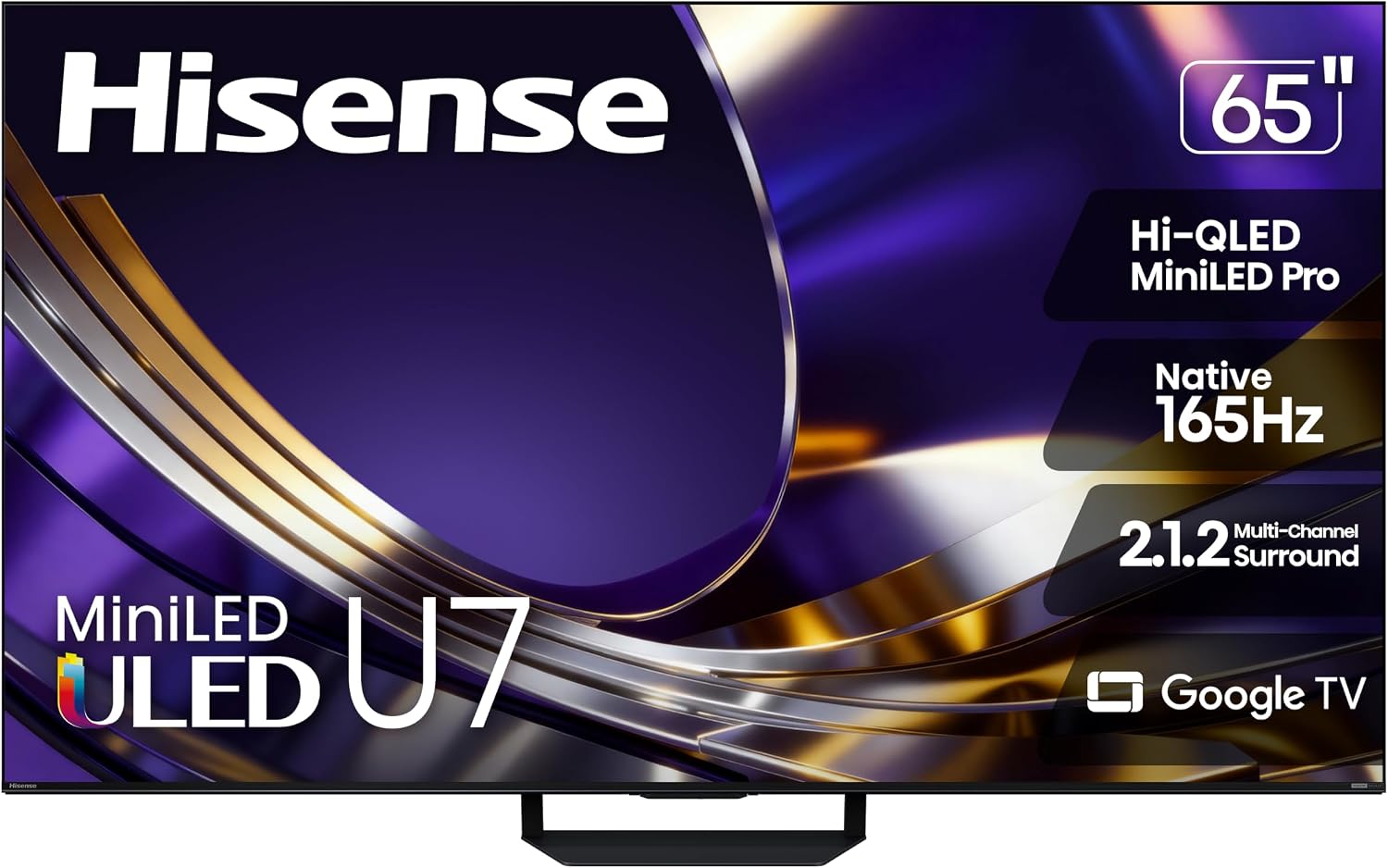
Hisense U7SG
The U7SG combines very high light output, a glare-resistant screen and four high-bandwidth HDMI inputs. It is particularly well suited to mixed movie, sports and gaming use in brighter rooms.
- Very high Mini-LED brightness
- Four HDMI 2.1 inputs and 4K/165Hz gaming
- Glare-resistant screen
- Exceptionally strong owner feedback for a budget set
- Black-level and HDR precision trail the strongest premium rivals
- Viewing angles remain limited
- Build and support confidence trails its performance
Very high Mini-LED brightness and a matte glare-resistant screen make the U7SG especially effective in bright living rooms, while four HDMI 2.1 inputs give multi-console and PC setups unusual flexibility. Support for 4K at up to 165Hz, broad HDR formats, Google TV and substantial built-in audio combine into a particularly complete package for sports, streaming and high-refresh gaming.
The U7SG pairs a Mini-LED backlight and matte screen with four HDMI 2.1 inputs and 4K support up to 165Hz.
Hisense U7SG scores 82/100 for reliability, build and support, trailing its picture and connectivity results. Owner validation is notably stronger at 98/100, the highest owner score in this ranking.
- Wide seating layouts or dark-room viewers who prioritize black-level precision over brightness.
| Resolution | 4K UHD |
|---|---|
| Display type | Mini-LED |
| Screen finish | Matte, glare-resistant |
| HDMI 2.1 | Four ports |
| Max refresh rate | 4K at 165Hz |
| Smart platform | Google TV |

LG B6 OLED
The B6 uses self-emissive OLED pixels for perfect blacks and precise contrast while retaining four HDMI 2.1 connections and full VRR support. Its 2026 panel also improves highlight brightness over the prior entry generation.
- Perfect OLED blacks
- Four HDMI 2.1 ports
- Strong VRR gaming
- Pixel-level contrast with brighter 2026 highlights
- Value is weaker than mainstream Mini-LED because entry-level OLED still costs more
- Built-in audio is only adequate; a soundbar better matches the picture quality
- Requires stretching beyond mainstream LCD budgets
The B6 stands out because it delivers the defining OLED advantages—perfect blacks and pixel-level contrast—without stripping away the gaming hardware expected from costlier models. Four HDMI 2.1 ports, VRR support and stronger 2026 highlight brightness make it a practical crossover for buyers who want cinematic image quality and serious gaming capability in the same television.
The B6 combines a WOLED panel with four HDMI 2.1 ports, VRR, Dolby Vision support and webOS 26.
LG’s mature OLED platform provides useful context, but the B6 itself is new for 2026. Reliability is scored from current build/support evidence and owner feedback without projecting older LG OLED history directly onto this model.
- Very bright rooms or shoppers focused on the largest screen possible for the lowest price.
| Resolution | 4K UHD |
|---|---|
| Display type | WOLED |
| HDMI 2.1 | Four ports |
| VRR | Yes |
| HDR formats | Dolby Vision |
| Smart platform | webOS 26 |

LG B5 OLED
The B5 pairs OLED contrast with four HDMI 2.1 ports, 4K/120Hz support and a mature webOS interface. Its strongest appeal comes when sale pricing narrows the gap to conventional Mini-LED televisions.
- Excellent OLED blacks
- Four HDMI 2.1 ports
- Strong webOS and gaming
- Precise contrast gives films exceptional depth
- Value depends heavily on sale pricing and HDR brightness is modest
- Built-in audio is fairly basic for an OLED
- Benefits from a soundbar for movie nights
Pixel-level OLED blacks and precise contrast give the B5 exceptional depth with films, while four HDMI 2.1 ports and low-latency 4K/120Hz support make it equally capable for current consoles. Mature webOS software, broad gaming support and consistently strong color reproduction combine with discounted pricing to deliver a premium-style movie and gaming experience at the lower end of the OLED market.
Independent testing found strong color, webOS and gaming performance on the B5, offset by low HDR brightness and a reflective screen.
The B5 has a larger owner base and a mature webOS/OLED platform, giving better real-world evidence than the newest sets. That evidence supports confidence in everyday ownership but still does not justify a precise panel-failure rate.
- Sunlit rooms where high HDR brightness and aggressive reflection handling are priorities.
| Resolution | 4K UHD |
|---|---|
| Display type | OLED |
| HDMI 2.1 | Four ports |
| Max refresh rate | 4K at 120Hz |
| Smart platform | webOS |
TCL QM7K
The QM7K delivers effective local dimming, high brightness and a mature Google TV platform. Its combination of HDR punch and 4K/144Hz capability makes it a versatile previous-generation value option.
- Strong contrast and halo control
- High brightness
- 4K/144Hz gaming
- Well regarded across a substantial owner base
- Strong direct reflections can be distracting
- Minor corner vignetting has been observed
- Long-term durability is still uncertain
The QM7K differentiates itself through balanced Mini-LED performance rather than a single headline specification. Strong contrast, effective halo control and 4K/144Hz gaming make it equally comfortable with films and consoles, while Google TV keeps daily use straightforward; its remaining compromises are reflections and mild corner uniformity issues rather than missing core features.
Lab measurements of the QM7K’s HDR, black level, color and gaming performance support its placement.
The QM7K has a substantial owner base and a mature Google TV implementation, giving useful evidence on everyday stability and construction. Long-term defect frequency remains too uncertain to treat as a measured failure percentage.
- Rooms with strong direct reflections or viewers bothered by mild corner vignetting.
| Resolution | 4K UHD |
|---|---|
| Display type | Mini-LED |
| Max refresh rate | 4K at 144Hz |
| Smart platform | Google TV |

TCL QM6K
The QM6K brings local dimming, deep blacks, Google TV and high-refresh gaming into a price band usually occupied by simpler LCD sets. It is particularly compelling for buyers wanting one affordable screen for streaming and games.
- Deep blacks for the price
- 4K/144Hz gaming
- Strong value
- Large owner sample backs its strong reputation
- HDR brightness is less forceful than brighter Mini-LED rivals
- Build and support confidence trails its value
- Built-in speakers are only average
The QM6K delivers a rare combination at its price: genuine Mini-LED black-level improvement and gaming hardware that reaches beyond ordinary budget TVs. 4K/144Hz support, very low latency and Google TV make it versatile, while more moderate HDR brightness and average speakers are easier compromises to accept than the feature omissions common in cheaper sets.
Independent testing found strong gaming performance and deep blacks on the QM6K, though HDR brightness is only moderate.
The QM6K has one of the larger owner-review samples for this specific model in this field, improving confidence in recurring setup, software and hardware themes. Review volume raises confidence only and does not inflate raw merit or imply a quantified long-term failure rate.
- Very bright rooms or buyers expecting powerful built-in speakers.
| Resolution | 4K UHD |
|---|---|
| Display type | Mini-LED |
| Max refresh rate | 4K at 144Hz |
| Smart platform | Google TV |

Hisense U6SF Pro
The U6SF Pro combines strong measured brightness with a glare-resistant screen and very low input lag. Its 144Hz panel, accurate color and built-in subwoofer make it unusually balanced for sports, games and everyday TV.
- Measured HDR brightness and anti-glare performance support bright-room picture quality
- 144Hz support and very low input lag support its gaming score
- Competitive pricing supports unusually strong overall value
- Bright-room Mini-LED performance at a mainstream budget price
- Fire TV usability is busier and less polished than Google TV
- Black levels remain short of OLED
- Fire TV may not suit Google TV households
The U6SF Pro separates itself from typical budget Mini-LED models through measured real-world advantages rather than specification-sheet claims. Strong HDR brightness, low input lag and an anti-glare screen directly benefit sports, daytime viewing and gaming, while 144Hz support and fuller built-in sound make the overall package unusually complete for the price.
The U6SF Pro combines a Mini-LED backlight with a matte anti-reflective coating and native 144Hz support.
The U6SF Pro is still early in its market life, so owner history is much thinner than for 2025 models. Current construction and support evidence is usable, but limited time in market keeps reliability confidence more restrained than its headline performance scores.
- Buyers who strongly prefer Google TV or who prioritize OLED-style black depth.
| Resolution | 4K UHD |
|---|---|
| Display type | Mini-LED |
| Screen finish | Matte anti-reflective |
| Max refresh rate | Native 144Hz |
| Smart platform | Fire TV |
| Built-in subwoofer | Yes |
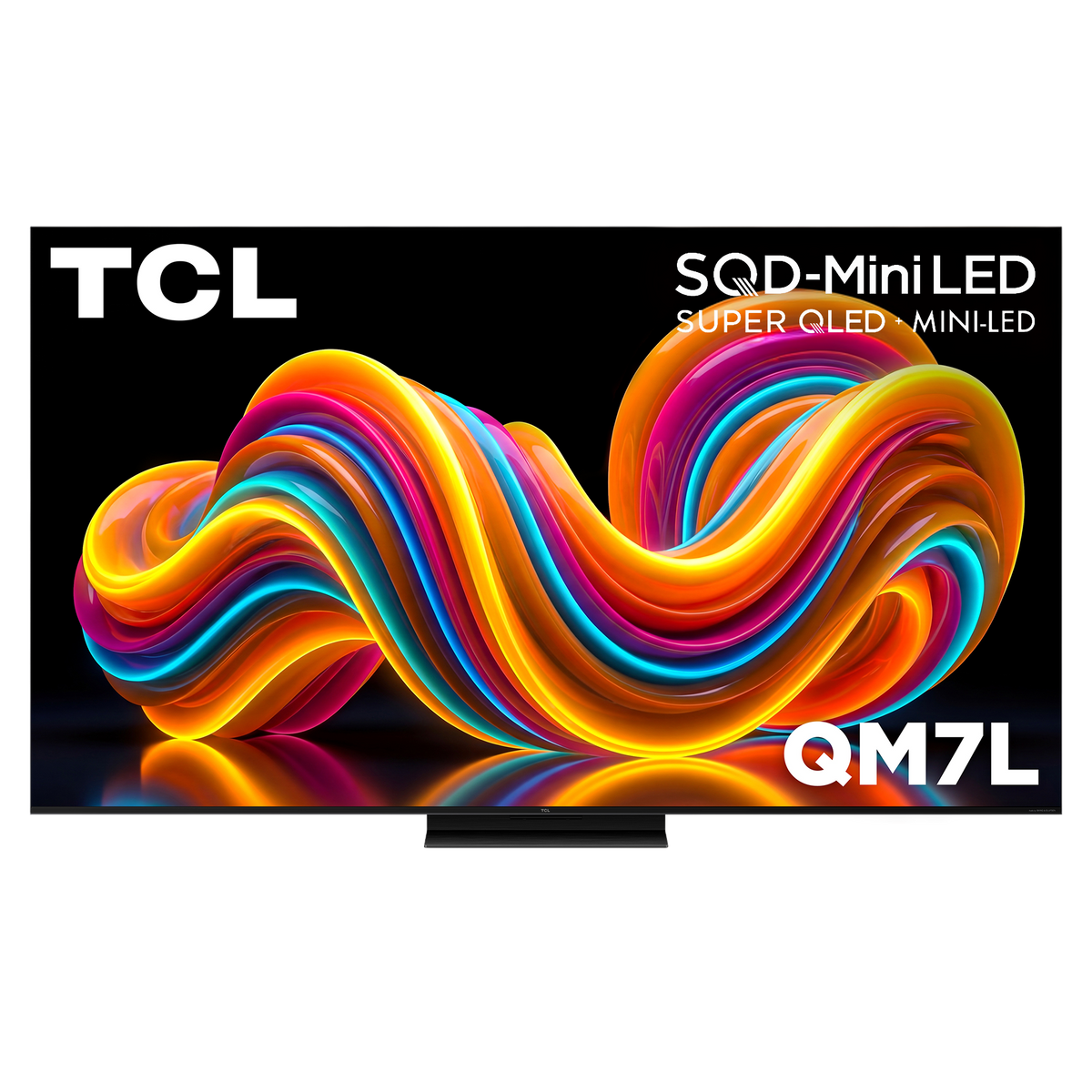
TCL QM7L
The QM7L emphasizes brightness, color volume and a current Google TV feature set. Two HDMI 2.1 ports and 4K/144Hz VRR support provide enough gaming capability for most mixed-use households.
- Bright SQD Mini-LED image
- Good color accuracy
- 4K/144Hz gaming
- Broad format support with VRR and 1080p/288Hz
- Motion response is not class-leading for competitive gaming
- Off-axis blooming remains visible
- Only two HDMI 2.1 ports for multi-console setups
The QM7L is strongest as a current-generation all-rounder for buyers wanting vivid HDR without flagship Mini-LED pricing. Its SQD panel, strong brightness and 4K/144Hz support cover the priorities most mixed-use households notice, while Google TV and broad format support make it easier to live with than a narrowly gaming- or cinema-focused alternative.
The QM7L pairs an SQD Mini-LED panel with two HDMI 2.1 ports, 4K/144Hz and 1080p/288Hz modes, and VRR support.
The QM7L is a recent 2026 model with a modest owner sample, leaving limited evidence on multi-year ownership. Current build quality and support still count in its score, and the shorter history lowers our confidence rather than adding a speculative penalty.
- Wide seating groups or motion-sensitive competitive gamers.
| Resolution | 4K UHD |
|---|---|
| Display type | SQD Mini-LED |
| HDMI 2.1 | Two ports |
| Max refresh rate | 4K at 144Hz, 1080p at 288Hz |
| VRR | Yes |
| Smart platform | Google TV |

Hisense U65QF
The U65QF remains attractive where discounts are deep, offering local dimming, bright SDR output and better-than-expected built-in sound. Its 4K/144Hz support gives gamers more headroom than many low-cost televisions.
- Mini-LED contrast and strong SDR brightness support its picture score
- 4K/144Hz capability gives it a meaningful gaming advantage at the price
- Low street pricing supports strong value despite its older generation
- Deep discounts bring Mini-LED and 144Hz cheaply
- Fire TV usability is less polished than leading Google TV interfaces
- Built-in sound is decent but not a replacement for a soundbar
- Weakest smart TV experience in this ranking
The U65QF remains worthwhile where discounts are aggressive because it preserves the hardware upgrades that matter most over entry-level televisions. Mini-LED local dimming, strong SDR brightness and 144Hz gaming create a meaningful jump in picture and responsiveness, although buyers must accept rougher Fire TV software and less precise HDR and motion handling.
Independent testing found good contrast, strong SDR brightness and 4K/144Hz support on the U65QF, along with HDR over-brightening and some motion blur.
The U65QF has a useful owner-history base and known Fire TV behavior, but its previous-generation status makes continuing support and stock quality more relevant. Reliability scoring uses recurring ownership themes without converting them into an invented defect percentage.
- Viewers who prioritize precise HDR tracking, polished software or the cleanest fast-motion response.
| Resolution | 4K UHD |
|---|---|
| Display type | Mini-LED |
| Max refresh rate | 4K at 144Hz |
| Smart platform | Fire TV |

Sony Bravia 3 II
The Bravia 3 II focuses on Sony image processing, responsive Google TV software and four HDMI 2.1 inputs rather than Mini-LED hardware. It is especially easy to integrate into living rooms with several modern sources.
- Strong processing
- Four HDMI 2.1 ports
- Responsive Google TV
- Flexible connections for several modern sources
- Value is weaker than similarly priced Mini-LED rivals
- Built-in audio is modest and lacks the impact of stronger TV speaker systems
- No local dimming limits dark-room blacks
Sony’s XR-assisted processing, clean upscaling and vivid color reproduction give the Bravia 3 II a polished everyday picture, while four HDMI 2.1 inputs make it unusually flexible for multiple modern sources. Its 120Hz support, responsive Google TV interface and strong source handling suit households that value processing quality, ease of use and straightforward gaming connectivity.
The Bravia 3 II uses a direct-lit IPS design with four high-bandwidth HDMI 2.1 inputs.
Sony’s current support structure and the Bravia 3 II’s conventional LED design provide a reasonable build baseline, but the model itself is recent. The score rewards documented construction and support without treating brand reputation as proof of this exact model’s long-term durability.
- Dark-room movie viewing where local dimming and deep blacks are the main priorities.
| Resolution | 4K UHD |
|---|---|
| Display type | Direct-lit LED, IPS panel |
| Local dimming | No |
| HDMI 2.1 | Four ports |
| Max refresh rate | 120Hz |
| Smart platform | Google TV |
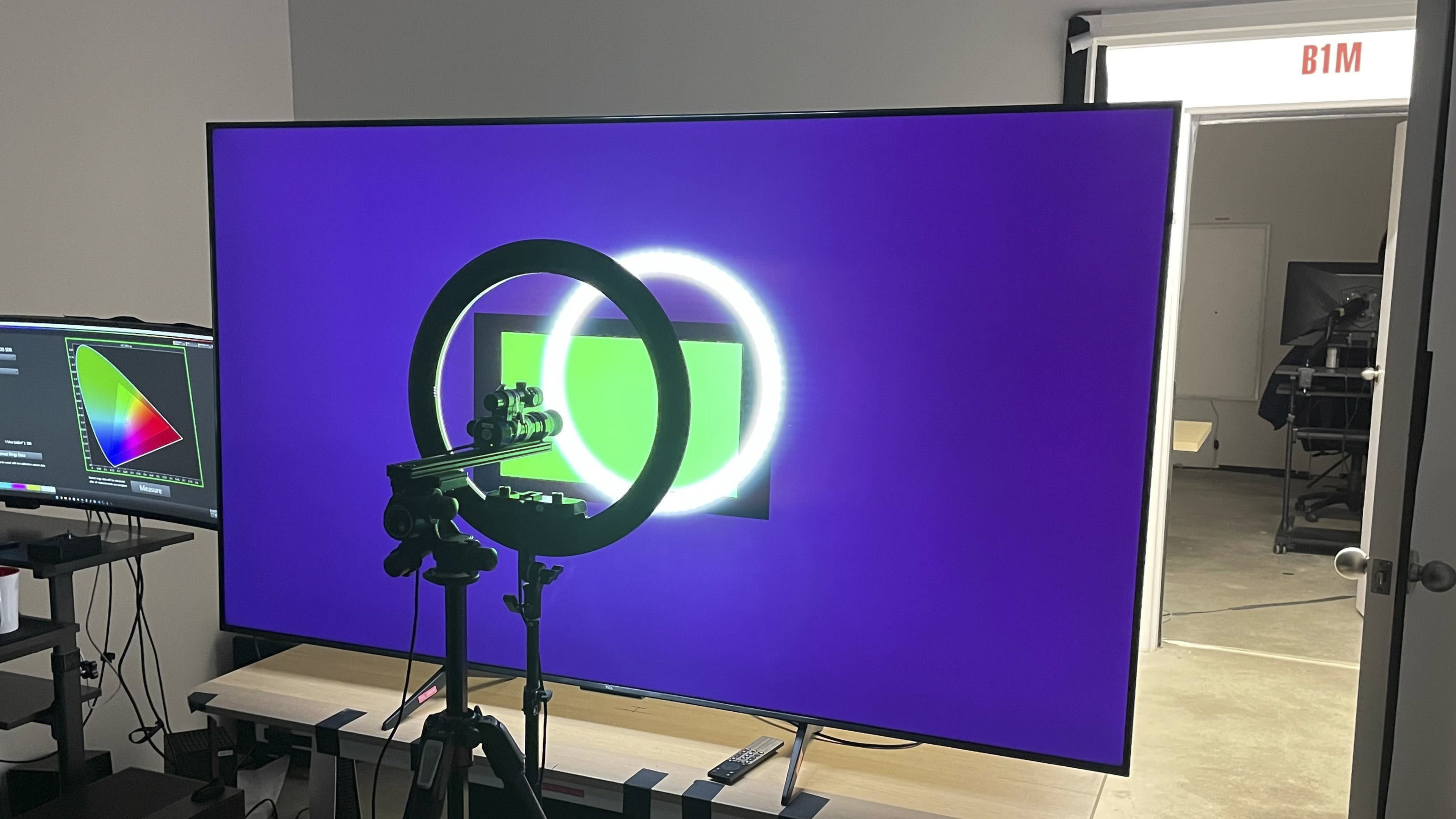
TCL QM5K
The QM5K concentrates on the picture benefits buyers notice first: deeper blacks, useful brightness and local dimming at a low entry price. Its Google TV platform also keeps setup and streaming simple.
- Mini-LED local dimming gives it stronger black levels than basic budget QLED sets
- Low pricing is its clearest value advantage
- Google TV keeps everyday streaming and setup straightforward
- Large owner sample supports everyday confidence
- Picture/HDR performance is clearly below the brighter QM6K and QM7K
- Gaming refresh and connectivity are more limited than higher TCL tiers
- Build/support confidence and built-in audio are both basic
The QM5K is best understood as a low-cost entry point to Mini-LED rather than a cut-down enthusiast display. It gives shoppers deeper blacks, useful brightness and simple Google TV operation for relatively little money, while deliberately giving up some refresh-rate, connectivity and audio headroom that the QM6K and QM7K provide at higher prices.
As an entry Mini-LED model, the QM5K delivers deeper blacks and better HDR brightness than basic QLED alternatives.
The QM5K has a comparatively large owner sample, helping establish everyday setup and stability patterns, but professional evidence is thinner than for TCL’s higher tiers. Reliability remains a cautious score based on available build, support and owner evidence.
- High-refresh PC gaming or wide-room seating arrangements.
| Resolution | 4K UHD |
|---|---|
| Display type | Mini-LED |
| Local dimming | Yes |
| Smart platform | Google TV |
How We Evaluate Budget TVs
Our rankings are built through the Flickthru CORE™ Market Research Engine, which first analyzes the category, its intended buyers, and the current US market. Products are then compared using category-specific evidence rather than a generic checklist applied the same way to every product type.
For Budget TVs specifically, the evaluation focuses on the dimensions that most directly affect real-world performance, everyday usability, ownership experience, and long-term value:
- Picture & HDR Quality: Assesses contrast, black levels, brightness, color accuracy, HDR impact, uniformity, viewing angles and how cleanly lower-resolution content is upscaled.
- Value for Money: Judges how much useful TV performance, screen size and feature coverage the buyer receives for the current US price, including meaningful extra costs caused by major omissions.
- Gaming & Motion: Checks input lag, refresh rate, VRR/ALLM support and motion handling so games, sports and fast scenes remain responsive and clean.
- Smart TV Experience: Assesses platform speed, app access, menu clarity, setup, casting and how easy it is to reach content and important settings without excessive friction.
- Connectivity & Formats: Checks HDMI/eARC and other useful connections plus HDR, casting and source compatibility, with penalties for port or format limits that restrict normal use.
- Reliability, Build & Support: Looks at construction, stability, recurring fault patterns, software reliability and warranty/support evidence, without treating a new model as worse simply because long-term history is limited.
- Owner Review Validation: Uses recurring exact-model owner praise and complaints to validate real-world strengths and problems; review volume affects confidence only, not the merit score.
- Built-In Sound: Assesses dialogue clarity, distortion, usable volume and overall speaker quality for buyers who plan to use the TV without a separate sound system.
Products are scored dimension-by-dimension across the same contender field so that the same performance standard is applied consistently to every model. Missing noncritical evidence is left unscored rather than assigned a placeholder score, with the remaining supported dimensions renormalized. Evidence confidence is tracked separately and does not alter product merit.
Documented strengths and weaknesses are cross-checked against the final buyer-facing pros and cons before publication, helping ensure that material scoring findings are reflected in the visible recommendation rather than replaced by generic copy. Read the full Flickthru product ranking methodology.