
Best AV Receivers 2026
A category-specific approach to ranking AV Receivers
Most general product roundups are built around broad buyer priorities. Flickthru evaluates AV receivers for buyers choosing an AV receiver for a home theater or music system, prioritizing sound quality & amplification, HDMI, video & gaming compatibility, room correction & calibration, channels, processing & expandability, and connectivity & streaming.

Marantz Cinema 30
Cinema 30 blends 11-channel power, 13.4-channel processing, advanced calibration options and extensive HDMI connectivity with a distinctly premium chassis. Its appeal is the way those capabilities are delivered with unusually refined, controlled sound.
- Eleven amplified channels and 13.4-channel processing suit full 7.2.4 systems without extra amplification
- Smooth, powerful sound combines large-scale effects with precise spatial placement
- Premium build, Audyssey XT32, optional Dirac Live and seven HDMI 2.1 inputs create a complete high-end package
- High $4,800 purchase price weakens total value versus similarly capable Denon and Onkyo alternatives
- 40Gbps HDMI implementation is not the absolute maximum available bandwidth
- Large chassis needs generous cabinet depth and ventilation
Eleven channels of amplification, sophisticated room calibration and a polished 8K HDMI platform give Cinema 30 the hardware to anchor a serious 7.2.4 theater without extra power amps. What elevates it beyond a specification exercise is the combination of smooth tonal balance, large-scale dynamics, precise Atmos placement and unusually high build quality in one integrated receiver.
Its strongest trait is composure: demanding movie sequences retain scale and punch without losing dialogue clarity or spatial precision, while two-channel music stays controlled and richly textured. Calibration is effective and the receiver remains easy to operate despite its depth.
Construction quality is excellent and the platform benefits from mature Denon/Marantz software foundations. Owner sentiment is very strong so far, though the sample is still modest for a premium model.
- Value-focused buyers who mainly need channel count and room correction rather than premium fit and finish.
| Amplified Channels | 11 |
|---|---|
| Immersive Audio | Dolby Atmos, DTS:X Pro, Auro-3D, IMAX Enhanced, 360 Reality Audio |
| Video | 7 HDMI inputs / 3 outputs; 8K/60Hz and 4K/120Hz; eARC |
| Room Correction | Audyssey MultEQ XT32 included; Dirac Live optional paid upgrade |
| Streaming | HEOS built-in, AirPlay 2, Spotify Connect, Bluetooth, Wi-Fi, Roon Tested |
| Price | $4,800.00 |

Denon AVR-A1H
The AVR-A1H combines 15 amplified channels, 17.4-channel pre-outs, extensive HDMI 2.1 connectivity and high-output amplification in a single chassis. It is built for complex Atmos systems where avoiding multiple external amplifiers has real practical value.
- Fifteen onboard amplifier channels can power a 9.4.6 Atmos layout without an external power amp
- Flagship power supply and processing deliver exceptional scale, bass authority and spatial control
- Seven HDMI 2.1 inputs, four independent subwoofer outputs and 17.4-channel pre-outs support very large systems
- The $7,199 price places it firmly in no-compromise territory
- Large, heavy chassis demands substantial rack space
- Setup depth can be excessive for buyers who will never use its 15-channel capability
Fifteen onboard amplifier channels, 17.4-channel processing and four independently managed subwoofer outputs let the AVR-A1H run unusually large immersive systems from one chassis. Its combination of powerful multichannel drive, broad HDMI 2.1 connectivity and unusually deep routing flexibility makes it stand out for dedicated theaters that need scale without moving immediately to separate processors and amplifiers.
The receiver produces a large, controlled presentation with strong bass weight and ample headroom, while its channel architecture supports very complex Atmos layouts. High-end DAC, processing and preamp facilities make it equally credible as the center of a separates-based system.
The heavy chassis, substantial power supply and flagship construction support a strong durability case, backed by very positive owner feedback. Its complexity and heat output still make good ventilation and careful installation important.
- Smaller rooms or buyers whose systems will never use more than nine amplified channels.
| Amplified Channels | 15 |
|---|---|
| Immersive Audio | Dolby Atmos, DTS:X Pro, Auro-3D, IMAX Enhanced, 360 Reality Audio |
| Video | 7 HDMI inputs (all 8K) / 3 outputs (1 eARC); 8K/60Hz and 4K/120Hz |
| Room Correction | Audyssey MultEQ XT32 included; Dirac Live and Dirac Live Bass Control optional paid upgrades |
| Streaming | HEOS built-in, AirPlay 2, Spotify Connect, Bluetooth, Wi-Fi, Roon Tested |
| Price | $7,199.00 |

Denon AVR-X6800H
AVR-X6800H combines 11 amplified channels, 13.4-channel processing, seven modern HDMI inputs and flexible room correction in a relatively compact premium receiver. It is especially strong for buyers wanting a complete 7.4.4 solution without stepping up to the much larger A1H.
- Eleven onboard amplifier channels can run 7.4.4 Atmos without external amplification
- Seven HDMI 2.1 inputs with 8K/60Hz and 4K/120Hz suit modern consoles and sources
- Audyssey XT32, optional Dirac Live and four independent subwoofer outputs provide deep calibration control
- Premium pricing remains significant even below the flagship A1H
- Sound presentation favors scale and warmth over the most incisive attack
- External amplification is still required to use all 13.4 processing channels
Eleven amplified channels, 13.4-channel processing, four independently addressable subwoofers and seven modern HDMI inputs give the AVR-X6800H unusually complete coverage for a single-box theater. Strong dynamic scale, straightforward setup and flexible Audyssey or Dirac calibration make those capabilities practical rather than merely extensive, especially in full 7.4.4 rooms.
The receiver favors a rich, authoritative presentation with convincing low-end impact and strong spatial scale. Its newer HDMI platform and refined setup interface improve day-to-day use while maintaining the powerful character expected from Denon’s upper X-series.
The AVR-X6800H builds on a mature Denon platform and owner feedback has been strong so far. Good ventilation remains important because sustained multichannel output and dense processing generate meaningful heat.
- Smaller 5.1.4 systems that will not use eleven amplified channels, or listeners who prefer a leaner, more incisive sound.
| Amplified Channels | 11 |
|---|---|
| Immersive Audio | Dolby Atmos, DTS:X Pro, Auro-3D, IMAX Enhanced, 360 Reality Audio |
| Video | 7 HDMI inputs / 3 outputs (1 eARC); 8K/60Hz and 4K/120Hz at up to 40Gbps |
| Room Correction | Audyssey MultEQ XT32 included; Dirac Live and Dirac Live Bass Control optional paid upgrades |
| Streaming | HEOS built-in, AirPlay 2, Spotify Connect, Bluetooth, Wi-Fi, Roon Tested |
| Price | $3,799.00 |

Onkyo TX-RZ70
TX-RZ70 combines serious amplifier capability, 11 onboard channels, comprehensive HDMI 2.1 connectivity and full Dirac Live in a package priced below many premium rivals. Its power and calibration flexibility are the core attractions.
- Strong bench-tested amplifier output gives it real headroom with demanding speakers
- Eleven amplified channels plus included full-bandwidth Dirac Live create a powerful 7.2.4 solution
- Seven 8K HDMI inputs and broad streaming support make it unusually complete at its price
- App and control integration feels less polished than premium rivals
- Dirac setup can be more involved than simpler automatic calibration systems
- Owner feedback is positive overall but less consistent than the strongest premium rivals
Bench-tested amplifier headroom, eleven onboard channels and included full-bandwidth Dirac Live give the TX-RZ70 unusually strong fundamentals for demanding multichannel systems. Add seven 8K-capable HDMI inputs, robust pre-outs and a broad streaming platform, and it becomes one of the most complete choices for buyers who want premium theater capability without flagship-level pricing.
The amplifier section delivers strong full-bandwidth output and maintains convincing dynamics with multichannel material, while Dirac Live materially improves bass integration and system coherence. Its preamp stage also has enough clean voltage swing to pair well with external amplification.
- Two-channel full-bandwidth output into 8 ohms: about 170 W/ch.
The steel chassis and substantial amplifier section inspire confidence, though owner feedback is less consistent than for premium rivals. Setup complexity and firmware-dependent features make careful updating and configuration worthwhile.
- Users who want the simplest possible calibration workflow or a particularly spacious rear-panel layout.
| Amplified Channels | 11 |
|---|---|
| Immersive Audio | Dolby Atmos, DTS:X, IMAX Enhanced, Auro-3D |
| Video | 7 HDMI inputs (1 front) / 3 outputs (2 x 8K, 1 x 4K); eARC; VRR, ALLM, QFT |
| Room Correction | Dirac Live Full Bandwidth included; Dirac Live Bass Control optional upgrade |
| Streaming | Chromecast built-in, AirPlay 2, Spotify Connect, Works with Sonos, DTS Play-Fi, Bluetooth (aptX HD transmit) |
| Price | $1,699.00 |
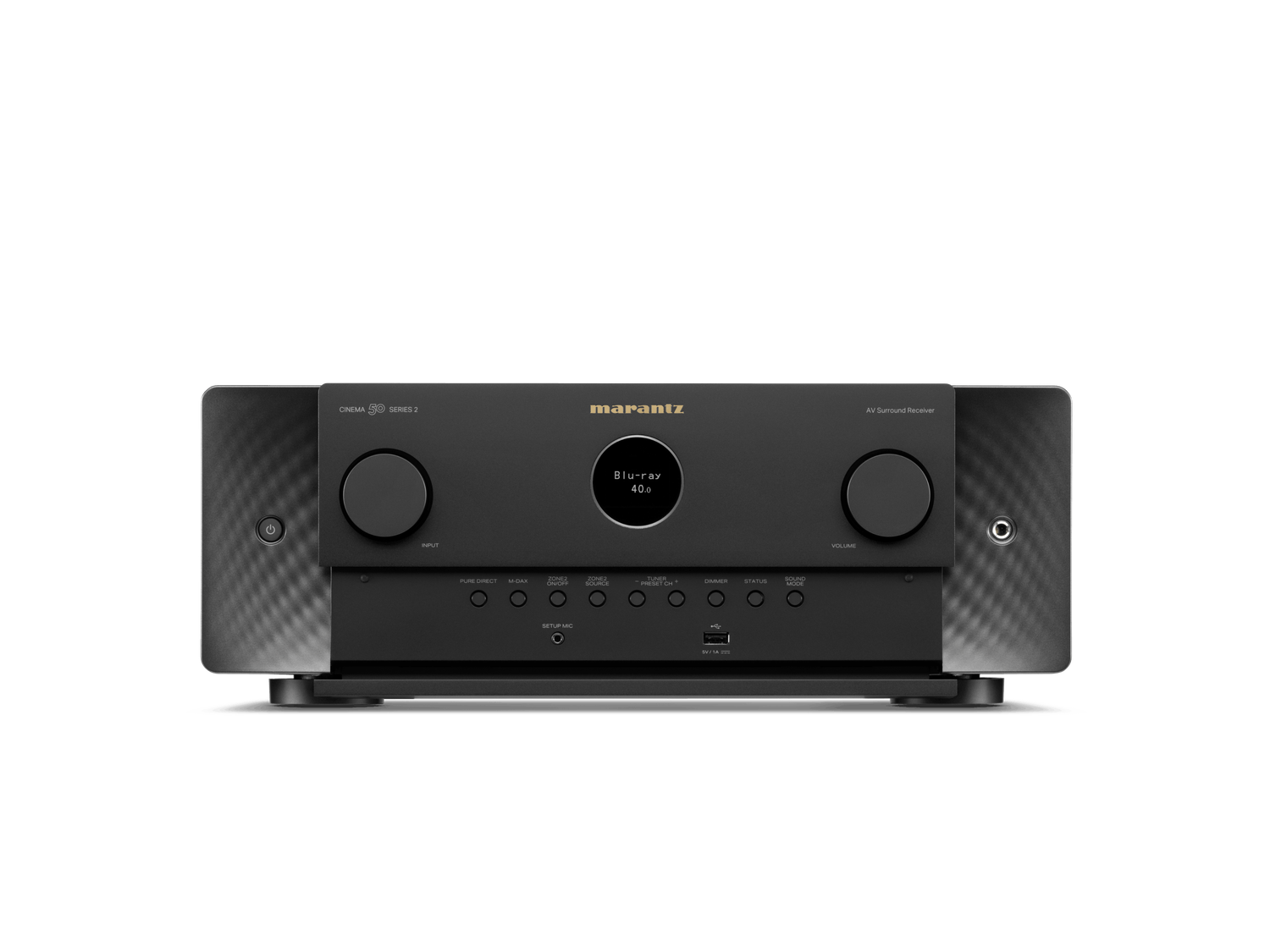
Marantz Cinema 50 Series 2
Cinema 50 Series 2 updates Marantz’s nine-channel formula with current DAC architecture, six 8K HDMI inputs and the familiar Audyssey/Dirac calibration path. It targets buyers who want a premium 5.1.4 or externally expanded 7.1.4 system.
- New-generation 9.4-channel platform combines 110W amplification with 11.4-channel pre-outs
- Six 8K HDMI inputs provide broad modern source coverage
- Audyssey XT32 plus Dirac-ready calibration gives strong room-tuning flexibility
- $3,000 launch price is high for a nine-channel receiver
- Only a very small owner sample exists so far
- Eleven-channel layouts still require external amplification
Nine amplified channels, 11.4-channel pre-outs, six 8K HDMI inputs and flexible Audyssey or Dirac calibration make Cinema 50 Series 2 a capable foundation for modern immersive systems. Its appeal comes from pairing that connectivity and expansion depth with Marantz’s premium implementation, giving buyers a current-generation route to a refined 5.1.4 or externally expanded 7.1.4 theater.
The Series 2 platform is designed around clean multichannel drive, broad format support and flexible calibration rather than extreme onboard channel count. Current early feedback points to clear sound and an unusually straightforward setup process.
Cinema 50 Series 2 is a new model with little long-term ownership history yet. Current owner feedback is excellent but based on only a few ratings, making long-term reliability conclusions premature.
- Shoppers prioritizing maximum channel count or proven long-term owner history at the same price.
| Amplified Channels | 9 |
|---|---|
| Immersive Audio | Dolby Atmos, DTS:X, Auro-3D, IMAX Enhanced |
| Video | 6 HDMI inputs (8K/60Hz and 4K/120Hz at 40Gbps) / 3 outputs; eARC on main output |
| Room Correction | Audyssey MultEQ XT32 included; Dirac Live optional paid upgrade |
| Streaming | HEOS built-in, AirPlay 2, Spotify Connect, Bluetooth, Wi-Fi |
| Price | $3,000.00 |

Denon AVR-X4800H
AVR-X4800H packs nine power channels, 11.4 processing, seven HDMI 2.1 inputs and extensive pre-outs into a proven platform. It balances capability, usability and price more evenly than many higher-end receivers.
- Nine amplified channels and 11.4 processing support 5.1.4 natively or larger layouts with an external amp
- Seven HDMI 2.1 inputs and four independent subwoofer outputs provide excellent system flexibility
- Strong dynamics, clear dialogue and mature setup tools make it easy to integrate
- Nine onboard channels limit full 7.1.4 without external amplification
- Current pricing overlaps newer models in some channels
- Remote control lacks the premium feel of more expensive flagships
Nine channels of amplification, 11.4-channel processing, seven HDMI 2.1 inputs and four independent subwoofer outputs give the AVR-X4800H broad flexibility for serious home theaters. Accurate effects steering, strong dynamics and mature setup software make that hardware easy to exploit, creating a balanced receiver that can start as a one-box 5.1.4 system and expand later.
Movie playback is energetic and well controlled, with clean dialogue and precise surround placement. The receiver’s modern video path and flexible speaker assignments make it particularly easy to combine gaming, streaming and immersive audio sources.
The AVR-X4800H has a larger owner history than newer 2026 models and current sentiment is strong overall. A small minority of low ratings keeps its reliability picture a step below the top-rated models.
- Buyers who want 11 amplified channels in one chassis.
| Amplified Channels | 9 |
|---|---|
| Immersive Audio | Dolby Atmos, DTS:X, Auro-3D, IMAX Enhanced, 360 Reality Audio |
| Video | 7 HDMI inputs (all 8K) / 3 outputs (1 eARC); 8K/60Hz and 4K/120Hz |
| Room Correction | Audyssey MultEQ XT32 included; Dirac Live and Dirac Live Bass Control optional paid upgrades |
| Streaming | HEOS built-in, AirPlay 2, Spotify Connect, Bluetooth, Wi-Fi, Roon Tested |
| Price | $2,799.00 |

Onkyo TX-RZ50
TX-RZ50 pairs nine amplified channels, 11.2 processing and full Dirac Live with a comprehensive HDMI 2.1 platform at a relatively accessible price. Its combination of room correction and expansion is the reason it remains competitive.
- Included Dirac Live is unusually strong room correction at this price
- Nine amplified channels and 11.2 processing support 5.1.4 natively and larger layouts with external power
- Broad HDMI 2.1 and streaming support create excellent value
- Owner ratings show more low-score reports than the strongest rivals
- Setup and firmware behavior can require more patience than simpler receivers
- Amplifier and build refinement sit below the newer RZ70
Included Dirac Live, nine channels of amplification and 11.2-channel processing let the TX-RZ50 build a serious 5.1.4 system and expand beyond it without a premium calibration surcharge. Its combination of HDMI 2.1 coverage, pre-outs, strong streaming support and aggressive pricing keeps it compelling for enthusiasts who value system flexibility over luxury finish.
The receiver delivers strong multichannel impact and benefits substantially from Dirac Live, especially in bass integration and tonal consistency. It has enough power for typical rooms, though the newer RZ70 offers more amplifier headroom and a more premium platform.
The TX-RZ50’s large owner pool shows both strong satisfaction and a meaningful minority of low ratings. HDMI, switching and firmware complaints appear often enough to keep reliability below the best premium competitors.
- Buyers who prioritize the most polished firmware experience or premium amplifier construction.
| Amplified Channels | 9 |
|---|---|
| Immersive Audio | Dolby Atmos, DTS:X, IMAX Enhanced |
| Video | 7 HDMI inputs (1 front) / 2 outputs (main eARC, sub/Zone 2); 8K; VRR, ALLM, QFT |
| Room Correction | Dirac Live room correction; AccuEQ |
| Streaming | Chromecast built-in, AirPlay 2, Spotify, TIDAL, Works with Sonos, Roon Tested, Wi-Fi, Bluetooth |
| Price | Check current US pricing |

Denon AVR-X3900H
AVR-X3900H offers nine onboard channels, 11.4 processing, six 8K HDMI inputs and a strong calibration stack in a current 2026 design. Its value depends on how closely street pricing sits to older discounted X-series models.
- Nine amplified channels and 11.4 processing bring upper-tier layout flexibility to a newer midrange model
- All six HDMI inputs support 8K-class connectivity
- Dirac-ready calibration, Audyssey and four independent subwoofer outputs provide unusually strong bass-management options
- 105W two-channel rating is lower than Denon’s higher-tier models
- Limited owner history so far for this new 2026 model
- Premium launch pricing reduces the value advantage over discounted older models
Nine amplified channels, 11.4-channel processing, six 8K HDMI inputs and four independent subwoofer outputs give the AVR-X3900H unusually deep system flexibility within Denon’s current range. Audyssey plus Dirac-ready calibration and a simplified current-generation interface make it especially attractive for buyers building a 5.1.4 theater that may later add external amplification.
The newer platform focuses on clean multichannel drive, modern video switching and deep calibration rather than flagship power reserves. Early owner feedback highlights clarity, dialogue intelligibility and smooth calibration in typical 5.1.4 systems.
The AVR-X3900H is a recent model, so its owner history is still limited and long-term conclusions remain provisional. Early owner feedback is positive, and the receiver builds on Denon’s mature X-series software foundations.
- Large rooms with difficult speakers that would benefit from the stronger amplifier section of upper-tier receivers.
| Amplified Channels | 9 |
|---|---|
| Immersive Audio | Dolby Atmos, DTS:X, Auro-3D, IMAX Enhanced, 360 Reality Audio |
| Video | 6 HDMI inputs (all 8K); eARC; 8K pass-through and 8K upscaling |
| Room Correction | Audyssey room correction included; Dirac Live optional upgrade |
| Streaming | HEOS built-in, Spotify, Bluetooth |
| Price | $1,849.00 |

Onkyo TX-RZ30
TX-RZ30 brings much of the RZ70’s software and calibration appeal to a nine-channel platform. It is especially compelling where full Dirac Live matters more than maximum onboard power.
- Full Dirac Live is included rather than sold as a paid upgrade
- Nine amplified channels support 5.1.4 without external power
- Strong sound quality and modern HDMI connectivity deliver excellent performance for the price
- Less amplifier headroom than the larger RZ70
- Expanding beyond 5.1.4 means adding a separate power amplifier
- Rear connectivity is dense once a complex system is installed
Full-bandwidth Dirac Live, nine amplified channels and broad HDMI 2.1 support give the TX-RZ30 the tools for a well-integrated 5.1.4 system without extra calibration spending. Strong multichannel sound, straightforward everyday control and an aggressive price make that feature mix unusually accessible, especially for rooms that do not need the RZ70’s greater amplifier reserves.
Its sound is energetic and well organized, with good spatial steering and strong bass integration after calibration. The amplifier section is capable for typical rooms, while the included room correction raises system-level performance beyond many similarly priced rivals.
Current owner sentiment is strong and the platform benefits from Onkyo’s newer-generation software direction. Its long-term ownership history is still shorter than the older RZ50’s, so durability evidence is less extensive.
- Very large rooms or difficult speakers that need the RZ70’s stronger amplifier section.
| Amplified Channels | 9 |
|---|---|
| Immersive Audio | Dolby Atmos, DTS:X, IMAX Enhanced |
| Video | 6 HDMI inputs / 2 outputs (eARC); HDMI 2.1a with 8K, VRR, ALLM, QFT |
| Room Correction | Dirac Live Full Bandwidth included; Dirac Live Bass Control optional upgrade |
| Streaming | Chromecast built-in, AirPlay 2, Spotify, TIDAL, Works with Sonos, Roon Tested, Wi-Fi, Bluetooth |
| Price | $999.00 |

Yamaha RX-A6A
RX-A6A remains a capable nine-channel receiver with strong amplification, MusicCast integration and 11-channel processing. Its weaker competitive points are room correction sophistication and the value of an older HDMI platform at current pricing.
- Strong amplifier headroom and excellent analog preamp measurements
- Nine amplified channels and 11-channel processing support substantial Atmos layouts
- MusicCast, extensive connectivity and sturdy build remain class strengths
- YPAO room correction is less flexible and less consistent than Dirac or Audyssey XT32
- HDMI 2.1 implementation and feature rollout have been less seamless than newer rivals
- Current pricing is difficult to justify against newer receivers with stronger calibration packages
Strong amplifier reserves, nine onboard channels, 11-channel processing and extensive MusicCast connectivity give the RX-A6A the foundations for a powerful immersive system. Its clean analog preamp performance, convincing multichannel dynamics and sturdy construction still distinguish it for Yamaha-focused installations, particularly where amplification quality and ecosystem integration matter more than having the newest calibration platform.
Bench testing shows strong two-channel power and very clean analog preamp performance, while hands-on listening confirms excellent dynamics and surround steering. The digital path measures less cleanly than the best modern designs, and YPAO is not as flexible as current Dirac-based competitors.
- Two-channel full-bandwidth output into 8 ohms: >150 W/ch.
- 1 kHz two-channel output: 186 W/ch at 8 ohms; 282 W/ch at 4 ohms.
The substantial chassis and mature platform support a strong reliability assessment. Earlier HDMI-feature rollout complications remain relevant to platform polish, but they do not erase the receiver’s solid construction.
- Buyers prioritizing the most advanced room correction or the cleanest current HDMI 2.1 value proposition.
| Amplified Channels | 9 |
|---|---|
| Immersive Audio | Dolby Atmos, DTS:X |
| Video | 7 HDMI inputs / 3 outputs; eARC; 4K/120Hz and 8K/60Hz on 3 inputs and 1 output |
| Room Correction | YPAO-R.S.C. with multipoint measurement and precision EQ |
| Streaming | MusicCast multi-room, AirPlay 2, Spotify Connect, Bluetooth, Wi-Fi |
| Price | $2,999.95 |
How We Evaluate AV Receivers
Our rankings are built through the Flickthru CORE™ Market Research Engine, which first analyzes the category, its intended buyers, and the current US market. Products are then compared using category-specific evidence rather than a generic checklist applied the same way to every product type.
For AV Receivers specifically, the evaluation focuses on the dimensions that most directly affect real-world performance, everyday usability, ownership experience, and long-term value:
- Sound Quality & Amplification: Assesses clarity, dynamics, multichannel drive capability, distortion control and how confidently the receiver powers real speaker systems for movies and music.
- HDMI, Video & Gaming Compatibility: Checks HDMI bandwidth and input coverage, 4K/8K and high-frame-rate passthrough, HDR formats, eARC, HDCP and whether modern consoles and displays work without signal problems.
- Room Correction & Calibration: Evaluates automatic speaker setup, bass integration, correction quality, calibration flexibility and whether the system improves sound across realistic listening positions.
- Channels, Processing & Expandability: Looks at amplified and processed channel counts, Dolby Atmos/DTS:X layouts, pre-outs, subwoofer support and how far the receiver can grow with a larger speaker system.
- Connectivity & Streaming: Covers wired and wireless inputs, network audio, AirPlay/Chromecast/Bluetooth, multi-room platforms, music services, phono and practical connection flexibility.
- Setup, Controls & Everyday Use: Assesses setup guidance, menu design, remote and app quality, input switching, labeling and how easy the receiver is to configure and live with day to day.
- Build, Reliability & Software Support: Considers construction quality, recurring HDMI/network/firmware faults, thermal or stability issues and manufacturer update support without penalizing newer models simply for having less history.
- Value & Total Cost: Judges purchase price against usable amplification, channel capability, required add-ons, paid room-correction upgrades and expected useful life rather than rewarding the cheapest receiver.
- Owner Review Validation: Uses attributable owner ratings and recurring real-world themes to corroborate reliability, setup and compatibility findings; review volume changes confidence only, not product merit.
Products are scored dimension-by-dimension across the same contender field so that the same performance standard is applied consistently to every model. Missing noncritical evidence is left unscored rather than assigned a placeholder score, with the remaining supported dimensions renormalized. Evidence confidence is tracked separately and does not alter product merit.
Documented strengths and weaknesses are cross-checked against the final buyer-facing pros and cons before publication, helping ensure that material scoring findings are reflected in the visible recommendation rather than replaced by generic copy. Read the full Flickthru product ranking methodology.