
Best Streaming Devices 2026
A category-specific approach to ranking Streaming Devices
Most general product roundups are built around broad buyer priorities. Flickthru evaluates streaming devices for US buyers choosing a streaming device for a TV, prioritising streaming quality & format support, speed & responsiveness, apps, services & content, interface & ease of use, and connectivity & A/V integration.

Apple TV 4K (3rd generation)
A premium streamer whose speed, polished interface and audiovisual consistency remain difficult for cheaper rivals to match.
- Exceptionally fast and fluid tvOS navigation
- Excellent 4K HDR picture and strong audio performance
- Clean interface with deep Apple ecosystem integration
- Premium purchase price
- Ethernet is limited to the 128GB version
- Less compelling for households outside the Apple ecosystem
A15 Bionic performance keeps navigation, app launches and playback exceptionally fluid, while Dolby Vision, HDR10+ and Atmos support cover demanding modern home-theater setups. Its clean tvOS interface, long software-support history and seamless AirPlay/HomeKit integration combine into a premium experience that feels faster and less cluttered than most rival platforms.
Navigation is exceptionally responsive and playback quality is consistently strong across major 4K HDR services. The device also handles format switching and demanding app use with ample processor headroom.
The mature tvOS platform and Apple’s long software-support history strengthen confidence in continued app and firmware support. Our research found no recurring hardware fault, although the premium hardware carries a higher replacement cost.
- Budget buyers who only need basic 4K apps or households that do not use Apple services.
| Resolution | 4K HDR up to 60 fps |
|---|---|
| HDR | Dolby Vision, HDR10+, HDR10, HLG |
| Audio | Dolby Atmos, Dolby Digital 7.1 |
| Storage | 64GB Wi-Fi or 128GB Wi-Fi + Ethernet |
| Network | Wi-Fi 6; Gigabit Ethernet on 128GB model |
| Processor | A15 Bionic |

Roku Ultra (2024, model 4850R)
The most complete Roku player, combining speed, strong connectivity and an unusually capable remote without abandoning Roku’s familiar interface.
- Fast Roku performance with broad HDR support
- Excellent rechargeable backlit remote and private listening
- Ethernet plus Wi-Fi 6 suit reliable home-theater use
- Home screen still carries prominent advertising
- Premium price for a Roku player
- Smart-home integration is mostly strongest inside Roku’s own ecosystem
Wi-Fi 6, Ethernet, Dolby Vision, HDR10+ and Quick Media Switching give the Ultra a broader home-theater feature set than Roku’s cheaper sticks. Pairing that connectivity with a rechargeable backlit remote, private listening and noticeably faster navigation makes it a particularly balanced choice for buyers who want Roku simplicity without entry-level hardware compromises.
The 2024 hardware is substantially more responsive than older Roku boxes, with quick menu movement and strong 4K Dolby Vision playback. Wired Ethernet remains useful for installations where wireless consistency matters.
Roku’s long-running platform and broad app support give the Ultra a well-established software base, while Ethernet reduces dependence on wireless stability. Our research found no recurring hardware defect.
- Anyone seeking an ad-light interface or broad Matter/Thread smart-home integration.
| Resolution | 4K up to 60 fps |
|---|---|
| HDR | Dolby Vision, HDR10+, HDR10, HLG |
| Audio | Dolby Atmos passthrough |
| Network | Wi-Fi 6 and 10/100 Ethernet |
| Remote | Rechargeable backlit Voice Remote Pro (2nd ed.) |
| HDMI | HDMI 2.1 with QMS support |

onn 4K Pro Streaming Device (2026)
A remarkably feature-dense budget box that brings premium-format support, Ethernet and 32GB storage to a price normally associated with basic streaming sticks.
- Exceptional feature set for $59.98
- 32GB storage, 3GB RAM and Ethernet exceed most budget rivals
- Dolby Vision and Atmos plus Google TV/Gemini support
- Google TV home screen remains content-heavy
- New 2026 hardware has less long-term field history
- Walmart-exclusive distribution narrows retailer choice
For $59.98, the 2026 4K Pro combines 32GB of storage, 3GB of RAM, Wi-Fi 6, Ethernet, Dolby Vision and Dolby Atmos in one compact Google TV box. That unusually complete hardware package, paired with Gemini voice features and a backlit find-my-remote design, gives budget buyers capabilities that normally require a much more expensive premium streamer.
The 3GB RAM and Wi-Fi 6 platform is designed for smooth app switching and 4K playback, while Ethernet provides a stable option for fixed home-theater installations.
The model is new, so maturity affects confidence rather than merit. Current owner feedback is broadly positive, and no repeated defect pattern is strong enough to justify a reliability penalty.
- Buyers who prefer a minimalist Roku-style interface or want multi-retailer availability.
| Resolution | 4K UHD |
|---|---|
| HDR | Dolby Vision |
| Audio | Dolby Atmos |
| Storage | 32GB |
| Memory | 3GB RAM |
| Network | Wi-Fi 6 and Ethernet |
| Platform | Google TV with Gemini |

Google TV Streamer (4K)
A polished Google TV box with excellent content discovery and class-leading smart-home integration, though its current price weakens the value case.
- Excellent Google TV content aggregation and smart-home controls
- 32GB storage and 4GB memory give ample app headroom
- Matter/Thread integration is the strongest in this field
- Current US price is high for the hardware
- No Wi-Fi 6 or Wi-Fi 6E
- Some owners report audio-sync and software-stability issues
Thirty-two gigabytes of storage, 4GB of memory, Gigabit Ethernet and full Dolby Vision/Atmos support make the Streamer a capable everyday 4K box rather than a minimal dongle. Its real distinction is the combination of Google TV’s cross-service discovery with Matter-controller and Thread-border-router functions, giving Google Home households unusually deep entertainment and smart-home integration in one device.
Apps load quickly and content switching is generally smooth, although it still trails Apple TV 4K for outright responsiveness and can show occasional interface lag.
Google’s current TV platform provides active software and smart-home integration support, but some owners report audio-sync and software-stability problems. That makes software consistency a more meaningful concern here than raw hardware capability.
- Value-focused buyers or anyone specifically needing Wi-Fi 6/6E.
| Resolution | 4K HDR up to 60 fps |
|---|---|
| HDR | Dolby Vision, HDR10, HDR10+, HLG |
| Audio | Dolby Atmos |
| Storage | 32GB |
| Memory | 4GB |
| Network | Wi-Fi 5, Gigabit Ethernet |
| Smart Home | Matter controller and Thread border router |

onn 4K Plus Streaming Device
One of the strongest low-cost 4K boxes, delivering premium video formats, quick navigation and generous storage at an unusually low price.
- Outstanding capability for the price
- Dolby Vision, HDR10+ and Atmos support
- 16GB storage and Wi-Fi 6 exceed most budget sticks
- No built-in Ethernet or USB-A port
- Google TV home screen is cluttered
- Remote omits dedicated transport controls
Dolby Vision, HDR10+, Dolby Atmos, Wi-Fi 6 and 16GB of app storage give the 4K Plus capabilities that are uncommon at its price. Lab testing also finds fast menu response and excellent 2160p picture quality, so the low cost does not require the usual compromises in core streaming quality or everyday responsiveness.
Independent testing finds fast interface response and excellent 2160p streaming picture quality, with broad HDR support and capable multichannel audio output.
Current owner feedback is extensive, while the newer platform has less long-term history than Roku or Apple. Maturity affects confidence only; no broad hardware failure pattern was established.
- Buyers who need built-in Ethernet, USB-A expansion or a minimalist interface.
| Resolution | 4K UHD |
|---|---|
| HDR | Dolby Vision, HDR10, HDR10+, HLG |
| Audio | Dolby Atmos |
| Storage | 16GB |
| Memory | 2GB RAM |
| Network | Wi-Fi 6; Ethernet via compatible USB-C hub |
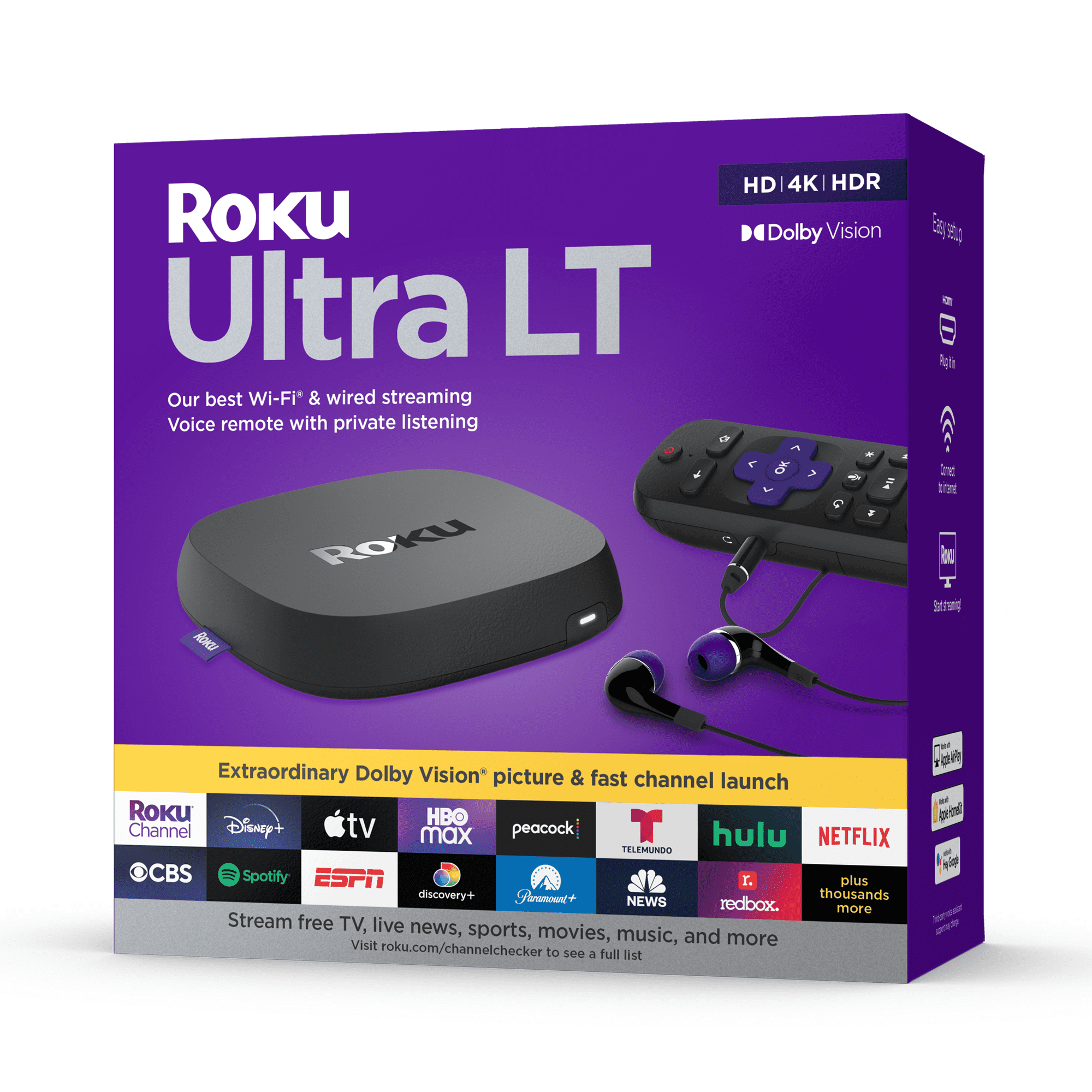
Roku Ultra LT
A still-useful value-oriented Roku box whose Ethernet, Dolby Vision and private listening keep it relevant despite its older platform.
- Ethernet and Dolby Vision at a lower price than the flagship Ultra
- Simple Roku interface with broad app support
- Remote private listening is useful at night
- Navigation and app responsiveness trail the current Roku Ultra because the older hardware has less processing headroom
- Fewer premium remote features than the current Ultra
- Platform extras are more limited than newer premium boxes
Ethernet, Dolby Vision and private listening give the Ultra LT a practical feature mix that inexpensive streaming sticks rarely combine in one box. Its wired-network option, straightforward Roku interface and headphone-equipped voice remote make it especially useful for households that value stable fixed-installation streaming and late-night viewing without adding adapters or separate audio hardware.
Navigation remains usable and 4K HDR playback is dependable, but the older platform does not match the fluidity of the current Ultra or Apple TV 4K.
The long-running Roku platform and large Walmart owner pool provide substantial field history, with no single recurring hardware failure theme dominating current feedback.
- Buyers prioritizing the fastest current hardware or the newest remote and smart-home features.
| Resolution | 4K HDR |
|---|---|
| HDR | Dolby Vision, HDR10+, HDR10 |
| Network | Dual-band Wi-Fi and Ethernet |
| Remote | Voice remote with headphone jack |
| Storage Expansion | microSD on legacy LT configuration |

Roku Streaming Stick 4K
A strong middle-ground Roku that keeps the platform’s simple interface while adding Dolby Vision and dependable mainstream 4K capability.
- Dolby Vision support at a moderate price
- Simple Roku interface with very broad app availability
- Compact stick design is easy to hide behind a TV
- Navigation and app responsiveness are slower than the stronger Roku Ultra and premium set-top boxes
- No built-in Ethernet
- Voice and smart-home ecosystem is narrower than Google or Amazon premium platforms
Dolby Vision, HDR10+ and Roku’s long-range Wi-Fi receiver give this small stick better home-theater credentials than entry-level 4K players. Combining those formats with Roku’s broad app catalog, straightforward voice remote and familiar tile-based interface makes it a particularly easy upgrade for buyers who want better HDR support without moving to a premium set-top box.
4K HDR playback is strong and the interface remains easy to navigate, though app launches and heavy menu use are less immediate than on Roku Ultra or Apple TV 4K.
Roku’s established app platform is a reliability advantage for service availability, but the Stick has less thermal and processing headroom than the Ultra and relies entirely on wireless networking. Our research found no wider pattern of failures.
- Home theaters that require built-in Ethernet or premium-box performance.
| Resolution | 4K up to 60 fps |
|---|---|
| HDR | Dolby Vision, HDR10+, HDR10, HLG |
| Network | Dual-band Wi-Fi with long-range receiver |
| Remote | Roku Voice Remote |
| Form Factor | HDMI stick |

Amazon Fire TV Stick 4K Max (2nd Gen)
A powerful streaming stick with premium HDR/audio support and unusually strong wireless hardware, held back mainly by Fire TV’s promotional interface.
- Excellent format support and fast Wi-Fi 6E hardware
- 16GB storage is generous for a streaming stick
- Strong Alexa and cloud-gaming ecosystem
- Fire TV interface gives ads and Amazon content heavy prominence
- No Ethernet without an adapter
- Some owner reports mention buffering or remote-response problems
Wi-Fi 6E, 16GB of storage, Dolby Vision, HDR10+ and Dolby Atmos give the 4K Max a premium specification set in a tiny HDMI-stick format. Fast Fire TV performance, Alexa integration and cloud-gaming support make those capabilities work together particularly well for Amazon-centric households that want more headroom than the cheaper Fire TV sticks provide.
App launches and navigation are quick for a stick-class device, and 4K HDR streaming is strong when network conditions are good. The 16GB storage pool also reduces app-space pressure versus most rivals.
This model has a very large number of owner reviews. Buffering and remote-response complaints recur at low levels, but the dominant feedback remains positive.
- Buyers wanting an ad-light interface or built-in Ethernet.
| Resolution | 4K Ultra HD |
|---|---|
| HDR | Dolby Vision, HDR10+, HDR10, HLG |
| Audio | Dolby Atmos |
| Storage | 16GB |
| Network | Wi-Fi 6E |
| Memory | 2GB |
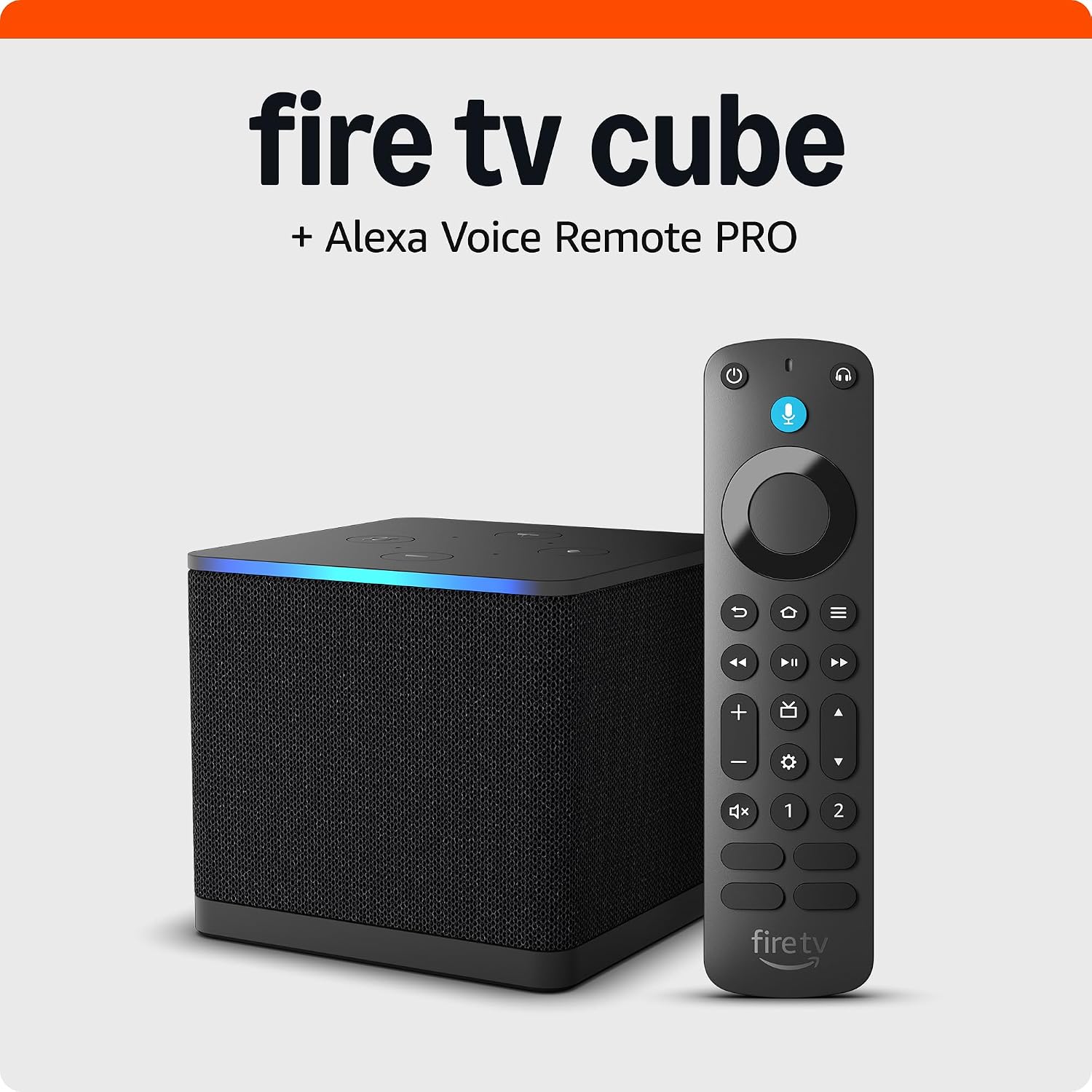
Amazon Fire TV Cube (3rd Gen)
Amazon’s most capable streaming box, combining strong performance and unusual A/V-control flexibility with deep Alexa integration.
- Fastest and most flexible Fire TV hardware
- Hands-free Alexa and HDMI input enable deep A/V control
- Wi-Fi 6E, Ethernet and broad HDR/audio support
- Fire TV interface is heavily promotional
- Price is high versus streaming sticks
- Picture and sound quality do not clearly exceed cheaper premium sticks
The third-generation Cube combines a fast octa-core platform, Wi-Fi 6E, Ethernet, HDMI input and broad Dolby Vision/Atmos support with hands-free Alexa control. That mix lets it operate as both a high-performance streamer and a voice-controlled hub for televisions, receivers and connected sources, a level of home-theater integration that ordinary HDMI sticks cannot match.
The upgraded processor makes the Cube one of the fastest Fire TV devices, while Wi-Fi 6E and wired networking provide strong transport options. Independent A/V testing finds capable but not class-leading picture and sound refinement.
The current generation has a large owner pool and mature Fire OS base. Reported remote and lag complaints exist, but they do not form a dominant product-wide failure pattern.
- Buyers who dislike promotional home screens or simply want low-cost 4K streaming.
| Resolution | 4K Ultra HD |
|---|---|
| HDR | Dolby Vision, HDR10+, HDR10, HLG |
| Audio | Dolby Atmos |
| Network | Wi-Fi 6E and Ethernet |
| Storage | 16GB |
| Ports | HDMI input, HDMI output, USB-A, IR extender |

Amazon Fire TV Stick 4K Plus
A capable mid-tier Fire TV stick that covers premium formats and Wi-Fi 6 while keeping cost below the Max.
- Broad Dolby Vision/HDR10+/Atmos support
- Wi-Fi 6 and solid 4K performance
- Strong Alexa and gaming-service integration
- Navigation and app responsiveness are slower than the stronger Fire TV Stick 4K Max and premium streaming boxes
- Fire TV interface remains ad-heavy
- Wi-Fi 6E and extra storage are reserved for the Max
Dolby Vision, HDR10+, Dolby Atmos, Wi-Fi 6 and 2GB of memory give the 4K Plus the core audiovisual capabilities expected from a modern premium stick. It combines those features with Alexa voice control and broad streaming-app support at a lower price than the Max, making it a strong fit for buyers who do not need Wi-Fi 6E or 16GB storage.
The renamed 4K-class hardware provides smooth mainstream streaming and broad HDR support, though storage capacity and wireless capability trail the Max model.
Amazon maintains the Fire TV software platform actively, and our research found no recurring hardware fault. Long-term usability is more likely to be shaped by software changes, interface advertising and the model’s lower storage and networking headroom than by a documented reliability defect.
- Heavy app users who need 16GB storage or buyers seeking an ad-light home screen.
| Resolution | 4K up to 60 fps |
|---|---|
| HDR | Dolby Vision, HDR10+, HDR10, HLG |
| Audio | Dolby Atmos |
| Storage | 8GB |
| Memory | 2GB |
| Network | Wi-Fi 6 |
How We Evaluate Streaming Devices
Our rankings are built through the Flickthru CORE™ Market Research Engine, which first analyses the category, its intended buyers, and the current US market. Products are then compared using category-specific evidence rather than a generic checklist applied the same way to every product type.
For Streaming Devices specifically, the evaluation focuses on the dimensions that most directly affect real-world performance, everyday usability, ownership experience, and long-term value:
- Streaming Quality & Format Support: We assess real-world 4K playback, HDR formats, audio support, frame-rate handling and whether picture and sound remain consistent across major services.
- Speed & Responsiveness: We assess setup time, app-launch speed, menu smoothness, search responsiveness and how quickly the device moves between services in everyday use.
- Apps, Services & Content: We assess support for major US streaming apps, live-TV services, casting and platform restrictions that can materially affect what you can actually watch.
- Interface & Ease of Use: We assess menu clarity, content discovery, ad clutter, remote usability, search quality and how easy the platform is to live with every day.
- Connectivity & A/V Integration: We assess Wi-Fi and Ethernet options, HDMI behavior, TV and receiver control, Bluetooth or headphone support, casting and practical home-theater integration.
- Voice, Ecosystem & Smart Home: We assess voice search, ecosystem fit, smart-home controls and cross-device features that make the streamer more useful beyond simply opening apps.
- Reliability & Software Support: We assess platform stability, update support, long-term app compatibility and well-documented recurring ownership issues without penalising a product merely for being newer.
- Value & Total Cost: We assess purchase price, useful life, required accessories and any realistic recurring costs against the streaming capability and features delivered.
Products are scored dimension-by-dimension across the same contender field so that the same performance standard is applied consistently to every model. Missing noncritical evidence is left unscored rather than assigned a placeholder score, with the remaining supported dimensions renormalized. Evidence confidence is tracked separately and does not alter product merit.
Documented strengths and weaknesses are cross-checked against the final buyer-facing pros and cons before publication, helping ensure that material scoring findings are reflected in the visible recommendation rather than replaced by generic copy. Read the full Flickthru product ranking methodology.