
Best best bookshelf speakers 2026
A category-specific approach to ranking Best Bookshelf Speakers
Most general product roundups are built around broad buyer priorities. Flickthru evaluates best bookshelf speakers for buyers choosing bookshelf speakers for music, TV, movies, desktop listening or a compact hi-fi system who want strong sound quality without moving to full-size floorstanding speakers. The ranking should identify the best overall bookshelf speakers by focusing on tonal accuracy, clarity and detail, stereo imaging and soundstage, bass extension and control, dynamics, listening fatigue, room-friendliness and placement flexibility, build quality, amplifier compatibility and sensitivity, reliability, owner validation, and overall value. Powered and passive models should only be compared where their intended use and total system cost can be assessed fairly, prioritising tonal accuracy & clarity, imaging & soundstage, bass extension & control, dynamics & clean output, and room & placement flexibility.

KEF Q3 Meta
The Q3 Meta’s concentric driver and controlled voicing create a broad sweet spot with strong clarity, useful bass depth and excellent stereo organization.
- Excellent imaging with a broad, stable sweet spot
- Mature, even-handed tonal balance
- Strong clarity and detail resolution
- Good bass weight for a mid-size standmount
- Best balance needs some distance from the rear wall
- Four-ohm load rewards a competent amplifier
- Cabinets are relatively bulky for compact-room use
The KEF Q3 Meta uses its concentric Uni-Q driver and refined crossover behavior to keep voices, instruments and spatial cues coherent across a notably broad listening area. Strong clarity, substantial bass for the cabinet size and stable imaging combine into a versatile presentation that works well for both focused stereo listening and less rigid room layouts.
Independent measurements and comparative listening point to smooth integration, wide useful dispersion and strong stereo organization. Bass is substantial for the size, while the rear port means placement still matters.
KEF Q3 Meta is a strong choice for buyers wanting precise imaging, broad dispersion and a refined all-round sound.
- Very tight wall-mounted spaces or systems built around a weak amplifier.

SVS Ultra Evolution Bookshelf
Ultra Evolution Bookshelf produces more low-frequency weight and dynamic scale than most similarly sized rivals while keeping the presentation smooth and listenable.
- Exceptional bass extension and physical weight for a two-way standmount
- Very strong clean output and dynamic punch
- Smooth, non-fatiguing overall balance
- Excellent cabinet finish and build
- Imaging precision is very good rather than the field’s absolute best
- Passive design still requires external amplification
- Large, substantial cabinets need proper stands and space
The SVS Ultra Evolution Bookshelf combines unusually deep low-frequency reach with strong dynamic punch, giving kick drums, bass lines and movie effects more physical weight than most similarly sized standmounts. Its smooth treble and clean midrange keep that scale controlled and listenable, so the speaker delivers near-floorstander authority without sacrificing the clarity expected from a high-quality bookshelf design.
Current hands-on testing supports exceptional bass depth, strong dynamics and a smooth, weighty balance. Imaging is still very good, but the speaker emphasizes physical scale and body more than the most surgically precise rivals.
SVS Ultra Evolution Bookshelf is a strong choice for buyers wanting near-floorstander bass and dynamics from a bookshelf-sized speaker.
- Small desktops or listeners prioritizing the narrowest cabinet and pin-point imaging above scale.

Q Acoustics 5020
The 5020 combines crisp detail, focused imaging and strong cabinet engineering at a price that undercuts many similarly capable standmounts.
- Excellent stereo imaging and instrumental separation
- Very strong detail and clarity
- Outstanding value for the performance level
- Flexible enough for small-to-medium listening rooms
- Upper register can sound bright with some recordings
- Amplifier choice affects balance and drive
- Upper-bass weight is more restrained than some warmer rivals
The Q Acoustics 5020 delivers crisp detail, strong center focus and unusually clear separation between instruments, helping dense mixes remain easy to follow. Its rigid cabinet design and responsive mid/bass driver support a spacious stereo presentation, while the attainable system price makes that combination of resolution and imaging accessible without moving into premium standmount territory.
Independent listening evidence consistently supports excellent imaging and clarity. The tonal balance can lean brighter than more relaxed rivals, and upper-bass weight is not the strongest in the field.
Q Acoustics 5020 is a strong choice for buyers seeking high clarity, imaging precision and strong value.
- Listeners who strongly prefer a dark, laid-back tonal balance.

Acoustic Energy AE300 Mk2
AE300 Mk2 succeeds through integration rather than spectacle, combining refined treble, articulate bass and a coherent midrange in an easy-to-match standmount.
- Balanced, natural tonality across varied music
- Excellent driver integration and low-fatigue treble
- Controlled, articulate bass
- Strong value against similarly priced audiophile rivals
- Does not deliver the deepest bass in the field
- Best imaging needs proper stands and modest toe-in
- Matte finishes can show handling marks
The Acoustic Energy AE300 Mk2 integrates its tweeter and mid/bass driver with unusual smoothness, giving vocals, instruments and transients a natural continuity that works across very different recordings. Controlled bass, refined treble and precise layering reinforce that balance, creating an unfussy speaker that reveals plenty of detail without demanding a narrow range of music or electronics.
Professional listening supports a notably even-handed balance, clean integration and articulate bass. Absolute low-frequency depth is less ambitious than the largest designs, but control is excellent.
Acoustic Energy AE300 Mk2 is a strong choice for listeners wanting an unfussy, natural speaker that works across many genres and amplifiers.
- Buyers chasing maximum low-bass output from a standmount alone.

Focal Aria Evo X N°1
Aria Evo X N°1 emphasizes smoothness, vocal presence and upscale construction, delivering an easy long-session presentation with serious dynamic capability.
- Beautifully refined vocal and midrange presentation
- Smooth, relaxed treble for long listening sessions
- Strong dynamic capability and scale
- Premium construction and finish
- High pair price is a significant value disadvantage
- Best performance rewards careful amplifier matching
- Premium system cost rises further once suitable stands and amplification are included
The Focal Aria Evo X N°1 brings a particularly polished vocal range, smooth upper frequencies and substantial dynamic scale to a compact premium cabinet. Its flax-cone mid/bass driver and refined tweeter integration give voices and acoustic instruments convincing texture, while the composed overall balance makes the speaker especially rewarding for long, detail-focused listening sessions.
Hands-on testing evidence highlights strong vocal presence, smoothness and a relaxed balance, with good scale and dynamics. The presentation favors refinement over hyper-explicit spatial etching.
Focal Aria Evo X N°1 is a strong choice for listeners who value refined vocals, smooth tonality and premium construction.
- Value-first buyers or systems built around inexpensive amplification.

Wharfedale Super Denton
Super Denton delivers a large, full-bodied presentation from a compact three-way cabinet, with convincing bass extension and an expressive midrange.
- Rich, full tonal balance with strong midrange presence
- Excellent bass weight for a standmount enclosure
- Large, layered soundstage
- Three-way design handles complex music cleanly
- Rear port and measured behavior reward careful placement away from walls
- Six-ohm load and voicing benefit from thoughtful amplifier matching
- Premium heritage pricing weakens total-system value
Wharfedale’s Super Denton uses a rare compact three-way layout to separate bass, midrange and treble duties more cleanly than most two-way rivals, giving voices and instruments generous body. Its strong low-frequency weight, broad presentation and relaxed midband character create a convincingly full-scale listening experience from a cabinet that remains manageable in a normal room.
Independent testing measured and listening evidence supports strong low-frequency output and a spacious presentation, with a rich midrange balance. The speaker is less placement-agnostic than the field leaders and benefits from careful amplifier and room matching.
Wharfedale Super Denton is a strong choice for listeners who want full-bodied standmount sound with strong bass and a spacious presentation.
- Near-wall installations or shoppers prioritizing compact size and lowest total cost.

PMC Prodigy1
Prodigy1 delivers striking clarity, precision and dynamic expression from a small cabinet, but extracting its best performance requires serious partnering electronics.
- Exceptional clarity and resolution
- Precise, organized imaging
- Strong dynamic expression
- Transmission-line design gives useful bass depth from a compact cabinet
- Amplifier matching is demanding enough to raise total system cost
- Premium price produces weak value beside excellent midrange rivals
- Small cabinet cannot match the deepest-bass designs
PMC’s Prodigy1 uses transmission-line loading to extract surprising bass extension from a compact cabinet while preserving fast, sharply defined transients and precise stereo placement. Its clear midrange, tightly organized imaging and ability to separate complex musical layers give recordings a focused, monitor-like presentation that suits listeners who value resolution and spatial precision.
Hands-on testing supports excellent clarity, organization and dynamics. Bass depth is impressive for the size, though overall system performance depends strongly on amplifier quality.
PMC Prodigy1 is a strong choice for detail-focused listeners willing to invest in suitable amplification.
- Budget-limited systems or buyers looking for effortless low-power amplifier matching.

Polk Audio Polk Reserve R200
Reserve R200 combines substantial bass output and strong dynamic capability with mostly neutral voicing at an aggressive price.
- Strong bass extension and control for the size
- Very good dynamic headroom
- Generally neutral overall tonal balance
- Excellent value at current-market pricing
- Upper-treble dispersion is narrower than the broadest-dispersion rivals, so off-axis placement is less forgiving
- Amplifier/system matching is less forgiving than easier loads
- Midrange measurements show a small coloration region
The Polk Reserve R200 couples a substantial 6.5-inch mid/bass driver with a high-output tweeter system to deliver bass weight and dynamic punch beyond many similarly priced standmounts. Its generally neutral balance and focused stereo placement keep that physical authority organized, making it especially persuasive for buyers who want energetic music playback without stepping up to larger cabinets.
Controlled measurements support strong bass extension, good tonality and focused imaging, while also showing narrower high-frequency dispersion and a modest midrange imperfection.
Polk Audio Polk Reserve R200 is a strong choice for buyers wanting strong bass, dynamics and value from a conventional passive speaker.
- Listeners who need the widest off-axis treble response or very low-power amplification.
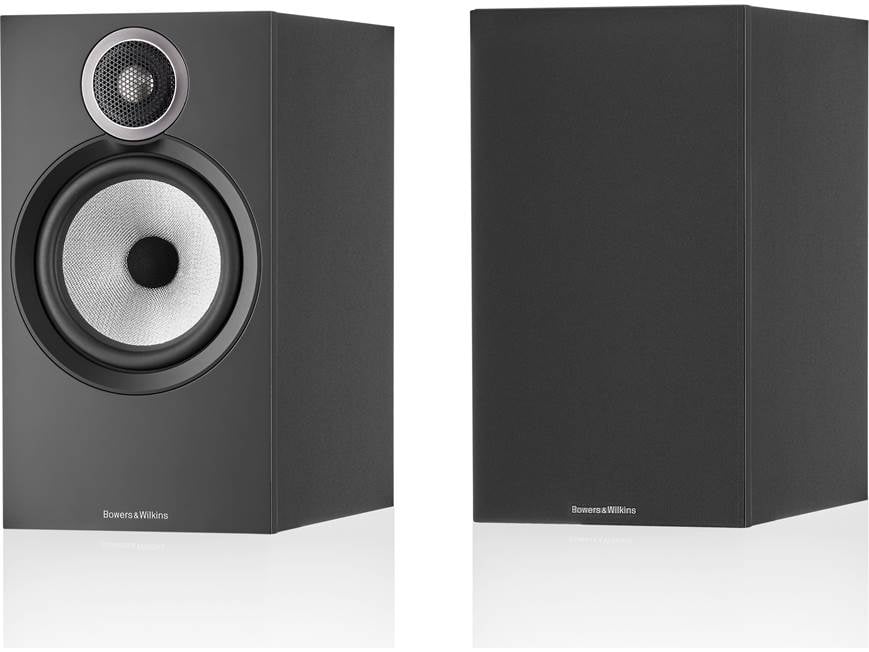
Bowers & Wilkins 606 S3
The 606 S3 produces a wide, detailed and refined presentation with convincing bass scale, but its system requirements make it less universally easy to recommend.
- Large, open soundstage
- Strong clarity, detail and refinement
- Good bass punch and scale
- High-quality cabinet and driver construction
- Placement is demanding because the rear port and voicing need space and careful positioning
- Amplifier matching is a significant requirement for best balance
- High speaker price plus amplification and stands creates a major value disadvantage
The Bowers & Wilkins 606 S3 combines a substantial Continuum-cone mid/bass driver with a refined titanium tweeter to produce a large, open presentation with clear vocal and instrumental detail. Its generous soundstage, strong bass punch and ability to play cleanly at realistic levels give music impressive scale from a conventional standmount cabinet.
Hands-on testing supports excellent clarity, spaciousness and useful dynamics. The speaker benefits strongly from thoughtful amplifier and placement choices, which reduces ease of system integration.
Bowers & Wilkins 606 S3 is a strong choice for listeners who value a spacious, detailed presentation and are willing to optimize the system around it.
- Budget-focused buyers or near-wall/desktop installations.

Triangle AIO Twin
AIO Twin combines amplification, streaming and a genuine stereo pair in one package, delivering engaging imaging and excellent usability for compact systems.
- Excellent powered-system flexibility and input selection
- Strong imaging with a spacious presentation
- Simple all-in-one ownership with no external amplifier needed
- Good value once amplification and streaming are included
- Deep bass is limited compared with the strongest passive designs
- Maximum dynamics are only adequate for large-room/high-level use
- Integrated amplification/network electronics create more reliability dependencies
The Triangle AIO Twin integrates amplification, network streaming, digital inputs and a true stereo speaker pair into a compact system that needs no separate electronics. Clear vocals, lively timing and a spacious soundfield combine with unusually broad source flexibility, making it a practical route to real hi-fi stereo for buyers who want fewer boxes.
Independent listening consistently supports an engaging, spacious and clean presentation. Deep bass and ultimate large-room dynamics remain below the strongest passive speakers in the field.
The integrated electronics and network platform add more failure/support dependencies than passive designs; no recurring defect pattern was established, but this architecture justifies lower reliability merit.
- Large-room listeners chasing maximum bass depth and very high output.
How We Evaluate Best Bookshelf Speakers
Our rankings are built through the Flickthru CORE™ Market Research Engine, which first analyses the category, its intended buyers, and the current US market. Products are then compared using category-specific evidence rather than a generic checklist applied the same way to every product type.
For Best Bookshelf Speakers specifically, the evaluation focuses on the dimensions that most directly affect real-world performance, everyday usability, ownership experience, and long-term value:
- Tonal Accuracy & Clarity: Assesses balanced frequency response, natural vocals and instruments, treble smoothness, fine detail and whether long listening stays free of obvious harshness or coloration.
- Imaging & Soundstage: Measures stereo placement, center-image stability, stage width and depth, and how consistently the presentation holds together across realistic listening positions.
- Bass Extension & Control: Looks at how deep the speakers reach, how cleanly and evenly bass notes are reproduced, and how well low frequencies remain controlled in normal rooms.
- Dynamics & Clean Output: Evaluates transient punch, clean listening level, compression and whether the speakers stay composed when music or movie peaks become demanding.
- Room & Placement Flexibility: Assesses how forgiving the speakers are of walls, stands or desktops, room size, toe-in and less-than-perfect listening positions.
- System Compatibility: Checks amplifier demands, sensitivity and impedance for passive models, or built-in amplification, inputs and system flexibility for powered models, so total setup requirements are compared fairly.
- Build, Reliability & Support: Looks at cabinet and hardware quality, recurring driver or electronics problems and support quality, while treating limited history on newer models as uncertainty rather than a merit penalty.
- Value & Total Cost: Judges performance against the real US cost of a usable system, including required amplification or accessories where relevant rather than comparing speaker sticker prices alone.
- Owner Review Validation: Uses verified or purchase-linked owner sentiment to validate real-world strengths and weaknesses; review volume affects confidence only, not merit.
Products are scored dimension-by-dimension across the same contender field so that the same performance standard is applied consistently to every model. Missing noncritical evidence is left unscored rather than assigned a placeholder score, with the remaining supported dimensions renormalized. Evidence confidence is tracked separately and does not alter product merit.
Documented strengths and weaknesses are cross-checked against the final buyer-facing pros and cons before publication, helping ensure that material scoring findings are reflected in the visible recommendation rather than replaced by generic copy. Read the full Flickthru product ranking methodology.