
Best Internal SSDs for Gaming PCs 2026
Already have an SSD? You may not need to buy one
If your PC already has an SSD with enough free space (often the C: drive), move the game onto it for free:
- Steam: Settings → Storage → add the SSD if it isn’t listed → tick the game → Move.
- Other launchers: reinstall the game and choose a folder on the SSD.
No SSD, or not enough space? The top 10 CORE™ rated internal SSDs are below.
A category-specific approach to ranking Internal SSDs For Gaming PCs
Most general product roundups are built around broad buyer priorities. Flickthru evaluates internal SSDs for gaming PCs for PC gamers whose games load slowly or hang from a hard drive, who need to identify the best internal SSD (M.2 NVMe or 2.5-inch SATA) to install in their desktop for faster game loading, prioritising gaming load & streaming performance, everyday random responsiveness, capacity & game-library fit, large installs & transfers, and reliability, endurance & support.

Samsung 9100 Pro
The 9100 Pro combines excellent all-round performance with a product family that reaches unusually large capacities. That flexibility matters for a premium gaming PC intended to keep a very large library on one primary drive.
- Very high all-around Gen5 performance
- Excellent random performance with dedicated DRAM
- Unusually broad capacity range including 8TB
- Premium pricing is difficult to justify for gaming alone
- Its premium pricing is difficult to recover through game-loading improvements alone
- Gaming-only builds where paying for top-tier Gen5 bandwidth brings little practical benefit
Flagship Gen5 throughput, strong low-queue responsiveness and an 8TB-capable product family give the 9100 Pro an unusually broad enthusiast profile. Its dedicated DRAM, mature management software and high-capacity options work together particularly well for a premium gaming PC that needs both rapid storage response and room for a very large modern game library.
Both sequential and random performance are high, with strong behavior across mixed workloads. Some real file transfers narrow the gap to other premium drives, but overall responsiveness remains excellent.
The 2TB model is rated for 1,200 TBW and carries a five-year limited warranty. Samsung also provides mature health and firmware tools, which strengthens the support side of the ownership proposition.
- Gaming-only builds where paying for top-tier Gen5 bandwidth brings little practical benefit.
| Form Factor | M.2 2280 |
|---|---|
| Interface | PCIe 5.0 x4 |
| Reference Capacity | 2TB |
| NAND | TLC |
| Cache | DRAM |
| Sequential Read (MB/s) | 14800 |
| Sequential Write (MB/s) | 13400 |
| Endurance (TBW, 2TB) | 1200 |

WD Black SN7100
The SN7100 concentrates its strengths where a gaming PC feels them most: low-queue responsiveness, fast loading behavior and efficient operation. Its 2TB model also carries a strong endurance rating without requiring elaborate cooling.
- Outstanding random-4K read responsiveness
- Excellent gaming performance without Gen5 pricing
- Very low power draw and cool operation
- Large sequential transfers are below flagship Gen5 drives
- HMB design can trail DRAM-equipped drives in some random-write and heavy-transfer workloads
- Its ceiling is PCIe 4.0, so large sequential transfers cannot match flagship Gen5 drives
Outstanding low-queue random reads, strong game-loading behavior and exceptionally low power draw target the storage traits a gaming PC uses constantly. Combined with near-ceiling Gen4 sequential speed and a 1,200 TBW rating at 2TB, those strengths deliver a fast, cool and durable game-drive profile without relying on headline Gen5 bandwidth.
Low-queue random reads are a standout, while sequential throughput sits near the practical ceiling of PCIe 4.0. That balance favors game launches, level streaming and everyday desktop work over benchmark-only bandwidth.
The 2TB version is rated for 1,200 TBW and a five-year limited warranty. Those figures support heavy consumer use, although endurance ratings do not by themselves predict individual-drive failure rates.
- Workstations that routinely move very large files and can exploit full-speed PCIe 5.0 transfers.
| Form Factor | M.2 2280 |
|---|---|
| Interface | PCIe 4.0 x4 |
| Reference Capacity | 2TB |
| NAND | TLC |
| Cache | DRAM-less/HMB |
| Sequential Read (MB/s) | 7250 |
| Sequential Write (MB/s) | 6900 |
| Endurance (TBW, 2TB) | 1200 |

WD Black SN8100
The SN8100 is one of the rare flagship Gen5 drives whose strength extends beyond sequential benchmarks. It pairs very high throughput with responsive random access and strong sustained behavior for an enthusiast gaming system.
- Exceptional game-load and random-read performance
- Very high Gen5 throughput without sacrificing desktop responsiveness
- 2TB model carries a five-year warranty and 1,200 TBW endurance
- Costs more than strong Gen4 gaming drives
- PCIe 5.0 capability brings limited visible gains in many current games
- The extra bandwidth costs more and produces smaller gaming gains than the specification gap suggests
Near-15 GB/s sequential throughput is paired with unusually strong random access and game-loading behavior, so the SN8100 offers more than a synthetic bandwidth headline. Its DRAM-backed design, 1,200 TBW endurance rating and broad high-end performance make it especially well suited to enthusiast PCs that combine gaming with frequent large installs and transfers.
Independent testing measured behavior is strong across game loads, low-queue random access and large transfers, with sequential throughput approaching the practical limit of a four-lane PCIe 5.0 link.
The 2TB reference model carries a five-year limited warranty and a 1,200 TBW endurance rating. That is a solid specification for a high-performance consumer drive, while real failure risk still depends on factors beyond TBW.
- Budget-focused systems where a modern Gen4 drive already delivers similar game-loading feel.
| Form Factor | M.2 2280 |
|---|---|
| Interface | PCIe 5.0 x4 |
| Reference Capacity | 2TB |
| NAND | TLC |
| Cache | DRAM |
| Sequential Read (MB/s) | 14900 |
| Sequential Write (MB/s) | 14000 |
| Endurance (TBW, 2TB) | 1200 |

WD Black SN850X
The SN850X remains useful because it combines proven high-end Gen4 behavior with capacities that extend far beyond the typical 2TB sweet spot. It is especially attractive when one fast drive must hold a very large library.
- Still excellent gaming and everyday performance
- Very broad capacity range up to 8TB
- Mature Gen4 platform with optional heatsink
- Random-4K responsiveness is no longer class-leading
- Newer Gen4 designs can match gaming performance for less
- Newer gaming SSDs can deliver stronger random responsiveness at similar or lower cost
Near-ceiling Gen4 throughput, dedicated DRAM and capacity options reaching 8TB give the SN850X a rare combination of speed and library flexibility. That breadth makes it particularly useful in gaming PCs where one primary SSD needs to hold a very large collection while still delivering consistently fast launches, installs and general desktop responsiveness.
Sequential performance is near the Gen4 ceiling and game behavior remains strong, although newer designs now deliver better low-queue random responsiveness. Large-transfer performance is still competitive for its interface generation.
The 2TB model carries a five-year limited warranty and a 1,200 TBW rating. Its long market life provides substantial usage history, while the endurance figure itself remains a write-limit specification rather than a failure-rate measure.
- New value-focused builds where newer Gen4 drives provide better random performance per dollar.
| Form Factor | M.2 2280 |
|---|---|
| Interface | PCIe 4.0 x4 |
| Reference Capacity | 2TB |
| NAND | TLC |
| Cache | DRAM |
| Sequential Read (MB/s) | 7300 |
| Sequential Write (MB/s) | 6600 |
| Endurance (TBW, 2TB) | 1200 |
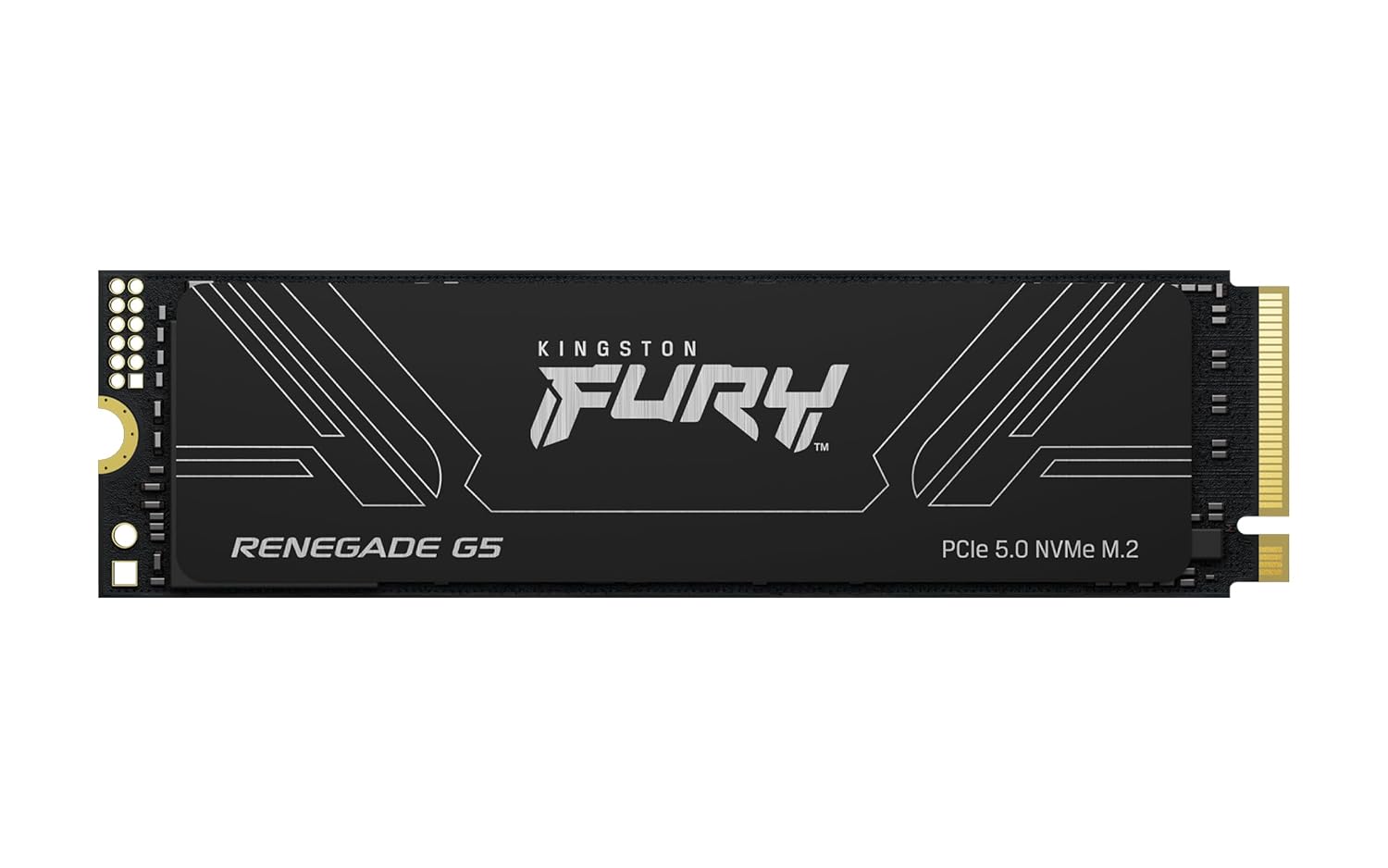
Kingston Fury Renegade G5
The Fury Renegade G5 combines flagship sequential speed with sustained transfer strength that matters during very large installs and file moves. Its 2TB endurance specification is also substantially higher than many direct competitors.
- Near-top Gen5 performance across mixed workloads
- Excellent sustained large-write behavior
- Exceptional 2,000 TBW endurance rating at 2TB
- Random performance trails the very best rivals
- Premium pricing limits its gaming value
- Its current 2TB price is unusually high relative to equally capable gaming alternatives
Near-top Gen5 throughput combines with exceptionally strong sustained writing and a 2,000 TBW endurance rating at 2TB. That mix gives the Fury Renegade G5 unusual appeal in a gaming PC that also absorbs frequent large installs, recordings or project files, because it maintains high transfer performance while offering a much larger rated write allowance than many rivals.
Sequential and sustained-write performance are major strengths, while low-queue random responsiveness is strong rather than class-leading. The result suits systems that mix gaming with large-volume storage work.
A 2,000 TBW rating at 2TB is unusually high for this class, paired with a five-year limited warranty. The rating indicates substantial write allowance but should not be read as a measured failure-rate guarantee.
- Gaming-only builds where current 2TB purchase price is the dominant concern.
| Form Factor | M.2 2280 |
|---|---|
| Interface | PCIe 5.0 x4 |
| Reference Capacity | 2TB |
| NAND | TLC |
| Cache | DRAM |
| Sequential Read (MB/s) | 14700 |
| Sequential Write (MB/s) | 14000 |
| Endurance (TBW, 2TB) | 2000 |

Samsung 990 Pro
The 990 Pro remains a balanced premium Gen4 option rather than a specialist. Its mix of random responsiveness, efficient operation and polished management tools keeps it competitive for gaming and general desktop use.
- Excellent all-round Gen4 performance
- Strong low-queue random reads and mature management software
- Good efficiency with 4TB capacity available
- Large sustained writes are not class-leading
- Often costs more than similarly fast Gen4 alternatives
- Its current price leaves less room between it and newer Gen5 alternatives
Strong low-queue responsiveness, near-ceiling Gen4 throughput and mature drive-management software give the 990 Pro a particularly polished all-round profile. Dedicated DRAM, efficient operation and a 4TB-capable family reinforce that balance, making it well suited to gaming PCs that need fast daily response, straightforward maintenance and enough capacity for a substantial library.
Low-queue random reads and everyday mixed workloads are strong, while very long writes are less dominant than the best sustained-transfer drives. Sequential throughput sits close to the practical Gen4 limit.
The 2TB model is rated for 1,200 TBW with a five-year limited warranty. Firmware and health-management tooling adds useful ownership support without proving a different underlying failure rate.
- Shoppers focused primarily on lowest 2TB cost or maximum Gen5 sequential bandwidth.
| Form Factor | M.2 2280 |
|---|---|
| Interface | PCIe 4.0 x4 |
| Reference Capacity | 2TB |
| NAND | TLC |
| Cache | DRAM |
| Sequential Read (MB/s) | 7450 |
| Sequential Write (MB/s) | 6900 |
| Endurance (TBW, 2TB) | 1200 |

Corsair MP700 Elite
The MP700 Elite gives up some peak sequential speed in exchange for a cooler, more efficient Gen5 design. That trade is sensible for gaming, where low-queue behavior matters more often than maximum large-file bandwidth.
- Excellent random-4K responsiveness
- Exceptional thermal and power efficiency for Gen5
- Strong gaming-oriented performance without flagship controller power draw
- Poor value at the current $459.99 2TB reference price compared with faster or similarly responsive alternatives
- Sustained large-transfer performance is weaker than the leading Gen5 drives despite strong random responsiveness
Excellent low-queue random responsiveness and exceptionally low Gen5 power draw make the MP700 Elite especially well matched to gaming workloads. Its TLC NAND, 1,200 TBW rating and cool-running controller combine with 10 GB/s-class sequential speed to deliver a responsive drive that avoids much of the thermal overhead associated with full-bandwidth flagship Gen5 models.
Random 4K responsiveness is a clear strength, while sequential throughput is below full-speed Gen5 flagships. Real large-file transfers can resemble strong Gen4 drives despite the newer interface.
The 2TB model is rated for 1,200 TBW and carries a five-year limited warranty. That provides a solid write allowance, while the simpler low-power controller may also reduce thermal stress without proving a failure-rate advantage.
- Workstations built around maximum sequential transfer rates above 10 GB/s.
| Form Factor | M.2 2280 |
|---|---|
| Interface | PCIe 5.0 x4 |
| Reference Capacity | 2TB |
| NAND | TLC |
| Cache | DRAM-less/HMB |
| Sequential Read (MB/s) | 10000 |
| Sequential Write (MB/s) | 8500 |
| Endurance (TBW, 2TB) | 1200 |

Lexar Professional NM1090 Pro
The NM1090 Pro offers a credible high-end package with dedicated DRAM and a healthy 2TB endurance rating. It is strongest as an all-round performance drive rather than a sustained-transfer specialist.
- Fast overall Gen5 performance
- Dedicated DRAM supports stronger random behavior
- Above-average 1,400 TBW endurance at 2TB
- Large sustained writes lag direct Gen5 DRAM rivals
- Does not clearly lead its price class in gaming performance
- Its performance drops more sharply than the leaders during very large sustained writes
Dedicated DRAM, fast Gen5 throughput and a 1,400 TBW endurance rating give the NM1090 Pro a solid foundation for a high-performance gaming PC. Those traits combine particularly well for buyers who want responsive everyday use, strong peak transfer speed and a larger-than-average rated write allowance in the same 2TB drive.
Everyday and peak throughput are strong, but very large writes expose a meaningful drop relative to the best Gen5 competitors. Random behavior remains suitable for a responsive gaming system.
Lexar rates the 2TB model for 1,400 TBW and a five-year limited warranty. That write allowance is above several 1,200 TBW peers, though it is not direct evidence of lower failure rates.
- Systems that routinely sustain hundreds of gigabytes of uninterrupted write traffic.
| Form Factor | M.2 2280 |
|---|---|
| Interface | PCIe 5.0 x4 |
| Reference Capacity | 2TB |
| NAND | TLC |
| Cache | DRAM |
| Sequential Read (MB/s) | 14000 |
| Sequential Write (MB/s) | 13000 |
| Endurance (TBW, 2TB) | 1400 |

Corsair MP700 Pro XT
The MP700 Pro XT is engineered for sustained high-end storage rather than gaming value. It combines near-interface-limit sequential performance with a large write allowance and unusually efficient behavior for its class.
- Extremely high Gen5 throughput
- Excellent power efficiency for flagship performance
- Very high endurance specification
- Extremely poor value at the current $1,379.99 2TB reference price, which overwhelms its performance advantage for a gaming PC
- Low-queue random responsiveness trails the strongest gaming-focused drives despite exceptional sequential throughput
Near-15 GB/s throughput, strong sustained-write behavior and a high rated write allowance give the MP700 Pro XT exceptional heavy-workload capability. Its efficient modern controller adds another practical strength, allowing an enthusiast gaming workstation to combine very large installs, frequent transfers and demanding content work without accepting the power behavior of many earlier full-speed Gen5 designs.
Peak throughput is among the fastest available and sustained behavior remains strong, while low-queue random results are good rather than dominant. It is most compelling when large-file work accompanies gaming.
The 2TB model carries a five-year limited warranty and a high rated write allowance. That endurance specification is a genuine strength for write-heavy use, while it still should not be treated as a measured failure-rate guarantee.
- Gaming-only systems where purchase price and low-queue response matter more than maximum bandwidth.
| Form Factor | M.2 2280 |
|---|---|
| Interface | PCIe 5.0 x4 |
| Reference Capacity | 2TB |
| NAND | TLC |
| Cache | DRAM |
| Sequential Read (MB/s) | 14900 |
| Sequential Write (MB/s) | 14500 |
| Endurance (TBW, 2TB) | 2800 |

Samsung 990 EVO Plus
The 990 EVO Plus favors efficiency and capacity flexibility over maximum responsiveness. It suits mainstream systems better than performance-focused gaming builds that regularly stress random access or large writes.
- Very cool and power-efficient operation
- Up to 4TB capacity with a five-year warranty
- Strong sequential speed for a mainstream HMB drive
- Poor value at the current $579.99 2TB reference price for a drive with weaker gaming-focused random responsiveness
- Low-queue random reads and sustained long-write behavior trail the stronger gaming SSDs in this field
Very low power draw, cool operation and a product family reaching 4TB give the 990 EVO Plus an easy-to-integrate mainstream profile. Its strong sequential speed, single-sided design and mature management software work together well for gaming PCs where thermal simplicity and library capacity matter more than class-leading low-queue random performance.
Sequential speeds are strong for its class, but low-queue random reads and game-loading behavior trail the better gaming SSDs. Long writes also slow substantially after the dynamic cache is exhausted.
Samsung rates the 2TB model for 1,200 TBW and a five-year limited warranty. The endurance specification is solid for mainstream use, while mature management tooling adds practical ownership support.
- Performance-led builds where low-queue random response and heavy sustained writes are priorities.
| Form Factor | M.2 2280 |
|---|---|
| Interface | PCIe 4.0 x4 / 5.0 x2 |
| Reference Capacity | 2TB |
| NAND | TLC |
| Cache | DRAM-less/HMB |
| Sequential Read (MB/s) | 7250 |
| Sequential Write (MB/s) | 6300 |
| Endurance (TBW, 2TB) | 1200 |
How We Evaluate Internal SSDs For Gaming PCs
Our rankings are built through the Flickthru CORE™ Market Research Engine, which first analyses the category, its intended buyers, and the current US market. Products are then compared using category-specific evidence rather than a generic checklist applied the same way to every product type.
For Internal SSDs For Gaming PCs specifically, the evaluation focuses on the dimensions that most directly affect real-world performance, everyday usability, ownership experience, and long-term value:
- Gaming load & streaming performance: Measures real game loading, saving, installing and asset-streaming behavior, prioritizing gaming traces and hands-on tests over advertised sequential speed.
- Everyday random responsiveness: Measures low-queue random and mixed-access responsiveness that reflects common Windows and game-file access patterns during normal play and desktop use.
- Capacity & game-library fit: Assesses whether available capacities suit modern game libraries, with like-for-like comparison centered on a practical 2TB gaming-PC configuration.
- Reliability, endurance & support: Assesses rated endurance, warranty and firmware support plus well-documented reliability patterns for each model, without penalizing newer drives merely for shorter history.
- Value & total ownership cost: Compares like-for-like US purchase cost, usable capacity, warranty, endurance and expected replacement burden rather than rewarding headline speed alone.
- Large installs & transfers: Assesses sustained performance during large game installs, patches, verification and file moves, including behavior after fast write cache is exhausted.
- Thermals & power efficiency: Assesses heat, throttling risk, cooling needs and power draw so a drive can sustain its intended performance in a normal gaming desktop.
Products are scored dimension-by-dimension across the same contender field so that the same performance standard is applied consistently to every model. Missing noncritical evidence is left unscored rather than assigned a placeholder score, with the remaining supported dimensions renormalized. Evidence confidence is tracked separately and does not alter product merit.
Documented strengths and weaknesses are cross-checked against the final buyer-facing pros and cons before publication, helping ensure that material scoring findings are reflected in the visible recommendation rather than replaced by generic copy. Read the full Flickthru product ranking methodology.