
Best Streaming Devices for 4K 2026
A category-specific approach to ranking 4K Streaming Devices
Most general product roundups are built around broad buyer priorities. Flickthru evaluates streaming devices for 4Ks for buyers choosing a 4K streaming device for a TV, prioritising 4K picture & HDR support, speed & responsiveness, apps & content access, home-theater audio, and connectivity & TV integration.

Apple TV 4K (3rd Gen, 128GB Wi‑Fi + Ethernet)
A premium but exceptionally polished 4K streamer whose speed, interface and wired networking remain excellent.
- Interface is exceptionally clean and responsive in daily 4K use
- Responsiveness remains class-leading thanks to the A15 Bionic
- Reliability and software support are strong across the mature tvOS platform
- Value is weak at current premium pricing versus newer low-cost 4K streamers
- The box lacks AV1 hardware decoding despite otherwise broad 4K HDR support
A15 Bionic performance keeps demanding 4K apps, menus and format switching unusually fluid, while the 128GB model adds Gigabit Ethernet and Thread alongside Dolby Vision, HDR10+ and Atmos. Its combination of mature tvOS support, restrained interface design and strong AV consistency is compelling, although its current price is difficult to justify on value alone.
The A15 platform still provides excellent app-launch speed and menu fluidity, with enough headroom for 4K HDR playback across major services. The 128GB configuration also adds wired networking for installations where Wi-Fi variability is undesirable.
The mature tvOS platform, long update history and strong current software-support record give this model one of the more established long-term support cases in the field. No recurring hardware fault has been reported for this model.
- Value-focused buyers or anyone specifically prioritizing AV1 hardware decode.
| Resolution | 4K HDR up to 60 fps |
|---|---|
| HDR | Dolby Vision, HDR10+, HDR10, HLG |
| Audio | Dolby Atmos; Dolby Digital Plus |
| Storage | 128GB |
| Network | Wi-Fi 6; Gigabit Ethernet |
| Processor | A15 Bionic |
| Smart Home | Thread and HomeKit/Matter home hub support |
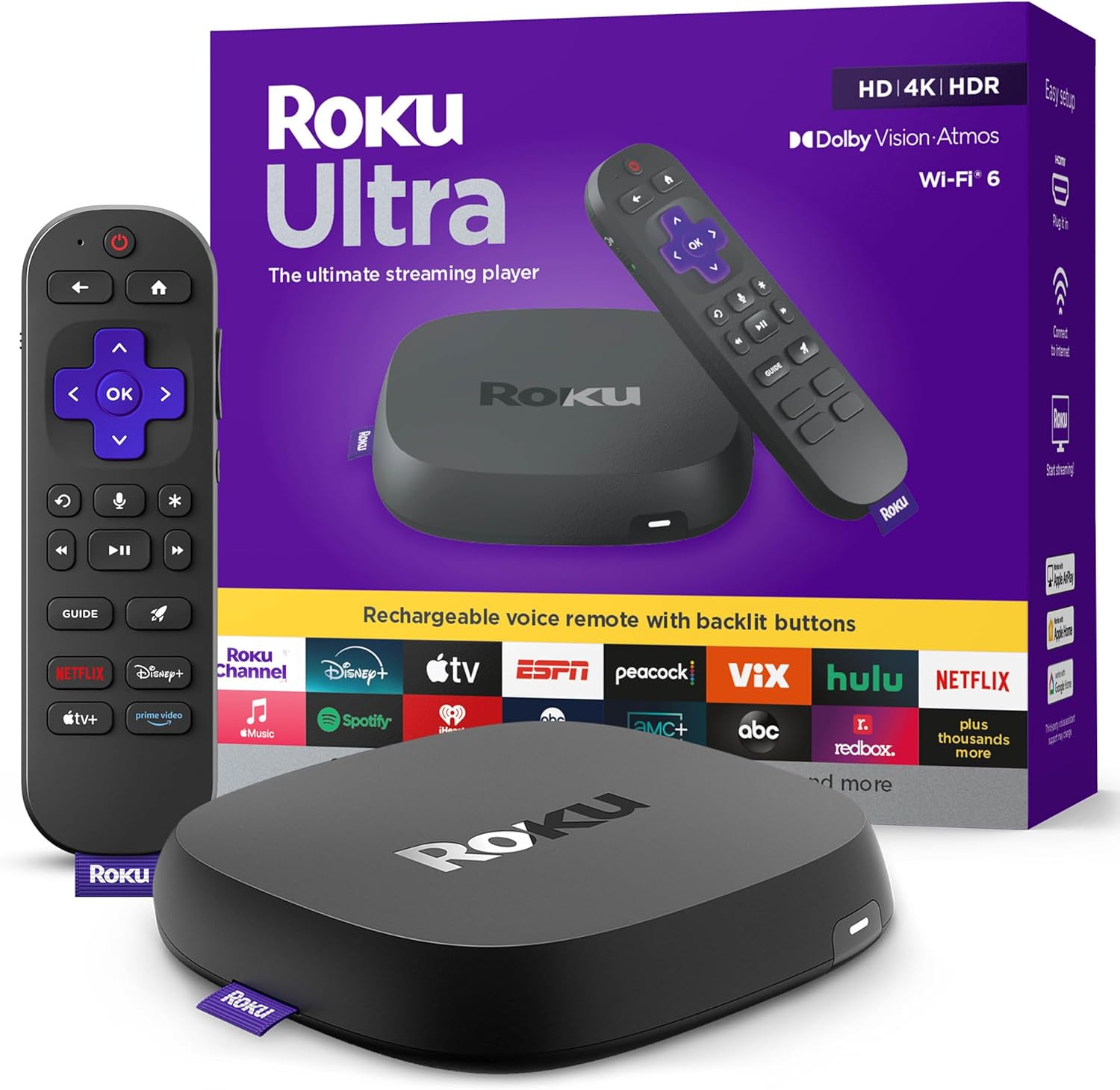
Roku Ultra (2024)
The strongest all-round Roku box, combining broad 4K formats, excellent connectivity and straightforward operation.
- Connectivity is excellent with Ethernet, Wi-Fi 6 and practical AV integration
- Streaming quality covers Dolby Vision and HDR10+ with strong 4K support
- Platform app support remains broad across major US services
- Smart-home ecosystem integration is narrower than the strongest Google, Amazon or Apple alternatives
- The home screen still carries prominent advertising
Dolby Vision, HDR10+, Ethernet and Wi-Fi 6 give the current Ultra a stronger home-theater foundation than Roku’s stick models, while its remote adds useful private-listening and backlighting features. The platform remains quick and easy to navigate, making this a balanced premium Roku choice even though its smart-home reach is less ambitious than some rivals.
The current Ultra is among Roku’s fastest players, with smooth navigation and quick app launches. Wired Ethernet and robust wireless options also reduce the chance that network limitations undermine high-bitrate 4K playback.
Roku’s mature streaming platform and broad service support provide a well-established software base, while Ethernet offers a stable fallback when wireless conditions are poor. No recurring hardware fault has been reported for this model.
- Smart-home-heavy households that want deeper ecosystem automation.
| Resolution | 4K up to 60 fps |
|---|---|
| HDR | Dolby Vision, HDR10+, HDR10, HLG |
| Audio | Dolby Atmos passthrough |
| Network | Wi-Fi 6 and 10/100 Ethernet |
| Remote | Rechargeable backlit Voice Remote Pro (2nd ed.) |
| HDMI | HDMI 2.1 with QMS support |

onn. 4K Pro Streaming Device (2026)
One of the strongest 4K values in the US market, offering premium-style hardware without premium pricing.
- Value is exceptional for the hardware and feature set
- Google TV provides broad access to major US streaming services
- Connectivity is unusually strong for the price with Ethernet and expanded ports
- The interface carries Google TV promotional content and recommendations
- Long-term software-support depth is less established than premium Apple or Roku boxes
The current 4K Pro combines Dolby Vision, Atmos, Ethernet and generous storage at a price far below most premium boxes, giving it unusually strong capability per dollar. Google TV supplies broad service access and smart-home integration, while the main reservations are a recommendation-heavy interface and a shorter long-term support history than the oldest platforms.
Its upgraded processor, memory and storage provide smooth mainstream streaming performance and enough headroom for demanding Google TV use. Wired networking is a notable advantage for stable 4K playback at this price.
The current model has a much shorter support and field-history record than Apple TV or Roku Ultra. Its hardware specification is strong for the price, but long-term software-support depth remains less established, so confidence is lower despite the absence of a documented recurring hardware defect.
- Buyers who want the cleanest ad-light interface or the longest-established update track record.
| Resolution | 4K UHD |
|---|---|
| HDR | Dolby Vision |
| Audio | Dolby Atmos |
| Storage | 32GB |
| Memory | 3GB RAM |
| Network | Wi-Fi 6 and Ethernet |
| Platform | Google TV with Gemini |

Apple TV 4K (3rd Gen, 64GB Wi‑Fi)
The same polished Apple streaming experience as the 128GB model, but with weaker connectivity and value.
- Interface quality is exceptionally clean and easy to navigate
- Responsiveness remains class-leading with the A15 Bionic
- Reliability and software support benefit from mature tvOS updates
- Value is poor at current pricing for a Wi-Fi-only 64GB configuration
- Connectivity is limited by the lack of Ethernet and Thread on this 64GB model
- The hardware lacks AV1 decode support
The 64GB third-generation model retains the same A15 speed, Dolby Vision, HDR10+ and Atmos strengths that make tvOS feel exceptionally polished for 4K streaming. It loses Gigabit Ethernet and Thread, however, so the lower-capacity version gives up meaningful installation flexibility while remaining expensive compared with capable Wi-Fi-only rivals.
App launches and navigation are extremely fast, and 4K HDR playback quality remains strong across major services. The key practical limitation is networking rather than processing performance because this configuration relies on Wi-Fi 6 only.
This version benefits from the same mature tvOS update history as the 128GB model, giving it a strong software-support foundation. The main ownership limitation is configuration-specific connectivity rather than a documented reliability problem: there is no Ethernet or Thread radio on this version.
- Wired-network installations or value-focused buyers.
| Resolution | 4K HDR up to 60 fps |
|---|---|
| HDR | Dolby Vision, HDR10+, HDR10, HLG |
| Audio | Dolby Atmos; Dolby Digital Plus |
| Storage | 64GB |
| Network | Wi-Fi 6 only; no Ethernet |
| Processor | A15 Bionic |
| Smart Home | Home hub support; no Thread radio on 64GB model |

Amazon Fire TV Cube (3rd Gen)
The most capable Fire TV box, with excellent speed and integration offset by a promotion-heavy interface.
- Smart-home ecosystem and hands-free voice control are class-leading
- Responsiveness is excellent for demanding Fire TV use
- Connectivity is strong with Ethernet, Wi-Fi 6E and HDMI input
- Interface usability is weakened by dense Amazon promotion and advertising
- Value is only moderate at the normal premium price
- The Fire TV experience strongly favors Amazon services
The third-generation Cube pairs fast hardware, Wi-Fi 6E, Ethernet and broad Dolby format support with hands-free Alexa control that cheaper Fire TV sticks cannot match. It is particularly capable in Amazon-centric homes, but the interface devotes substantial space to promotions and its regular price makes the value case less convincing than the hardware case.
The Cube’s processor and networking deliver fast navigation, quick launches and strong 4K playback, with more headroom than Fire TV sticks. HDMI input and wired networking also broaden integration options.
The Cube sits on Amazon’s actively maintained Fire TV platform and has enough hardware headroom to avoid the performance constraints of cheaper sticks. No recurring hardware fault has been reported for this model, though the software experience remains heavily shaped by Amazon’s interface and service changes.
- People who want a clean neutral interface or the strongest value.
| Resolution | 4K Ultra HD |
|---|---|
| HDR | Dolby Vision, HDR10+, HDR10, HLG |
| Audio | Dolby Atmos |
| Network | Wi-Fi 6E and Ethernet |
| Storage | 16GB |
| Ports | HDMI input, HDMI output, USB-A, IR extender |

Amazon Fire TV Stick 4K Max (2nd Gen)
A fast and well-equipped 4K stick whose biggest compromise is Fire TV’s busy interface.
- Platform app support is broad across major US streaming services
- Smart-home ecosystem integration with Alexa is strong
- Streaming quality supports Dolby Vision, HDR10+ and Atmos
- Interface usability is reduced by heavy advertising and Amazon content promotion
- No built-in Ethernet; wired networking requires an accessory
Wi-Fi 6E, 16GB storage and broad Dolby/HDR format support make the second-generation 4K Max one of the most capable stick-style streamers available. Its speed and Alexa integration are genuine strengths, but Amazon’s promotion-heavy home screen makes everyday discovery less neutral and less visually restrained than the cleanest competing platforms.
The 4K Max is responsive for a stick and has useful storage headroom, while Wi-Fi 6E can provide strong wireless throughput on compatible networks. It remains less expandable than full-size premium boxes.
The current-generation stick has substantial owner usage without a recurring defect pattern strong enough to support a broad reliability penalty.
- Buyers who dislike advertising-heavy home screens.
| Resolution | 4K Ultra HD |
|---|---|
| HDR | Dolby Vision, HDR10+, HDR10, HLG |
| Audio | Dolby Atmos |
| Storage | 16GB |
| Network | Wi-Fi 6E |
| Memory | 2GB |

Google TV Streamer (4K)
A capable Google TV hub with excellent ecosystem integration, but less compelling value than its feature set suggests.
- Smart-home ecosystem support is excellent with Matter and Thread
- Google TV combines wide service coverage with cross-service discovery
- Connectivity includes Gigabit Ethernet and ample 32GB storage
- Value is mediocre at its current premium price relative to faster or cheaper rivals
- Wi-Fi remains Wi-Fi 5 rather than Wi-Fi 6
The Streamer combines Dolby Vision, 32GB storage, Gigabit Ethernet, Matter and Thread in a device built around Google’s current TV platform, making it unusually useful in connected-home setups. Broad app support, a capable remote and strong smart-home integration give it a distinctive role for households that want streaming and home-control duties consolidated in one compact box.
The device is noticeably more capable than older Chromecast hardware, but its processor does not lead the current field for navigation or app-launch speed. Ethernet and extra memory/storage help make everyday 4K use consistent.
Google continues to support the current Google TV and smart-home stack, but this newer hardware has a shorter field record than Apple TV or Roku Ultra. Long-term confidence is therefore moderate rather than exceptional, although no recurring hardware fault has been reported.
- Buyers prioritizing raw speed or the strongest price-to-performance ratio.
| Resolution | 4K HDR up to 60 fps |
|---|---|
| HDR | Dolby Vision, HDR10, HDR10+, HLG |
| Audio | Dolby Atmos |
| Storage | 32GB |
| Memory | 4GB |
| Network | Wi-Fi 5, Gigabit Ethernet |
| Smart Home | Matter controller and Thread border router |

onn. 4K Plus Streaming Device
A remarkably capable low-cost Google TV streamer whose main compromises are connectivity and hardware headroom.
- Value is outstanding for Dolby Vision and Atmos capability
- Google TV keeps mainstream streaming-service coverage extensive
- Streaming quality is strong for a low-cost stick-class device
- Connectivity is limited because Ethernet requires an added USB-C hub
- Responsiveness has less multitasking headroom than premium boxes
- Reliability and software-support history are less established than long-running premium platforms
Dolby Vision, Atmos, Wi-Fi 6 and 16GB storage give the 4K Plus a specification set rarely found at its price, while Google TV keeps mainstream service coverage broad. Its compromises are practical rather than fundamental: built-in Ethernet is absent and the modest memory/processor platform cannot match premium boxes for sustained responsiveness.
Mainstream 4K streaming is smooth and the expanded storage helps app capacity, but the 2GB RAM platform offers less multitasking headroom than premium set-top boxes. Network performance depends primarily on Wi-Fi unless a compatible hub is added.
This low-cost model has a shorter software-support and field-history record than the longest-running premium platforms. No recurring hardware fault has been reported for this model, but long-term update depth remains less certain.
- Installations requiring built-in Ethernet or premium-box processing headroom.
| Resolution | 4K UHD |
|---|---|
| HDR | Dolby Vision, HDR10, HDR10+, HLG |
| Audio | Dolby Atmos |
| Storage | 16GB |
| Memory | 2GB RAM |
| Network | Wi-Fi 6; Ethernet via compatible USB-C hub |

Homatics Box R 4K Plus
A feature-rich enthusiast box with superb AV flexibility but more firmware complexity and weaker mainstream polish.
- Audio home-theater support is exceptional, including advanced passthrough capability
- Connectivity is excellent with Gigabit Ethernet, Wi-Fi 6 and multiple ports
- Streaming format support includes Dolby Vision, HDR10+ and AV1
- Value is weaker than mainstream boxes unless its specialist AV features are genuinely needed
- Platform app support is less predictable for advanced audio/video workflows than on mainstream boxes
- Reliability and software-support maturity are weaker, with firmware complexity and update issues reported
The Box R 4K Plus combines Dolby Vision, HDR10+, AV1, Gigabit Ethernet, 4GB RAM and unusually broad audio passthrough options, giving home-theater enthusiasts capabilities mainstream sticks rarely offer. Its appeal is narrower because software behavior, firmware transitions and app-specific quirks require more tolerance, while the price only makes sense when those specialist AV features matter.
The 2GHz quad-core platform and 4GB RAM provide good Android TV responsiveness, while Gigabit Ethernet and extensive I/O suit high-bitrate local and network playback. Firmware and app combinations can materially affect advanced format behavior.
Long-running owner threads document both successful long-term use and firmware/update problems, including isolated update failures, so software-support maturity is a real caution rather than a product-age penalty.
- Buyers who want the simplest mainstream setup, strongest support history or lowest price.
| Resolution | Up to 4K60 |
|---|---|
| HDR | Dolby Vision, HDR10+, HDR10, HLG |
| Audio | Dolby Atmos; advanced passthrough varies by firmware/app |
| Storage | 32GB eMMC |
| Memory | 4GB LPDDR4 |
| Network | Wi-Fi 6; Gigabit Ethernet |
| Processor | Amlogic S905X4-K |
| Ports | HDMI 2.1, USB 3.0, USB 2.0, USB-C, optical/AV |
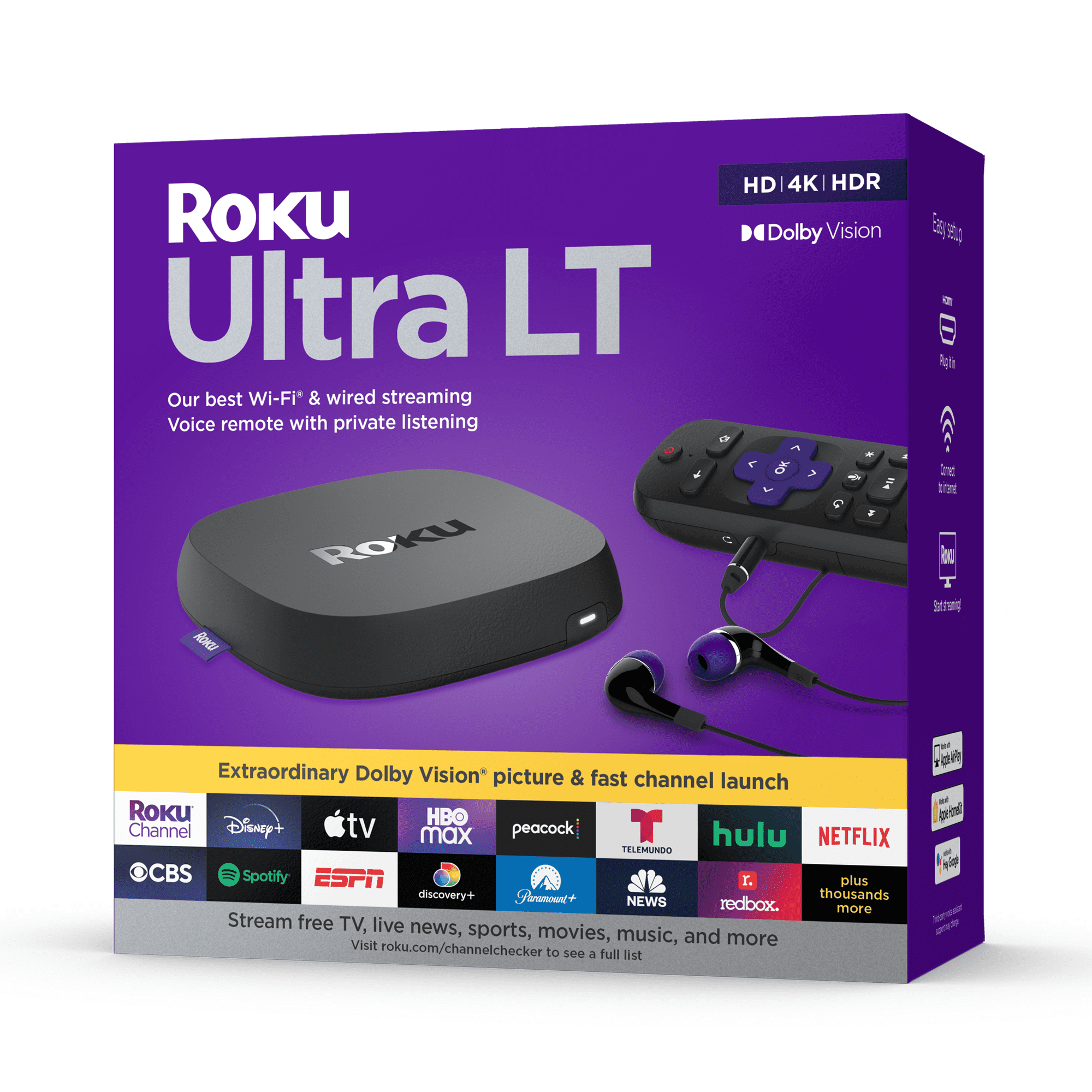
Roku Ultra LT
A still-usable wired Roku option whose older hardware now trails the strongest current boxes.
- Value remains good for a wired Roku box
- Platform app support is broad and familiar
- Interface usability is straightforward for mainstream streaming
- Smart-home ecosystem support is limited compared with newer Google, Amazon and Apple boxes
- Responsiveness has less headroom than the current Roku Ultra and other premium boxes
- Its older hardware platform offers fewer premium features than newer alternatives
Ultra LT keeps Roku’s broad service catalog, straightforward interface and wired networking at a price below the current Ultra, which preserves a useful niche for buyers who prefer Roku. Its aging processor and narrower ecosystem features are increasingly apparent, so it works best as a value-led Roku choice rather than a premium-performance recommendation.
Navigation remains serviceable for mainstream streaming, but app launches and menu response lack the headroom of the current Ultra and premium Apple or Fire TV hardware.
Roku’s established platform and broad service support give the Ultra LT a familiar software base, but the older hardware platform has less performance headroom than the current Ultra. Its age is treated as a capability limitation rather than evidence of poor durability.
- Buyers prioritizing maximum speed, modern smart-home integration or newest-generation hardware.
| Resolution | 4K HDR |
|---|---|
| HDR | Dolby Vision, HDR10+, HDR10 |
| Network | Dual-band Wi-Fi and Ethernet |
| Remote | Voice remote with headphone jack |
| Storage Expansion | microSD on legacy LT configuration |
How We Evaluate 4K Streaming Devices
Our rankings are built through the Flickthru CORE™ Market Research Engine, which first analyses the category, its intended buyers, and the current US market. Products are then compared using category-specific evidence rather than a generic checklist applied the same way to every product type.
For 4K streaming devices specifically, the evaluation focuses on the dimensions that most directly affect real-world performance, everyday usability, ownership experience, and long-term value:
- 4K picture & HDR support: We assess native 4K delivery, HDR format compatibility, frame-rate and dynamic-range handling, and picture features that affect how well a streamer works with modern 4K TVs.
- Speed & responsiveness: We assess menu fluidity, app-launch speed, search response and sustained day-to-day smoothness rather than relying on processor specifications alone.
- Apps & content access: We check support for major US streaming services, live-TV workflows, casting and other content-access features that determine what you can actually watch.
- Home-theater audio: We assess Dolby Atmos and other relevant audio-format support, passthrough behavior and practical compatibility with soundbars and AV receivers.
- Connectivity & TV integration: We assess Wi-Fi reliability, Ethernet options, HDMI and TV-control behavior, and the physical connections that help maintain stable 4K playback.
- Interface & ease of use: We assess setup, navigation, content discovery, remote usability and interface friction so the device remains easy to live with every day.
- Value & total ownership cost: We compare purchase price, included hardware, expected useful life and realistic replacement or ongoing costs against the streaming capability delivered.
- Reliability & software support: We assess stability, app reliability, update support and evidence of sustained usefulness, without penalizing newer products simply for having a shorter history.
- Voice & ecosystem features: We assess voice search, phone and casting integration, smart-home controls and ecosystem conveniences without letting optional extras outweigh core streaming quality.
Products are scored dimension-by-dimension across the same contender field so that the same performance standard is applied consistently to every model. Missing noncritical evidence is left unscored rather than assigned a placeholder score, with the remaining supported dimensions renormalized. Evidence confidence is tracked separately and does not alter product merit.
Documented strengths and weaknesses are cross-checked against the final buyer-facing pros and cons before publication, helping ensure that material scoring findings are reflected in the visible recommendation rather than replaced by generic copy. Read the full Flickthru product ranking methodology.