
Best HDMI Switches & Splitters 2026
A category-specific approach to ranking HDMI Switches & Splitters
Most general product roundups are built around broad buyer priorities. Flickthru evaluates HDMI switches & splitters for home-theater buyers who need a reliable way to switch, split or route modern HDMI sources and displays without losing video, gaming or audio capability. The ranking should identify the HDMI switches and splitters that offer the strongest combination of signal integrity, HDMI 2.1/4K/8K support, gaming compatibility, audio passthrough/extraction, EDID/HDCP handling, port flexibility, usability, reliability and value for their intended setup, prioritising signal stability & compatibility, bandwidth & video support, EDID, HDCP & routing control, ports & system flexibility, and audio passthrough & extraction.
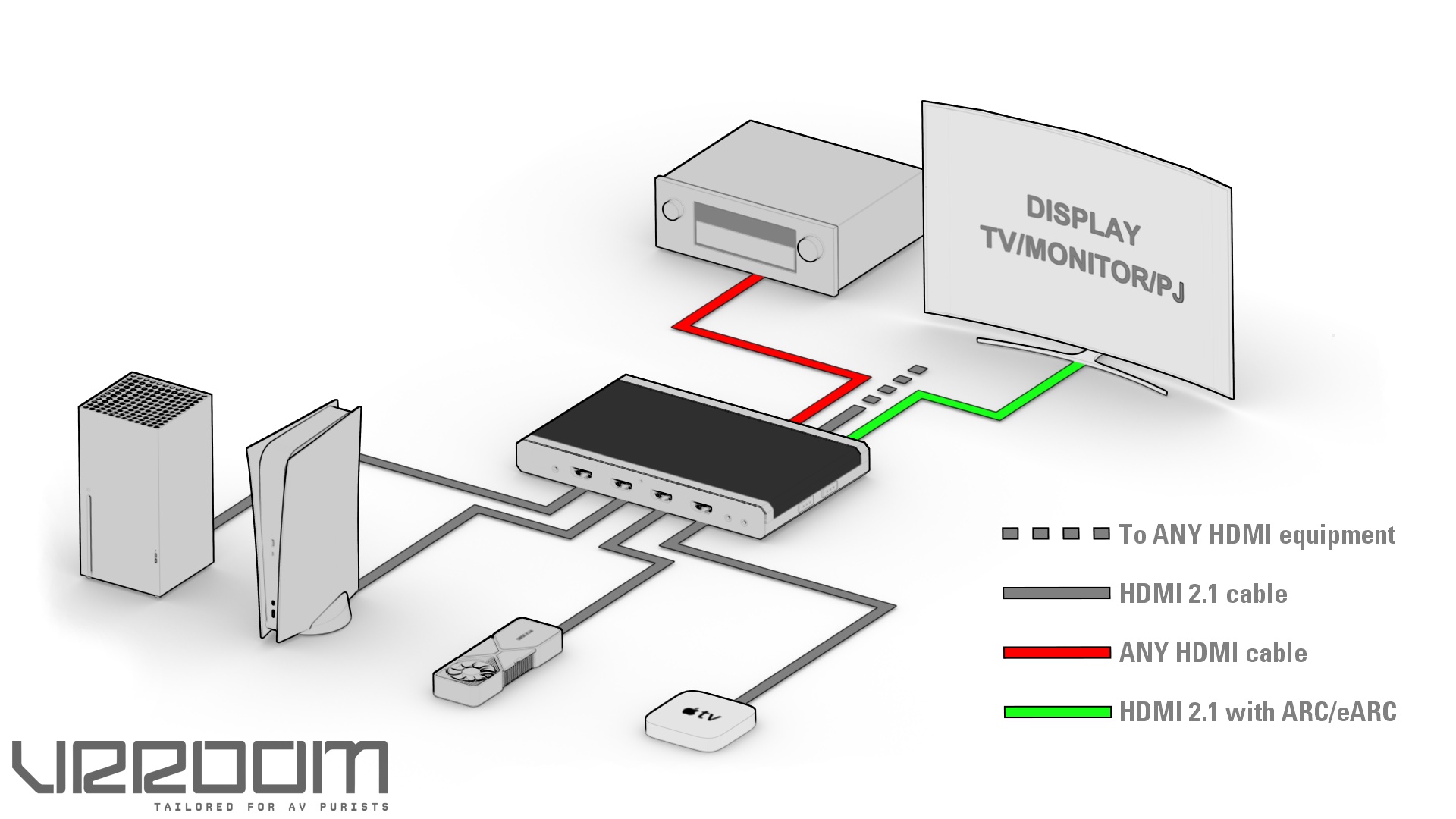
HDFury 8K VRROOM 40Gbps
A premium four-input/two-output HDMI matrix built for difficult home-theater integration, with advanced EDID/HDCP processing, scaling, eARC handling and extensive audio routing.
- Advanced EDID/HDCP processing and scaling solve difficult HDMI compatibility problems
- Four-input/two-output matrix topology supports complex theater routing
- Full audio extraction and eARC handling suit older AVRs and modern soundbars
- High purchase price weakens value for straightforward switching jobs
- Setup and control complexity is substantial compared with basic switches
VRROOM earns its place through unusually deep signal-management capability rather than simple port expansion. Its matrix routing, EDID/HDCP tools, scaling and eARC/audio handling address compatibility problems that basic HDMI switches cannot.
The evidence supports four-input/two-output matrix routing alongside advanced EDID and HDCP processing, scaling and full audio extraction, giving it the broadest integration toolkit in this field.
VRROOM benefits from an established firmware and support ecosystem, while its programmable design means stable operation depends more on correct configuration than on the simple plug-and-play behavior expected from a basic switch.
- Straightforward source switching where a cheaper plug-and-play device is sufficient, or buyers who want minimal setup complexity.
| Market | United States |
|---|---|
| Video Support | 40Gbps HDMI 2.1, 8K and 4K120, with scaling |
| Routing | 4×2 matrix |
| Audio | Full audio extraction and eARC |

AVPro Edge AC-DA-12X2
A professional one-input/two-output HDMI 2.1 distribution amplifier focused on high-bandwidth signal stability, per-output scaling and EDID control for mixed-display installations.
- Independent bench testing sustained full-bandwidth 48Gbps signals without dropout
- Per-output scaling and extensive EDID control handle mixed displays unusually well
- Audio extraction and professional metal construction suit permanent installations
- Two-output splitter topology cannot independently route two sources
- Premium cost weakens value for identical-display mirroring
Its strongest case is signal distribution quality: independent bench testing showed sustained full-bandwidth operation, while per-output scaling and EDID controls make mixed-display installations easier to stabilize than with a basic splitter.
AC-DA-12X2 is built around stable one-to-two distribution at very high bandwidth, with per-output scaling and EDID tools that help each connected display receive a format it can actually use.
AC-DA-12X2 uses installer-oriented metal construction, a locking power connection and active support, with independent bench testing also showing sustained high-bandwidth operation during extended use.
- Buyers who need independent source routing rather than one-source mirroring, or who do not need installer-grade scaling and control.
| Market | United States |
|---|---|
| Video Support | 48Gbps HDMI 2.1, per-output scaling |
| Routing | 1×2 splitter (distribution amplifier) |
| Audio | Audio extraction |
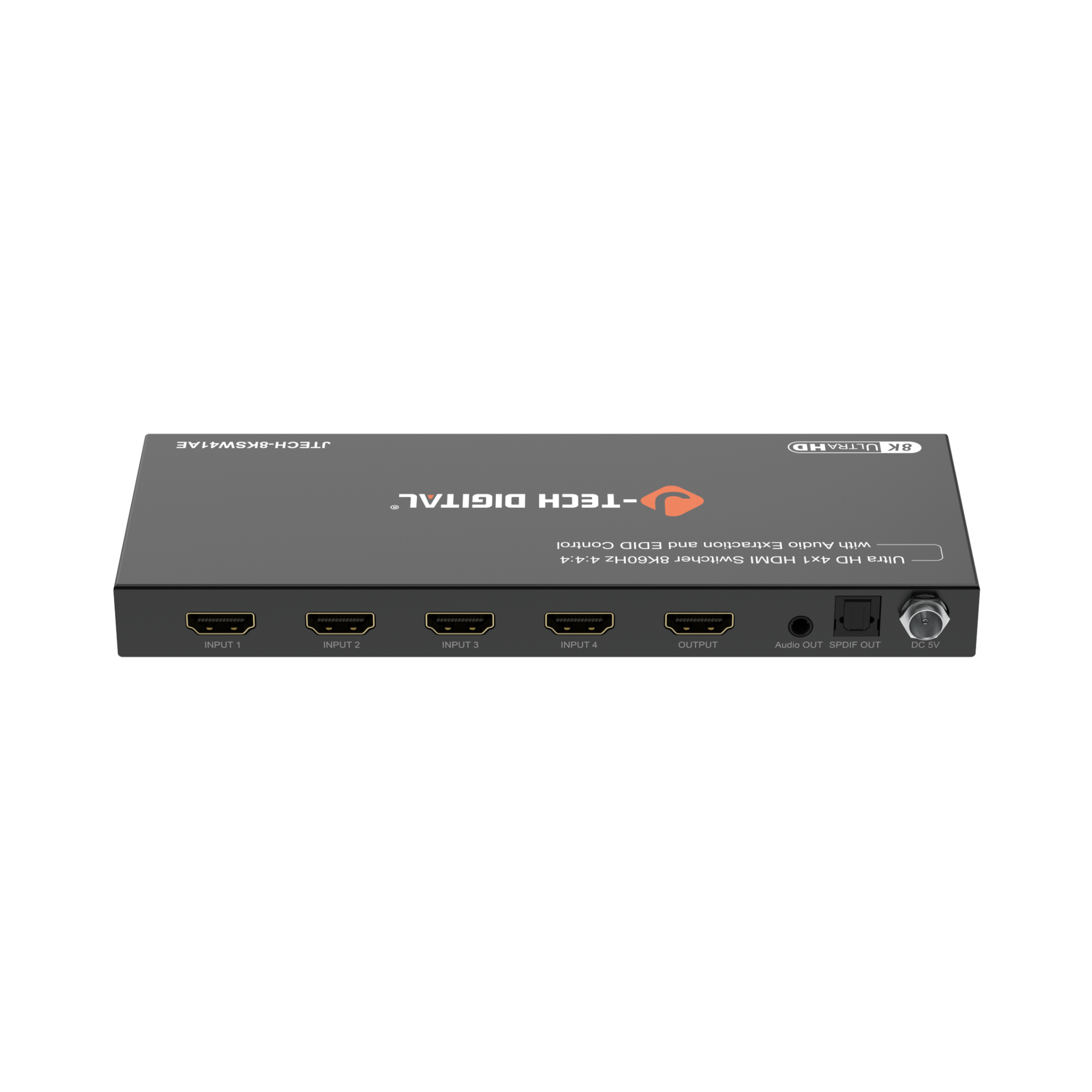
J-Tech Digital JTECH-8KSW41AE
A four-input HDMI 2.1 switch that combines 8K60/4K120 source expansion with extensive EDID presets and separate optical and analog audio extraction.
- Four HDMI 2.1 inputs support 8K60 and 4K120 sources
- Fifteen EDID presets provide unusually useful compatibility control at this price
- Optical and analog audio extraction adds soundbar and legacy-AVR flexibility
- Audio switching can require source shutdown or re-handshake in some setups
It balances modern bandwidth with useful integration features at a less specialized level than the top professional options. Four HDMI 2.1 inputs, fifteen EDID presets and dual audio-extraction routes make it especially versatile for mixed display, soundbar and legacy-AVR setups.
JTECH-8KSW41AE concentrates on source expansion and integration, combining four high-bandwidth inputs with a large EDID preset set and separate optical/analog audio outputs for more flexible system wiring.
JTECH-8KSW41AE has encouraging owner feedback but only a very small sample, so the present reliability picture is positive yet still too narrow for strong long-term conclusions.
- Systems where audio handshakes must remain completely interruption-free during source changes, or buyers who need matrix-style multi-output routing.
| Market | United States |
|---|---|
| Video Support | HDMI 2.1, 8K60 and 4K120 |
| Routing | 4×1 switch |
| Audio | Optical and analog audio extraction |

BZBGEAR BG-8K-HS41A
A four-input 8K/4K120 HDMI switch aimed at installation-heavy systems, adding manual EDID control and audio de-embedding to modern high-bandwidth source switching.
- Four-input HDMI 2.1 topology covers large console and streaming setups
- Manual EDID plus audio de-embedding provide more integration flexibility than basic switchers
- 48Gbps-class feature set includes 4K120 and modern HDR/gaming formats
- Premium price weakens value versus simpler four-port consumer switches
BG-8K-HS41A combines four high-bandwidth HDMI inputs with 4K120 and 8K support, manual EDID control and audio de-embedding in a compact installation-oriented switch. Those capabilities make it a strong fit for systems that need several modern sources plus direct audio breakout and more handshake control than a basic automatic switch normally provides.
BG-8K-HS41A adds manual EDID choices and audio de-embedding to a four-input 4K120-class switch, giving it more control over display handshakes and audio routing than a basic source selector.
BG-8K-HS41A has current troubleshooting and support material covering picture, audio, EDID and ARC behavior, but public long-term owner history remains limited.
- Budget-focused buyers who only need straightforward four-port switching and do not require manual EDID control or audio de-embedding.
| Market | United States |
|---|---|
| Video Support | 48Gbps-class HDMI 2.1, 8K and 4K120 |
| Routing | 4×1 switch |
| Audio | Audio de-embedding |

OREI BK-202A 2×2 8K HDMI Matrix
A compact 2×2 HDMI matrix that can route either of two modern sources to either output while adding manual EDID control and separate audio extraction.
- True 2×2 matrix routing can send either source to either output
- Manual EDID and audio extraction support mixed AV systems
- 4K120 and VRR capability suits modern consoles and PCs
- No per-output downscaling means mixed displays can force a lower common format
The key differentiator is true 2×2 matrix flexibility. Unlike mirrored-output switchers, BK-202A can send either source to either display, while manual EDID and audio extraction add useful control for compact mixed-AV systems.
BK-202A’s central advantage is independent 2×2 routing, allowing either of two sources to be sent to either output while retaining manual EDID and separate audio breakout for compact theater systems.
There isn’t yet enough long-term owner or durability evidence to make a strong reliability claim, so its case rests mainly on its verified routing and integration capability.
- Mixed-resolution display pairs that require per-output downscaling, because this model can force the system toward a lower common format.
| Market | United States |
|---|---|
| Video Support | 8K HDMI 2.1, 4K120 and VRR |
| Routing | 2×2 matrix |
| Audio | Separate audio extraction |

KanexPro SW-2X1A8K
A two-input 4K120 switch built around compatibility control and audio integration, with manual EDID presets plus optical and analog audio de-embedding.
- Manual EDID presets help solve source/display compatibility problems
- Optical and analog audio de-embedding supports older AVRs and soundbars
- 4K120, VRR and ALLM cover current gaming sources
- Two-input topology limits ports and system flexibility for larger source collections
- Current price weakens value beside cheaper four-input consumer switches
SW-2X1A8K pairs two-source 4K120 switching with manual EDID presets, VRR and ALLM support plus optical and analog audio de-embedding. That focused combination is well suited to buyers who need a modern display and gaming source to work cleanly with an older AVR, powered speakers or another audio device that benefits from a separate output.
SW-2X1A8K focuses on two-source switching with useful integration controls, pairing modern gaming-format passthrough with manual EDID selection and optical/analog audio de-embedding.
Its feature set and integration role are well documented, but there isn’t yet enough long-term owner feedback to support a stronger durability or reliability conclusion.
- Larger source collections that need more than two HDMI inputs, or value-focused buyers who do not need EDID control and audio de-embedding.
| Market | United States |
|---|---|
| Video Support | 4K120 with VRR and ALLM |
| Routing | 2×1 switch |
| Audio | Optical and analog audio de-embedding |

KanexPro SW-2X28K
A two-input, dual-output 4K120 switch/splitter designed to mirror either source across two similar displays, with EDID presets and signal equalization for handshake control.
- Two-input/two-output topology suits mirrored dual-display gaming
- Eight EDID presets and built-in equalization improve handshake control
- 40Gbps support covers 4K120 with VRR and ALLM
- Both outputs mirror the same source and cannot downscale independently
SW-2X28K combines two-source switching, dual mirrored outputs, eight EDID presets and 4K120 support with VRR and ALLM in a compact metal chassis. That topology is particularly useful for gaming rooms or presentation setups that need either of two modern sources displayed simultaneously on a pair of similarly capable screens.
SW-2X28K is designed around mirrored dual-display use: either input can feed both outputs while EDID presets and equalization help keep two-screen 4K120 chains predictable.
Its routing, EDID and equalization features are well documented, but there isn’t yet enough long-term owner feedback for confident reliability claims.
- Setups that need independent content on each display or per-output downscaling for mismatched screen capabilities.
| Market | United States |
|---|---|
| Video Support | 40Gbps, 4K120 with VRR and ALLM |
| Routing | 2×2 switch/splitter (mirrored outputs) |

OREI BK-22 2×2 8K Switch/Splitter
A compact two-input switch with dual mirrored 4K120 outputs, manual EDID presets and verified gaming-format support including VRR and ALLM.
- Combines two-input switching with dual mirrored 4K120 outputs
- Manual EDID presets support predictable gaming and theater setups
- Independent testing verifies VRR, ALLM and major HDR formats
- No per-output downscaling makes mixed-resolution displays awkward
BK-22 combines two-source switching with dual mirrored 4K120 outputs, manual EDID presets and verified support for VRR, ALLM and major HDR formats. It is particularly well matched to gaming or theater setups where either of two sources needs to appear on two similarly capable displays at the same time without adding a separate switch and splitter.
BK-22 is optimized for mirrored two-display operation, combining source selection with 4K120 gaming-format passthrough and manual EDID presets in one compact switch-splitter.
BK-22 uses a simple metal-enclosure design, but inconsistent physical specifications published for units carrying the same model number reduce documentation confidence even though they do not establish a functional defect.
- Mixed-resolution display pairs that need independent downscaling, because both outputs are designed around the same source format.
| Market | United States |
|---|---|
| Video Support | 4K120 with VRR, ALLM and major HDR formats |
| Routing | 2×2 switch/splitter (mirrored outputs) |

BZBGEAR BG-8K-HS41
A relatively affordable four-input HDMI 2.1 switch centered on 4K120/8K source expansion, automatic switching and straightforward high-refresh gaming use.
- Full 48Gbps-class 4K120/8K support suits modern consoles and PCs
- Four-input topology and auto-switching cover large source collections
- Owner reports praise 4K120 stability, CEC behavior and low latency
- No manual EDID presets limit routing compatibility with difficult displays
BG-8K-HS41 combines four HDMI 2.1 inputs, 4K120 and 8K support, automatic source selection and current owner reports of stable high-refresh operation. That gives buyers a relatively affordable route to expanding a single modern display input across several consoles, PCs or streaming devices while retaining the gaming formats that matter most.
BG-8K-HS41 is a direct four-to-one gaming-oriented switch whose appeal comes from combining modern HDMI bandwidth, automatic source selection and a lower-cost design without extra signal-processing layers.
BG-8K-HS41 has two strongly positive owner reports, including successful 4K120 use, but that sample remains too small to support a broad long-term reliability claim.
- Difficult display chains that need manual EDID presets or more advanced routing and signal-management controls.
| Market | United States |
|---|---|
| Video Support | 48Gbps-class HDMI 2.1, 8K and 4K120 |
| Routing | 4×1 switch with auto-switching |
| Audio | HDMI passthrough (no audio extraction) |

StarTech HDMI-SPLITTER-44K60S
A commercial four-output HDMI splitter for 4K60 distribution, with built-in scaling and optical/analog audio extraction for mixed-display installations.
- Built-in scaling helps mixed-resolution 4K60 and 1080p displays coexist
- Four mirrored outputs suit signage, boardrooms and multi-screen distribution
- Optical and analog audio extraction increases installation flexibility
- 18Gbps bandwidth and 4K60 video support limit modern 4K120 gaming
- Premium price weakens value for buyers who do not need scaling and four outputs
It ranks for installation flexibility rather than cutting-edge gaming bandwidth. Four mirrored outputs, built-in scaling and separate audio extraction make it useful where one source must feed several screens that may not all share the same resolution capability.
Its 18Gbps design supports 4K60 distribution across four mirrored outputs, while built-in scaling helps 4K60 and 1080p displays coexist and audio extraction simplifies connection to external sound systems.
HDMI-SPLITTER-44K60S combines a metal chassis, a two-year warranty and a long-running commercial support route, giving it a stronger durability case than many low-cost commodity splitters.
- Modern 4K120 gaming systems, or simpler one- and two-display setups that do not need four outputs, scaling and audio extraction.
| Market | United States |
|---|---|
| Video Support | 18Gbps, 4K60, with built-in scaling |
| Routing | 1×4 splitter |
| Audio | Optical and analog audio extraction |
How We Evaluate HDMI Switches & Splitters
Our rankings are built through the Flickthru CORE™ Market Research Engine, which first analyses the category, its intended buyers, and the current US market. Products are then compared using category-specific evidence rather than a generic checklist applied the same way to every product type.
For HDMI Switches & Splitters specifically, the evaluation focuses on the dimensions that most directly affect real-world performance, everyday usability, ownership experience, and long-term value:
- Signal Stability & Compatibility: We assess whether the device maintains a stable HDMI handshake and clean picture across real source, display and cable combinations without dropouts, black screens or format failures.
- Bandwidth & Video Support: We check the real signal formats the device can pass, including 4K/120, 8K, HDR, VRR, ALLM and the bandwidth needed for modern gaming and home theater.
- EDID, HDCP & Routing Control: We examine EDID handling, HDCP compatibility, mixed-display behavior, scaling and routing controls that determine whether complex HDMI setups actually work.
- Ports & System Flexibility: We compare input/output count and whether the topology—switch, splitter or matrix—matches useful home-theater layouts without unnecessary compromises.
- Audio Passthrough & Extraction: We assess lossless audio passthrough plus useful ARC/eARC or optical/analog extraction where the design supports it, without double-counting features the device does not need.
- Switching & Everyday Use: We look at switching speed, remote and front-panel control, auto-switch behavior, status indicators and setup clarity in day-to-day use.
- Build & Reliability: We assess enclosure quality, power stability, heat behavior, firmware/support history and recurring real-world failures without penalizing newer products simply for having less history.
- Value & Total Cost: We weigh purchase price against useful capability, expected service life and any realistic replacement or accessory burden rather than rewarding low price alone.
- Owner Review Validation: We use exact-model owner ratings to validate overall sentiment; review volume changes confidence only and never raises or lowers merit by itself.
Products are scored dimension-by-dimension across the same contender field so that the same performance standard is applied consistently to every model. Missing noncritical evidence is left unscored rather than assigned a placeholder score, with the remaining supported dimensions renormalized. Evidence confidence is tracked separately and does not alter product merit.
Documented strengths and weaknesses are cross-checked against the final buyer-facing pros and cons before publication, helping ensure that material scoring findings are reflected in the visible recommendation rather than replaced by generic copy. Read the full Flickthru product ranking methodology.