
Best Media Servers / NAS For Home Theater 2026
A category-specific approach to ranking Media Servers / NAS for Home Theater
Most general product roundups are built around broad buyer priorities. Flickthru evaluates media servers / NAS for home theaters for buyers choosing a media server or NAS for a home theater, prioritising media playback & transcoding, storage capacity & expansion, network performance, media software & platform, and data protection & reliability.

UGREEN NASync DXP4800 Pro
Among four-bay systems, the DXP4800 Pro stands out for Intel media capability and 10GbE-class networking, making it particularly suitable for demanding Plex or Jellyfin households with fast local infrastructure.
- Excellent Plex/Jellyfin hardware transcoding with AV1 decode
- 10GbE plus 2.5GbE provide standout four-bay network performance
- Core i3 compute gives ample container and concurrent-service headroom
- UGOS media-platform software still has a smaller native-app ecosystem than QTS or DSM
- Setup can require Docker knowledge for some Plex workflows
- Power consumption rises noticeably under active drive workloads
The Core i3-1315U, AV1 decode, 10GbE and four-bay layout give the DXP4800 Pro an unusually strong balance of transcoding power, network speed and practical capacity. It is especially well suited to a demanding Plex or Jellyfin household that wants high-end media performance without stepping up to a six- or eight-bay enclosure.
The Core i3-1315U platform provides hardware media acceleration with AV1 decode, while 10GbE plus 2.5GbE networking gives the DXP4800 Pro unusually high transfer and concurrency headroom for a four-bay NAS.
The hardware platform is strong, but long-term confidence is tempered by UGOS having a shorter maturity record than DSM or QTS. Our research found no recurring hardware fault, while setup complexity and the younger software ecosystem remain the more meaningful ownership cautions.
- Anyone unwilling to use Docker or learn a newer software ecosystem for some media-server workloads.
| Processor | Intel Core i3-1315U with integrated graphics |
|---|---|
| Storage | 4 SATA + 2 M.2 |
| Network | 10GbE + 2.5GbE |
| Media Software | UGOS Pro with container support |

TerraMaster F4-425 Pro
The F4-425 Pro is built around a strong mix of four-bay capacity, dual 5GbE and modern Intel hardware, giving technically confident users ample room for media, containers and high-speed storage.
- Strong N350 media and container performance
- Dual 5GbE and three M.2 slots provide excellent hybrid-storage flexibility
- Plex, Jellyfin and Emby are all practical deployment options
- TOS media-platform software still has rough edges despite major improvement
- Setup can be more hands-on than DSM for first-time NAS users
- The price premium over the Plus model weakens total value
The F4-425 Pro combines an eight-core Intel platform, four SATA bays, three M.2 slots and dual 5GbE in a compact home-server chassis. Plex, Jellyfin and Emby support plus strong storage flexibility make it a particularly capable choice for users who want one NAS to handle media, containers and high-speed file service together.
Independent reviews consistently describe the F4-425 Pro as fast, with dual 5GbE and ample local compute for media streaming, containers and storage tasks. Its N350 prioritizes efficiency over the prior i3-N305’s peak compute, so it is strongest as a balanced NAS rather than a miniature workstation.
TerraMaster combines conventional RAID and TRAID options with TOS 7 management and an established four-bay hardware design. The software platform is improving, although it remains less polished and less mature than the longest-established NAS ecosystems.
- Buyers who prioritize the most polished software interface or who can get enough performance from the cheaper Plus model.
| Processor | Intel N305/N350 with integrated graphics |
|---|---|
| Storage | 4 SATA + 3 M.2 |
| Network | dual 5GbE |
| Media Software | TOS 7, Docker, Plex/Emby/Jellyfin support |

QNAP TS-464
The TS-464 remains a practical four-bay choice for users who prefer proven QTS workflows, broad expansion options and known Plex behavior over chasing the newest processor or fastest built-in Ethernet.
- Proven Plex playback and transcoding capability
- Mature QTS software offers deep storage and backup control
- Four bays, M.2 and PCIe expansion balance capacity with flexibility
- The older Celeron offers less transcoding headroom than newer Intel alternatives
- Power and acoustics are merely average beside newer efficient rivals
- Four-bay value is challenged by newer 5GbE and 10GbE models
The TS-464 combines four bays, Intel hardware media support, M.2 slots and QNAP’s deep software ecosystem in a well-established home-server platform. It remains attractive for buyers who value predictable Plex behavior and mature storage management more than having the newest processor generation, and its mature expansion path also makes it easier to add faster networking or storage acceleration as a library and workload mix grows.
The TS-464 pairs Intel integrated graphics with four SATA bays, two M.2 slots and PCIe expansion, giving Plex users hardware-assisted media handling plus room to add cache, storage or faster networking as requirements grow.
QTS provides mature RAID, snapshots, backup and monitoring tools, and the TS-464 has a longer field record than the newest 2026 platforms. That history increases research confidence, but age itself does not add reliability points.
- Buyers wanting the quietest, newest or simplest four-bay platform with minimal administration.
| Processor | Intel Celeron N5095 with Intel UHD Graphics |
|---|---|
| Storage | 4 SATA + 2 M.2, PCIe expansion |
| Network | dual 2.5GbE; 10GbE expansion |
| Media Software | QTS/QuTS hero; Container Station; established Plex workflow |
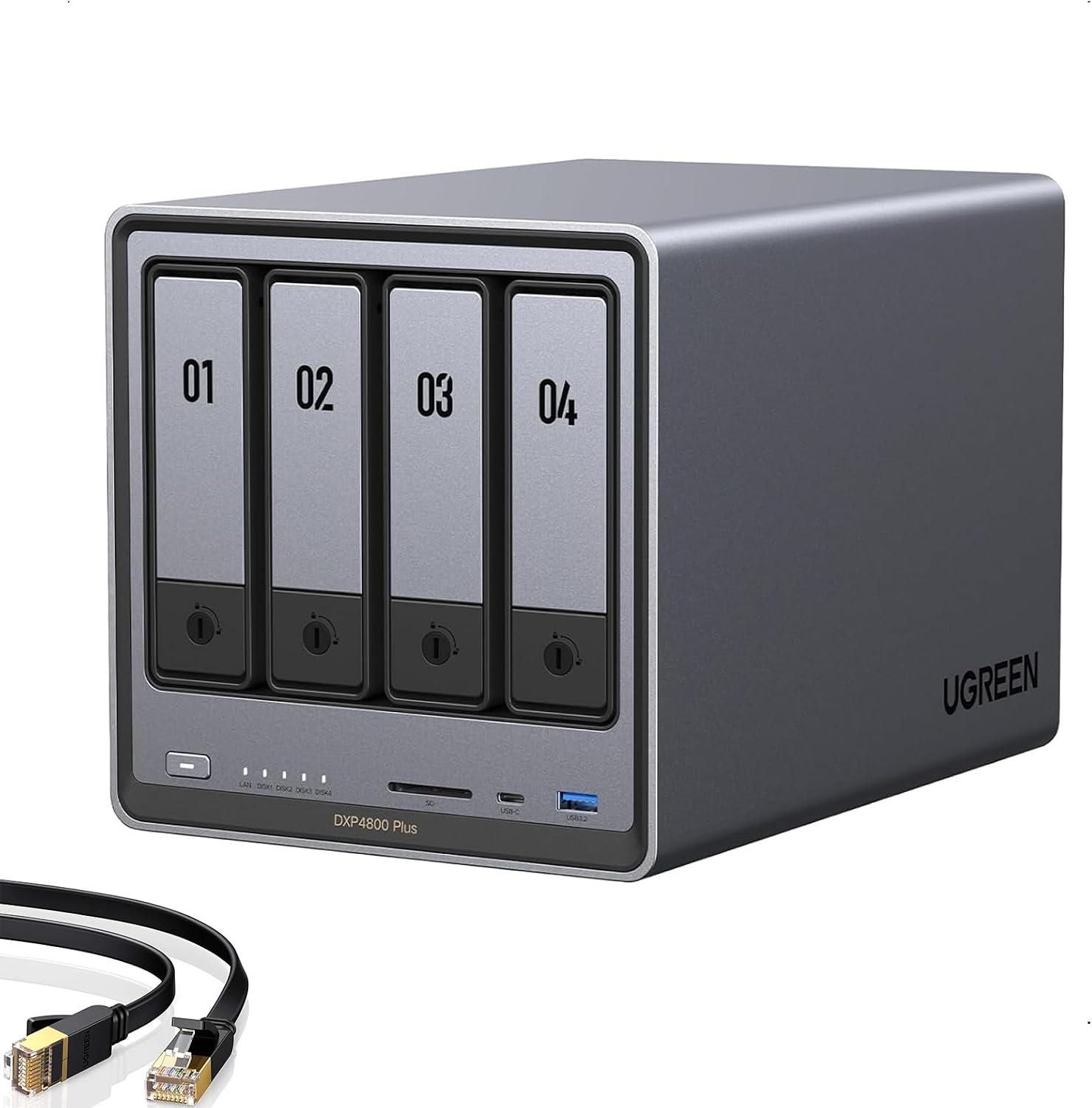
UGREEN NASync DXP4800 Plus
The DXP4800 Plus offers a strong middle ground for home media storage, combining four bays and fast networking with enough Intel media capability for Plex, Jellyfin and other self-hosted services.
- Pentium 8505 hardware gives strong Plex/Jellyfin performance
- 10GbE is unusually fast for this price class
- Four bays plus dual M.2 provide useful storage growth
- UGOS media-platform software remains less mature than DSM or QTS
- Setup may require Docker for preferred media-server workflows
- Data-protection tooling is still developing compared with the longest-established ecosystems
The Pentium Gold 8505, four drive bays, dual M.2 slots and 10GbE give the DXP4800 Plus unusually strong hardware for a mainstream four-bay NAS. Its balance of transcoding capability, fast networking and reasonable cost makes it particularly attractive to technically comfortable Plex or Jellyfin users.
Its Pentium Gold 8505 platform supplies hardware-assisted media capability, while 10GbE networking and dual M.2 slots give the four-bay chassis much more throughput and expansion headroom than typical mainstream NAS hardware.
The enclosure’s build quality and quiet operation were praised in hands-on use, and UGOS has matured considerably since launch. Its software ecosystem still has less history than DSM/QTS, so confidence remains somewhat lower without imposing an age-based penalty.
- Buyers who expect every media and backup workflow to be available as a polished native app.
| Processor | Intel Pentium Gold 8505 with integrated graphics |
|---|---|
| Storage | 4 SATA + 2 M.2 |
| Network | 10GbE + 2.5GbE |
| Media Software | UGOS Pro with container support |

UGREEN NASync DXP8800 Plus
Designed for very large collections, this eight-bay system emphasizes raw storage scale and network bandwidth, giving advanced users room to combine media serving with demanding local storage and self-hosted workloads.
- Eight bays and dual 10GbE provide exceptional storage and network headroom
- Powerful Intel graphics-backed compute suits demanding Plex/Jellyfin workloads
- PCIe, M.2 and Thunderbolt options give unusually broad expansion
- The purchase price and total cost are high for a home media server
- UGOS setup and management remain less mature than QTS, ADM or DSM
- Eight-drive acoustics and power demand can be substantial in a quiet theater room
Eight SATA bays, dual 10GbE and a powerful Intel platform give the DXP8800 Plus exceptional headroom for large libraries, multiple clients and demanding self-hosted services. It suits enthusiasts who want one chassis to combine high-capacity storage, fast networking and media-server compute without immediately adding separate hardware.
The Intel Core-class platform, eight SATA bays and dual 10GbE links provide unusually high compute, storage and network headroom for a desktop NAS. Independent hands-on testing also measured very fast NVMe performance, although the two M.2 slots did not deliver identical bandwidth.
The eight-bay chassis and dual-10GbE design provide substantial redundancy and capacity options, but the larger drive count also raises power, heat and acoustic demands. UGOS remains less mature than QTS, ADM or DSM, so the software-support case is not as established as the hardware one.
- Budget-conscious buyers or anyone prioritizing the simplest, most mature NAS software experience.
| Processor | Intel Core i5-1235U with integrated graphics |
|---|---|
| Storage | 8 SATA + 2 M.2 |
| Network | dual 10GbE |
| Media Software | UGOS Pro with container support |

TerraMaster F4-425 Plus
This model concentrates on high-value home-server hardware: four bays, multiple M.2 slots, dual 5GbE and efficient Intel media support, with enough capability for serious Plex or Jellyfin use.
- Dual 5GbE and three M.2 slots are exceptional at this price
- Intel N150 hardware is well suited to home media transcoding
- Four bays and TRAID give strong capacity and expansion flexibility
- TOS media-platform software is less mature than DSM or QTS
- The N150 has less compute headroom for heavy containers than the Pro model
- Setup can require more manual tuning than appliance-style rivals
Four SATA bays, three M.2 slots, dual 5GbE and an Intel N150 give the F4-425 Plus an excellent mix of storage flexibility and media-server capability for its price. It is a strong match for buyers building a substantial Plex or Jellyfin library who want faster-than-2.5GbE networking without paying for workstation-class compute.
Independent hands-on testing describes the N150 platform as capable for file transfers, Docker and media transcoding, while the dual 5GbE links provide unusually strong network headroom in this price class. The CPU is less suited to heavy multi-service compute than the Pro model, but remains well matched to home media workloads.
TerraMaster’s TRAID and conventional RAID options provide useful protection flexibility, and owner comments on the manufacturer’s store report smooth operation. TOS is improving quickly, but its shorter maturity record than DSM/QTS keeps confidence below the longest-established platforms.
- Buyers who want the most mature NAS operating system or maximum CPU headroom for heavy virtualization.
| Processor | Intel N150/N95 with hardware decoding |
|---|---|
| Storage | 4 SATA + 3 M.2 |
| Network | dual 5GbE |
| Media Software | TOS 7, Plex/Emby/Jellyfin and Docker |

QNAP TS-664
For buyers who prioritize established NAS software and six-bay storage flexibility, the TS-664 offers a balanced route to Plex, backups and broader home-server use without relying on a newer software ecosystem.
- Six bays and mature QTS storage tools suit large protected libraries
- Intel graphics keep hardware-assisted media handling available
- Dual 2.5GbE, M.2 and expansion options provide flexible growth
- The older Celeron limits media-transcoding headroom compared with newer Intel Core and N-series systems
- Power efficiency is less impressive than newer low-power NAS hardware
- Value is only average once six drives are added
Six bays, dual 2.5GbE, M.2 storage and QNAP’s mature application ecosystem make the TS-664 a versatile foundation for a large protected media library. Its Intel platform also keeps hardware-assisted media handling available while QTS provides deeper storage, backup and remote-management tools than newer NAS ecosystems.
The Celeron platform is not as fast as newer Core or N-series competitors, but its integrated graphics remain useful for Plex media work and the six-bay layout provides strong storage concurrency. Dual 2.5GbE and expansion options add practical headroom for multiple clients and faster storage workloads.
QNAP’s mature storage stack, snapshot/backup tooling and long-running platform support strengthen the data-protection case. The older CPU generation affects performance efficiency rather than serving as evidence of poor durability.
- Buyers seeking the newest Intel media engine or the lowest possible power draw and purchase price.
| Processor | Intel Celeron N5095/N5105 with Intel UHD Graphics |
|---|---|
| Storage | 6 SATA + 2 M.2, PCIe expansion |
| Network | dual 2.5GbE; expansion |
| Media Software | QTS/QuTS hero; Container Station |

UGREEN NASync DXP6800 Pro
This six-bay model targets growing libraries that need more capacity than a four-bay chassis while still retaining strong Intel media hardware and fast networking for several simultaneous home-server jobs.
- Six bays provide substantial protected-library capacity
- Strong Intel hardware supports demanding media-server and container workloads
- High-speed networking gives ample concurrency headroom
- Value is weaker for buyers who do not need six drive bays
- UGOS setup and management are still less mature than the established NAS platforms
- Power use is higher than smaller N-series systems
Six drive bays, a strong Intel processor and high-speed networking give the DXP6800 Pro room for a large 4K library and substantial concurrent workloads. Its combination of capacity and compute is particularly attractive when a four-bay NAS would constrain future growth but an eight-bay system would be excessive.
The DXP6800 Pro’s Intel Core-class hardware and integrated graphics provide substantial transcoding and container headroom, while six SATA bays and fast networking reduce storage and transfer constraints. Its hardware package is stronger than older Celeron-based systems, especially for multi-service use.
UGREEN’s hardware construction is strong, but UGOS remains younger than the established NAS platforms and has less multi-year field history. Our research found no product-specific defect pattern strong enough to lower its reliability score.
- Buyers who can meet their storage needs with four bays or who prefer a long-established NAS operating system.
| Processor | Intel Core i5-1235U with integrated graphics |
|---|---|
| Storage | 6 SATA + 2 M.2 |
| Network | 10GbE + 2.5GbE |
| Media Software | UGOS Pro with container support |

ASUSTOR Lockerstor 4 Gen2 AS6704T
ASUSTOR’s four-bay platform favors buyers who want mature ADM software, hardware-assisted media handling and flexible storage expansion in one appliance rather than a newer but less established ecosystem.
- Intel Quick Sync supports capable Plex transcoding
- ADM offers a mature media and storage software ecosystem
- Four bays plus NVMe and PCIe flexibility provide excellent expansion
- The older N5105 limits compute headroom beside newer Intel NAS platforms
- Total value is less aggressive than newer four-bay rivals
- Power efficiency trails newer N-series hardware
Four bays, Intel Quick Sync, M.2 flexibility, dual 2.5GbE and ADM’s mature app ecosystem make the AS6704T a versatile home-theater NAS. It is particularly appealing to buyers who want native NAS features and hardware media support without accepting the younger software environments of newer entrants.
Intel Quick Sync, four SATA bays, NVMe support and PCIe expansion give the AS6704T a flexible media-server hardware base, while ADM adds established app, storage and management tooling for Plex-oriented deployments.
ADM provides mature storage management, Btrfs support, snapshots and remote-access tooling, giving this model a strong protection and administration foundation. The older processor generation affects relative performance and value rather than reliability merit.
- Buyers seeking the newest CPU generation or the strongest value against aggressively priced 2026 rivals.
| Processor | Intel Celeron N5105 with integrated graphics |
|---|---|
| Storage | 4 SATA + M.2/PCIe flexibility |
| Network | dual 2.5GbE; PCIe 10GbE option |
| Media Software | ADM, 4K transcoding, media apps |

TerraMaster F4-424 Pro
This four-bay TerraMaster favors users who value substantial i3-N305 compute for media and containers and are comfortable trading some software polish for stronger general-purpose processing capability.
- i3-N305 provides substantial media and container compute
- Four bays and 32GB-class memory headroom suit demanding self-hosting
- Hardware transcoding is a strong fit for large 4K libraries
- Dual 2.5GbE network throughput trails the newer dual-5GbE TerraMaster models
- Setup and remote management are less polished and more hands-on than DSM or QTS
- Value and total cost are weaker now that newer F4-425 models offer a better-balanced hardware package
The i3-N305, four drive bays and generous memory give the F4-424 Pro substantial compute headroom for Plex, containers and other self-hosted services. It remains attractive to technically confident users who value CPU capability and storage flexibility more than having the newest networking or the slickest NAS interface.
The i3-N305 platform provides considerably more general compute than older Celeron NAS processors and is widely used successfully for Plex hardware transcoding. Dual 2.5GbE is serviceable, but newer TerraMaster models have moved to dual 5GbE and offer a better-balanced 2026 platform.
The hardware platform has broad self-hosting flexibility, but user reports and reviews continue to identify TOS polish as a weaker point than the major established ecosystems. That software friction affects management merit while reliability remains anchored to actual storage and fault evidence.
- Buyers who want a highly polished appliance-style software experience with minimal tinkering.
| Processor | Intel Core i3-N305 with integrated graphics |
|---|---|
| Storage | 4 SATA + 2 M.2 |
| Network | dual 2.5GbE |
| Media Software | TOS, Docker/media apps |
How We Evaluate Media Servers / NAS for Home Theater
Our rankings are built through the Flickthru CORE™ Market Research Engine, which first analyses the category, its intended buyers, and the current US market. Products are then compared using category-specific evidence rather than a generic checklist applied the same way to every product type.
For Media Servers / NAS for Home Theater specifically, the evaluation focuses on the dimensions that most directly affect real-world performance, everyday usability, ownership experience, and long-term value:
- Media Playback & Transcoding: We assess Plex/Jellyfin/Emby suitability, 4K HDR direct play, codec support, hardware transcoding and tone-mapping capability for real home-theater use.
- Storage Capacity & Expansion: We assess drive bays, expansion options, storage-pool flexibility and how comfortably the system can grow with a large 4K media library.
- Network Performance: We assess Ethernet capability, measured transfer performance and headroom for high-bitrate local streaming, concurrent users and background storage tasks.
- Media Software & Platform: We assess Plex/Jellyfin/Emby deployment, app and container support, update paths, permissions and the day-to-day software experience around a media library.
- Data Protection & Reliability: We assess RAID and backup options, filesystem safeguards, platform stability and credible evidence that an always-on media library can be protected over time.
- Setup & Management: We assess initial setup, storage administration, monitoring, remote access and routine maintenance for a home user running a media server full time.
- Noise & Power Efficiency: We assess fan and drive noise, idle/load power draw and thermal behavior because an always-on server can affect both room comfort and running cost.
- Value & Total Cost: We compare the full ownership cost, including the enclosure, drives, likely upgrades, software requirements, electricity use and useful expansion headroom.
Products are scored dimension-by-dimension across the same contender field so that the same performance standard is applied consistently to every model. Missing noncritical evidence is left unscored rather than assigned a placeholder score, with the remaining supported dimensions renormalized. Evidence confidence is tracked separately and does not alter product merit.
Documented strengths and weaknesses are cross-checked against the final buyer-facing pros and cons before publication, helping ensure that material scoring findings are reflected in the visible recommendation rather than replaced by generic copy. Read the full Flickthru product ranking methodology.